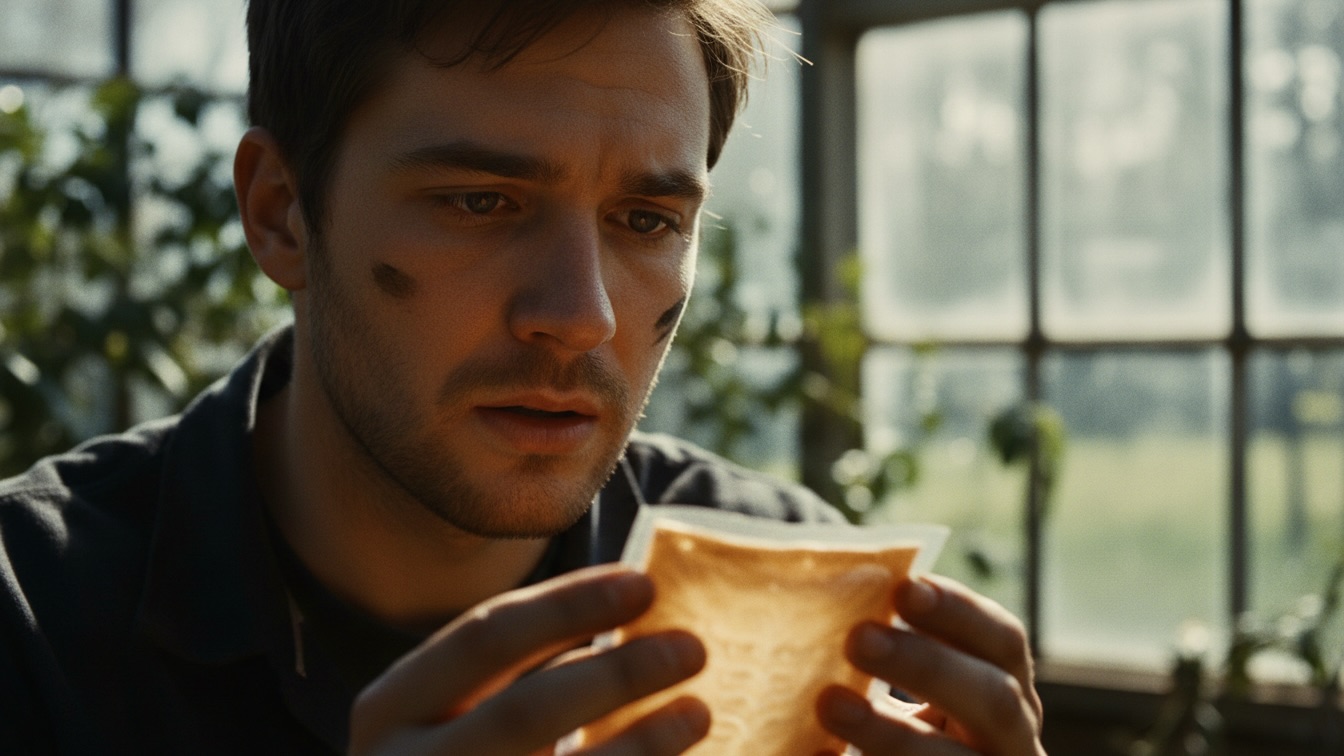
The narrative follows Kenny, a weary courier navigating the desolate, sludge-filled ruins of The Forks in a post-apocalyptic Winnipeg. He carries a mysterious, pulsing "star-seed" that feels like a living heartbeat, a relic of the "Maple Whisper" project intended to restore the dying world. Kenny meets his contact, Barb, who leads him through a treacherous landscape of debris and watchful sentries to a hidden greenhouse. This facility serves as a sanctuary where a group known as the Stargazers attempts to monitor the shifting atmosphere and failing environment.
Inside the greenhouse, Kenny delivers the seed to Old Man Willis, the leader of the operation. The seed is placed into a central pedestal, where it dissolves into a cloud of bioluminescent pollen that reactivates the facility’s oxygen scrubbers. This process not only purifies the air but also reveals a hidden holographic map on the moist walls of the chamber. The map points to a specific location in a northern valley where the permafrost is melting and life is beginning to stir. Realizing his mission has only just begun, Kenny prepares to leave the safety of the greenhouse to follow the signal toward a new destination.
The central theme of the story is the synthesis of nature and technology as a means of planetary resurrection. The "star-seed" is not a traditional biological entity, nor is it a purely mechanical device; it is a bio-membrane that reacts to human touch and environmental cues. This fusion suggests that the characters believe the only way to save the earth is through a deliberate, engineered rebirth. The "Glow Dance" of the pollen represents the moment where cold, hard machinery is softened and revitalized by organic light, turning a stagnant bunker into a living lung.
Another prominent theme is the transition from survival to purpose. For much of the chapter, Kenny is defined by his exhaustion and his desire to simply avoid conflict. He views the seed as a "heavy weight" he is forced to carry rather than a symbol of hope. However, the activation of the map changes the internal landscape of the narrative. The "hollow sensation" he feels once the seed is gone indicates that he has moved past the stage of mere endurance and is now seeking a meaningful destination.
The environment itself acts as a thematic mirror for the characters' internal states. The "gray sludge" and "rusted iron" of Winnipeg represent the decay of the old world and the heavy psychological toll of the apocalypse. In contrast, the humid, oxygen-rich air of the greenhouse symbolizes the fragile possibility of a future. The "warming wind" mentioned by the Stargazers suggests that the world is on the precipice of a massive shift, moving from the frozen stasis of the past toward an uncertain but vibrant spring.
Kenny is a protagonist defined by profound physical and emotional fatigue. He moves through the world with a defensive posture, his hand hovering near his knife even as he admits he is too tired for a fight. Psychologically, he appears to be suffering from a form of survival-related burnout, where the world has become a "graveyard of everything we used to be." His connection to the star-seed is his only source of warmth, suggesting that his humanity is being kept alive solely by the mission he has been assigned.
As the story progresses, Kenny undergoes a subtle but significant transformation. When he places the seed in the cradle, he experiences a sense of loss that quickly turns into curiosity. The "weird hollow sensation" in his chest marks the moment his identity shifts from a "Courier" to a pioneer. By the final lines of the chapter, he is no longer just a passive participant in his own life. He accepts a fresh magazine for his sidearm and commits to the journey north, demonstrating a reclaimed sense of agency.
Barb serves as the pragmatic, hardened foil to Kenny’s internal exhaustion. She is a survivor who has adapted to the harsh realities of the ruins, evidenced by her coat of patched synthetic wool and her "gravel in a blender" voice. Her role is that of a shepherd, guiding Kenny through the "twitchy" security of the Sentry and ensuring the package reaches its destination. She lacks the luxury of sentimentality, focusing instead on the immediate needs of the mission and the physical safety of her team.
Despite her rough exterior, Barb is driven by a deep-seated belief in the Stargazers' cause. She is the one who notices the thaw on the map first, and her voice shakes with an emotion that she usually keeps tightly suppressed. This moment of vulnerability reveals that her toughness is a protective shell for a persistent hope. She is ready to move at a moment's notice, showing that her commitment to the future outweighs her need for rest or comfort.
Old Man Willis represents the intellectual and historical memory of the community. Though his eyes are "milky with cataracts," he possesses a clarity of vision that the younger characters lack. He sees the genetic code within the light and understands the technical requirements for human survival. He is the bridge between the lost knowledge of the old world and the desperate needs of the present, operating ancient technology to facilitate a biological miracle.
Willis acts as a mentor figure who pushes Kenny toward his destiny. He is the one who explains that the mission is not over and that the "spark" Kenny delivered must now become a "fire." His calm, authoritative presence provides the necessary gravity for the activation of the seed. He treats the star-seed with a level of reverence that borders on the religious, recognizing it as the "only one left" and the final chance for their species to breathe clean air.
The narrative style is characterized by a heavy use of sensory details that ground the reader in a tactile, decaying world. The author emphasizes the "smell of rusted iron" and the "thick, gray sludge" to create an immersive atmosphere of industrial rot. These descriptions are contrasted sharply with the "sweet" smell of oxygen and the "amber light" inside the greenhouse. This sensory juxtaposition reinforces the narrative's central conflict between a dead past and a living future.
The pacing of the chapter is deliberate, starting with a slow, rhythmic crawl through the mud that mirrors Kenny’s own physical struggle. As the characters enter the greenhouse and the seed is activated, the pacing accelerates. The language becomes more lyrical during the "Glow Dance," using words like "spiraling," "shimmering," and "singing" to elevate the tone from gritty realism to speculative wonder. This shift in prose style effectively captures the awe the characters feel as they witness the activation of the map.
The narrative voice is a grounded, first-person perspective that provides intimate access to Kenny's internal state. The prose is sparse and direct, reflecting the utilitarian mindset of a survivor. There is a recurring motif of "weight" and "pressure," from the heavy mud to the humid air that hits Kenny like a "physical weight." This consistency in imagery helps to build a cohesive world where every action and every breath requires effort, making the final moment of hope feel earned rather than accidental.


