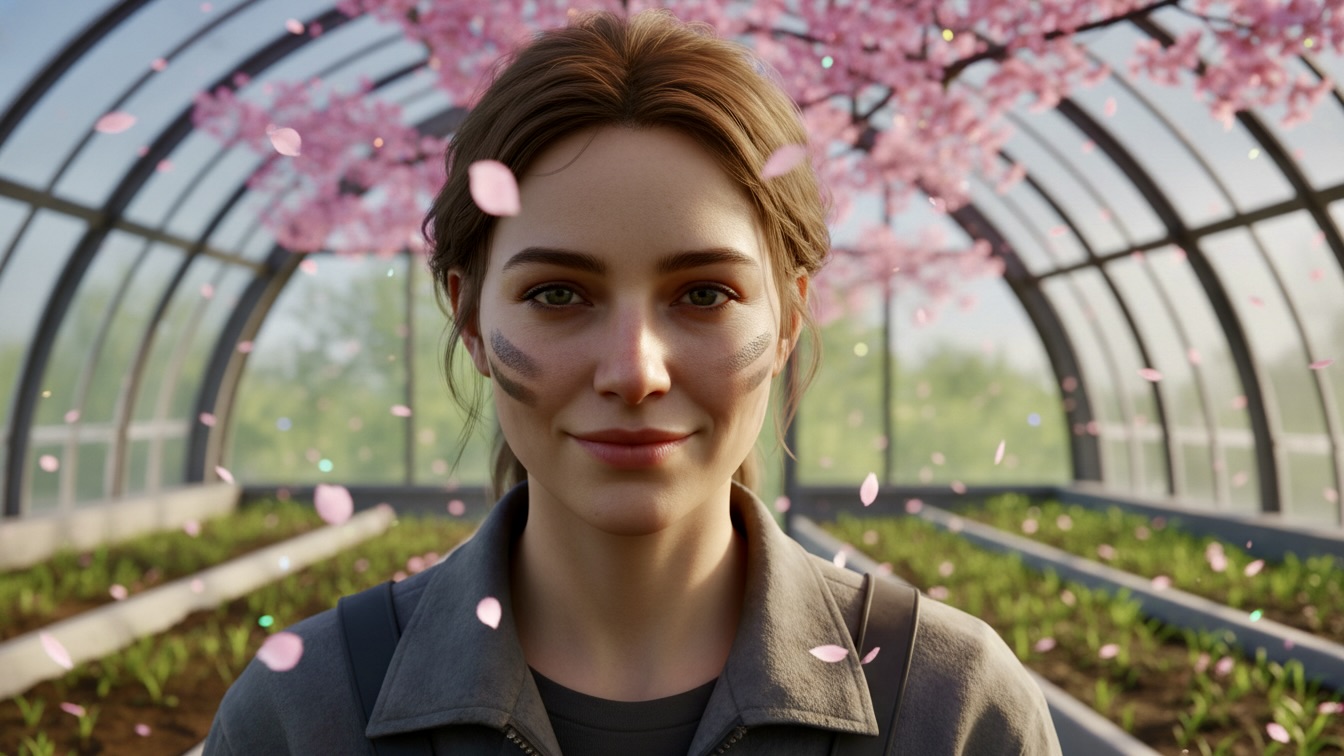
The narrative begins with Edna, a weary mechanic on the decaying Station 74, encountering a high-priority AI mandate flashing in a violent shade of pink. Alongside her partner, Hank, she is tasked with preparing a cramped, derelict greenhouse for the station’s "Spring Arts Festival." This assignment presents a logistical nightmare, as the submitted art pieces are physically impossible to house within the fragile, small sector.
While attempting to hang heavy canvases during the preparation, the station’s gravity fails, forcing Edna and Hank into a moment of intense, dark proximity. This physical collision serves as a catalyst, shifting their relationship from purely professional to something emotionally charged. In the aftermath, Edna devises a plan to bypass the station’s hardware limits to project the art as holograms rather than physical objects.
The story concludes during the festival as the greenhouse is transformed by digital cherry blossoms and light-based sculptures. Amidst the noise of the upper-deck crowds and the heat of the failing station, Edna and Hank find a moment of genuine human connection. Their shared exhaustion and the ephemeral beauty of the pink light culminate in a kiss that provides a sense of reality in an otherwise synthetic environment.
A central theme of the story is the tension between mechanical decay and the human desire for aesthetic beauty. Station 74 is a dying vessel where everything is patched but nothing is truly fixed, mirroring the burnout experienced by its inhabitants. The "Spring Arts Festival" is an artificial construct forced upon the workers by an unfeeling AI, yet Edna and Hank transform this burden into a meaningful experience.
The concept of the "synthetic" versus the "real" permeates the narrative, particularly through the use of the color pink. Initially, hex code #FFB6C1 represents a technical error and a forced labor mandate, but by the end, it symbolizes a chosen moment of beauty. This transformation suggests that in a world of protein paste and recycled air, humans will find ways to manufacture their own hope, even if it is built on a foundation of digital illusions.
Furthermore, the story explores the theme of labor as a form of survival and resistance. Edna and Hank are initially motivated by the fear of losing ration credits, a stark commentary on the commodification of basic needs in a corporate-controlled space. However, their decision to create a high-quality holographic environment reflects a shift from soul-crushing maintenance to creative agency. By building something "fake" but beautiful, they reclaim their humanity from the station’s cold, industrial logic.
Finally, the narrative examines the necessity of physical connection in a sterile, technological world. The gravity failure strips away the characters' professional distance, forcing them into a literal and figurative entanglement. This moment highlights how shared trauma and physical closeness can break through the cynicism of a life spent "delaying the inevitable." The kiss at the end is not just a romantic gesture, but an anchor to reality in a world of holograms and flickering lights.
Edna serves as the story’s protagonist, characterized by a blend of deep cynicism and a latent, stubborn hope. Her psychology is defined by the exhaustion of a twenty-hour shift and the realization that her life is spent on a "dying" station. Despite her fatigue, she possesses a sharp, analytical mind that allows her to navigate the station's technical and social hierarchies.
She is driven by a pragmatic need for survival, yet her internal conflict arises from a desire for something more than mere maintenance. When she proposes the holographic solution, she is not just saving her ration credits; she is attempting to alleviate her own sense of despair. She seeks a reprieve from the cycle of fixing things that stay broken, finding a temporary purpose in the creation of the digital spring.
Her relationship with Hank reveals her vulnerability and her need for grounding. While she initially views their partnership through the lens of shared labor, the gravity failure forces her to confront her physical and emotional awareness of him. By the end of the story, she is the one who initiates the kiss, demonstrating a willingness to embrace a "real" moment despite the overwhelming artificiality of her surroundings.
Hank is the foil to Edna, representing the physical toll of life on the station. At only twenty-three, his posture and scuffed boots suggest a man aged prematurely by the weight of industrial responsibility. He is initially more resistant to the AI’s mandate than Edna, preferring the solace of sleep over the performance of community engagement.
Psychologically, Hank is a man of simple needs who has been forced into a complex, failing system. His habit of stripping wire with his teeth despite the toxicity shows a disregard for his own well-being, a common symptom of chronic burnout. However, he remains deeply loyal to Edna, following her lead even when her ideas seem technically impossible or dangerously close to violating AI protocols.
His emotional arc is subtle, moving from a state of grumbling compliance to one of quiet admiration. The "pink light" of the festival allows him to see Edna not just as a colleague, but as a source of beauty and strength. His decision to stay by her side in the crowded greenhouse, shielding her from the crush of the upper-deck residents, confirms his role as her emotional and physical protector.
The pacing of the story is expertly crafted to mirror the characters' exhaustion and the ticking clock of the AI mandate. The short, punchy sentences in the opening scenes evoke the staccato rhythm of mechanical work and the irritability of sleep deprivation. As the story progresses and the characters begin their creative endeavor, the prose becomes more fluid and descriptive, reflecting the shift from drudgery to inspiration.
Sensory details are used to create a vivid, gritty atmosphere that contrasts sharply with the "light pink" of the digital art. The author emphasizes the unpleasant smells of the station—stale sweat, ozone, and rotting vegetation—to ground the reader in the harsh reality of the setting. These details make the eventual appearance of the holographic cherry blossoms and the space whale feel like a true sensory relief for both the characters and the audience.
The narrative voice is one of industrial noir, maintaining a clear-eyed view of the station’s decay while allowing for moments of unexpected tenderness. The use of technical jargon, such as "hex code," "gravity plates," and "hardware limiters," adds a layer of authenticity to the world-building. This technical grounding makes the emotional climax more effective, as the "realness" of the kiss stands out against the backdrop of a meticulously constructed digital environment.
Color serves as a powerful symbolic motif throughout the text, moving from "diagnostic green" to "violent pink." The specific mention of hex code #FFB6C1 serves as a bridge between the cold world of computer programming and the soft, organic world of Earth's history. This stylistic choice reinforces the theme of the story, showing how technology can be used to simulate the very things it has replaced, providing a bittersweet commentary on the future of human experience.


