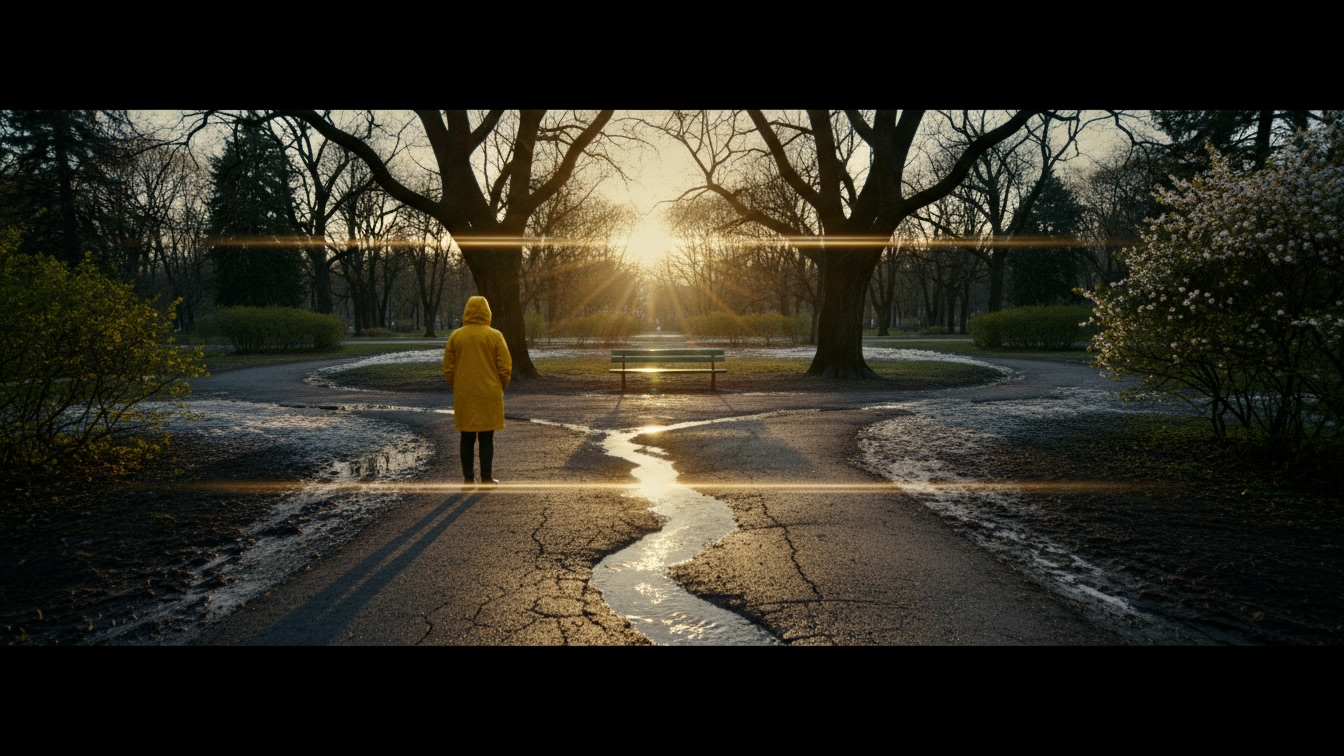
The story follows a tense and melancholic meeting between Brian and Stacey in a park during a grim winter thaw. The environment is described as a "gray soup," where melting snow and mud mirror the disintegration of the characters' past relationship. They sit together on a damp, peeling bench, observing a small stream of meltwater that has been blocked by a discarded cigarette butt. This mundane blockage becomes a focal point for their conversation, representing the stagnation and pressure that defined their final months together.
As the dialogue unfolds, Brian attempts to physically intervene by carving a new path for the water with his boot, while Stacey argues for the necessity of letting things fall apart naturally. They reminisce about their "Ghost Map," the shared habits and physical memories that continue to haunt them even after their separation. Ultimately, Stacey chooses to walk away, heading toward the "deep" of the park’s drainage system. Brian is left alone, grappling with the cold reality that while he can redirect a stream, he cannot easily navigate the end of their shared history.
One of the central themes explored in the text is the conflict between the impulse to fix and the necessity of surrender. Brian represents the human desire for agency and control in the face of inevitable decay. He views the world as something that can be mapped and repaired, believing that by carving a new groove in the mud, he can prevent a "flood." This reflects a psychological defense mechanism where one focuses on small, manageable tasks to avoid facing a large, overwhelming emotional truth.
Stacey, conversely, embodies the theme of radical acceptance. She challenges Brian’s need for order, suggesting that there is a certain honesty in "drowning." For her, the "January stuff" was characterized by a build-up of pressure that was never allowed to break. Her perspective suggests that some structures, whether they are dams in a puddle or long-term relationships, must be allowed to fail completely before the individuals involved can truly move on.
The story also delves deeply into the theme of psychological haunting and the persistence of intimacy. This is most poignantly illustrated through the concept of the "Ghost Map." The narrative suggests that a shared life creates a form of muscle memory that survives the end of the relationship. Brian and Stacey are not just haunted by memories, but by the very way they walk and the routes they take through the city. This theme highlights how identity is often inextricably linked to the people we have loved, making a clean break nearly impossible.
Brian is a man who struggles with the vulnerability of being seen and the discomfort of emotional chaos. His decision to wear sneakers instead of boots, despite the freezing slush, reveals a preoccupation with appearing effortless and unbothered. This choice backfires, leaving him with "wet and sad" toes, which serves as a physical manifestation of his internal state. He wants to be the navigator and the map-maker, but he finds himself lost in a "forest at night with no flashlight."
Psychologically, Brian is a "fixer" who equates control with safety. When he encounters the blocked water, his immediate instinct is to intervene and create a bypass. This action is a surrogate for his desire to fix the relationship, yet he lacks the emotional vocabulary to address the "marble" in his throat directly. He clings to the "Ghost Map" because it provides a sense of direction in a world that feels increasingly shapeless and gray. Even at the end, his "shoulders up" posture suggests a man who is bracing himself against a world he can no longer manage.
Stacey is presented as a woman who has reached a state of weary clarity. Her bright yellow raincoat marks her as an outlier in the gray park, suggesting she is no longer trying to blend into the "soup" of her past with Brian. While Brian is focused on the logistics of the flow, Stacey is focused on the weight of the water. She has moved past the stage of trying to redirect their problems and has accepted the "deep" as an inevitable destination.
Her psychological journey is defined by the transition from "getting stuck" to "letting go." She recognizes that her body still carries Brian’s influence—his fast walk and his "ghost map"—but she is actively choosing to walk away from the bench and the cigarette butt. Unlike Brian, she is not afraid of the dark drain or the unknown ocean. She views the disappearance of the water as a necessary cleansing, even if it means the memories are "eaten" by the park. Her strength lies in her ability to face the "honest" reality of their failure.
The narrative style is characterized by a heavy use of sensory details that evoke a sense of visceral discomfort. The author utilizes words like "soggy," "squelching," "peeling," and "shredded" to create a tactile experience of a world in decay. This grimy imagery serves as a powerful metaphor for the emotional residue of a dying relationship. The personification of the trees as having "skinny fingers" and the drain as a "mouth with square teeth" adds a slightly predatory, gothic undertone to the mundane setting.
The pacing of the story is slow and deliberate, mimicking the sluggish movement of the melting snow. The dialogue is sparse, with much of the actual communication happening through the observation of the puddle and the cigarette butt. This "show, don't tell" approach allows the reader to feel the weight of the unspoken words between the characters. The rhythmic repetition of the sound "Ssh-luck" creates an auditory anchor that emphasizes the difficulty of movement in this environment.
The tone is one of quiet, resigned melancholy. The author avoids melodrama, opting instead for a cold realism that mirrors the March weather. The "Ghost Map" serves as a recurring motif that bridges the gap between the physical landscape and the internal psychological landscape. By the end of the chapter, the shift from the "bruised peach" sky to the "heavy chill" of the city reinforces the idea that the thaw is not a beginning, but a painful transition toward an uncertain future.


