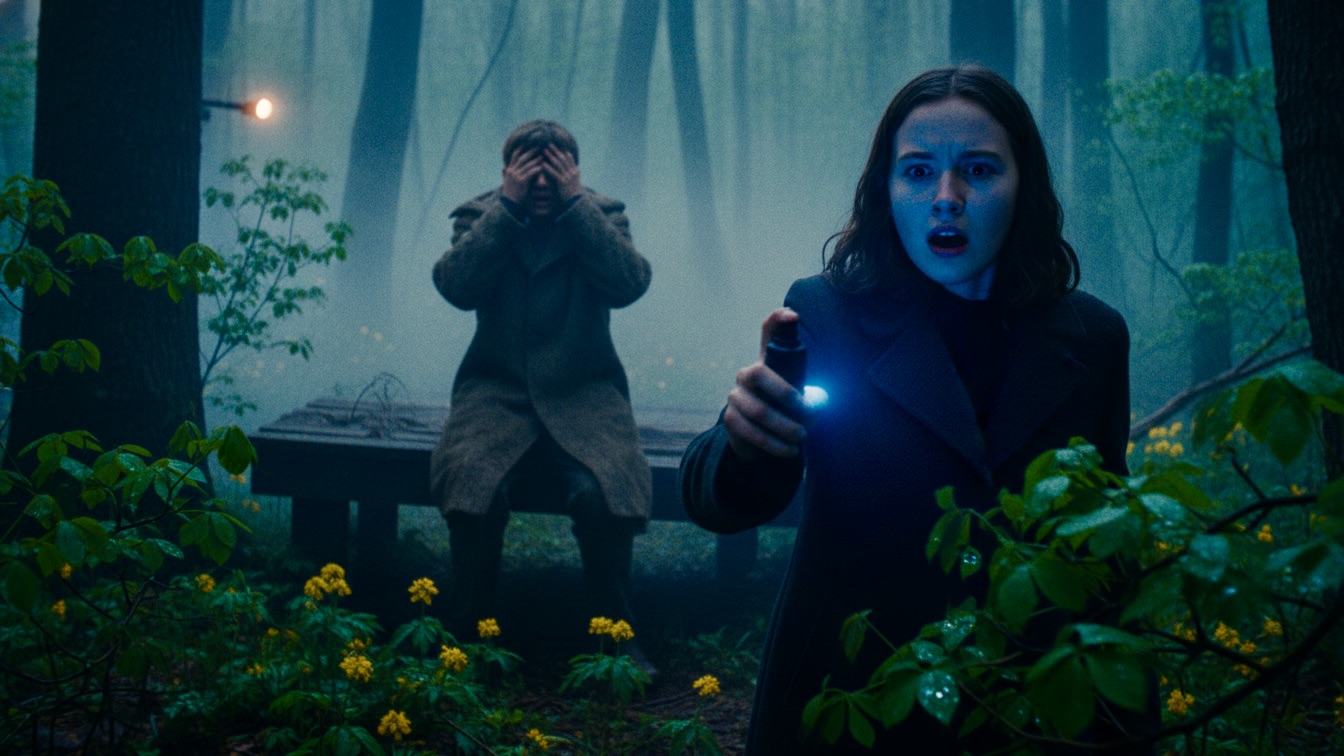
The chapter follows Jane and Benjamin during a night hike through a damp, foggy forest. Jane is consumed by a paralyzing fear of a legendary killer known as the Hiker-Harvester, relying heavily on a safety app called Guardian Angel to monitor her surroundings. Benjamin, oblivious to her genuine distress, attempts to orchestrate a romantic, high-concept marriage proposal on a slick wooden overlook. The situation rapidly deteriorates when Benjamin trips on a root, losing the engagement ring in the mud and causing a loud commotion.
Mistaking the noise of a breaking branch for an imminent attack, Jane attempts a tactical maneuver that ends with her face-down in a puddle. In her panic, she accidentally pepper-sprays Benjamin, blinding him and ruining his expensive coat. The comedic tragedy of the moment is abruptly silenced by a chilling, guttural laugh emerging from the darkness. As the chapter ends, Jane’s phone issues a proximity alert, confirming that a real threat is indeed nearby.
One of the most prominent themes in the text is the intersection of modern technology and primal human fear. Jane’s reliance on the Guardian Angel app illustrates how digital tools can amplify paranoia rather than alleviate it. The app quantifies her environment into "caution" levels and "statistical facts," creating a false sense of control that ultimately fails her when physical action is required. This theme suggests that while technology can map the world, it cannot protect the psyche from the ancient, irrational terrors found in the dark.
The narrative also explores the profound disconnect between romantic idealism and survivalist reality. Benjamin views the hike as a "shared narrative" and a "singular moment of profound significance," using flowery, archaic language to frame their relationship. Jane, conversely, views the world through the lens of a true-crime documentary, seeing herself as a "pre-victim." This clash of perspectives highlights how individuals can inhabit the same physical space while living in entirely different psychological universes.
Finally, the story touches upon the irony of self-fulfilling prophecies and the "uncanny" nature of the environment. Jane’s hyper-vigilance, intended to keep her safe, results in her injuring the person she loves and leaving them both vulnerable. However, the ending subverts the idea that her fear was merely a "digital superstition." By introducing a laughing predator at the end, the text suggests that even the most neurotic anxieties can be rooted in a valid, albeit poorly managed, survival instinct.
Jane is a character defined by hyper-vigilance and a clinical, data-driven approach to anxiety. She has internalized the tropes of the true-crime genre to the point where she views her own life as a series of tactical decisions and risk assessments. Her internal monologue is a blend of survivalist jargon and genuine terror, showing a woman who has lost the ability to experience the world without a digital filter. For her, the woods are not a place of beauty but a "geographic profile" for disappearances.
Her psychological state is one of constant siege, which manifests in her physical preparation, such as her "tactical leggings" and pepper spray. This obsession with safety is a defense mechanism against a world she perceives as inherently hostile and unpredictable. However, her reliance on these tools leads to a catastrophic loss of situational awareness. She is so focused on the ghost of the Hiker-Harvester that she fails to navigate the physical reality of the overlook, eventually causing the very chaos she feared.
Benjamin acts as the romantic foil to Jane’s cynicism, though his character is marked by a specific type of intellectual pretension. He speaks in a manner that suggests he is the protagonist of a Victorian novel, prioritizing the "vibe" and the "majesty" of the moment over his partner's visible distress. His choice of a heavy wool coat for a damp hike symbolizes his preference for aesthetic over utility. He is a man who values the performance of romance more than the emotional safety of his partner.
His primary conflict stems from his refusal to acknowledge Jane's reality, dismissing her fears as mere "superstitions." This dismissal creates a wall between them, as he attempts to force a "profound" moment onto a woman who is currently in a "fight-or-flight" state. His physical clumsiness during the proposal serves as a metaphor for his emotional tone-deafness. By the end of the chapter, his blindness is both metaphorical and literal, leaving him completely dependent on the woman whose fears he ridiculed.
The narrative voice is characterized by a sharp, satirical tone that effectively blends dark comedy with psychological tension. The author uses Jane’s clinical observations to create a sense of irony, such as when she compares her heart rate to a "drum solo" or her boyfriend to an extra in a period piece. This stylistic choice keeps the reader at a distance from the horror until the very end, making the final reveal of the laughing figure more jarring. The pacing moves from a slow, atmospheric crawl to a frantic sequence of physical blunders.
Sensory details are used to create an "uncanny" atmosphere where nature feels distorted and threatening. The description of spring buds as "tiny, distorted faces" and the smell of "wet dirt and slow rot" subverts the traditional romantic associations of the season. The fog is treated as a physical barrier, a "wall of white" that isolates the characters and heightens their sensory deprivation. These details ground the story in a visceral, unpleasant reality that contrasts sharply with Benjamin’s elevated prose.
The use of sound is a crucial stylistic element that drives the chapter’s climax. The "thud" of Benjamin’s fall and the "snap" of the branch serve as auditory catalysts for Jane’s panic. The silence that follows the pepper-spray incident is described as a "heartbeat," creating a vacuum of tension that is shattered by the "low, guttural" laugh of the antagonist. This transition from the mundane sounds of a clumsy accident to the supernatural sound of a predator creates a powerful shift in genre, moving the story firmly into the realm of horror.


