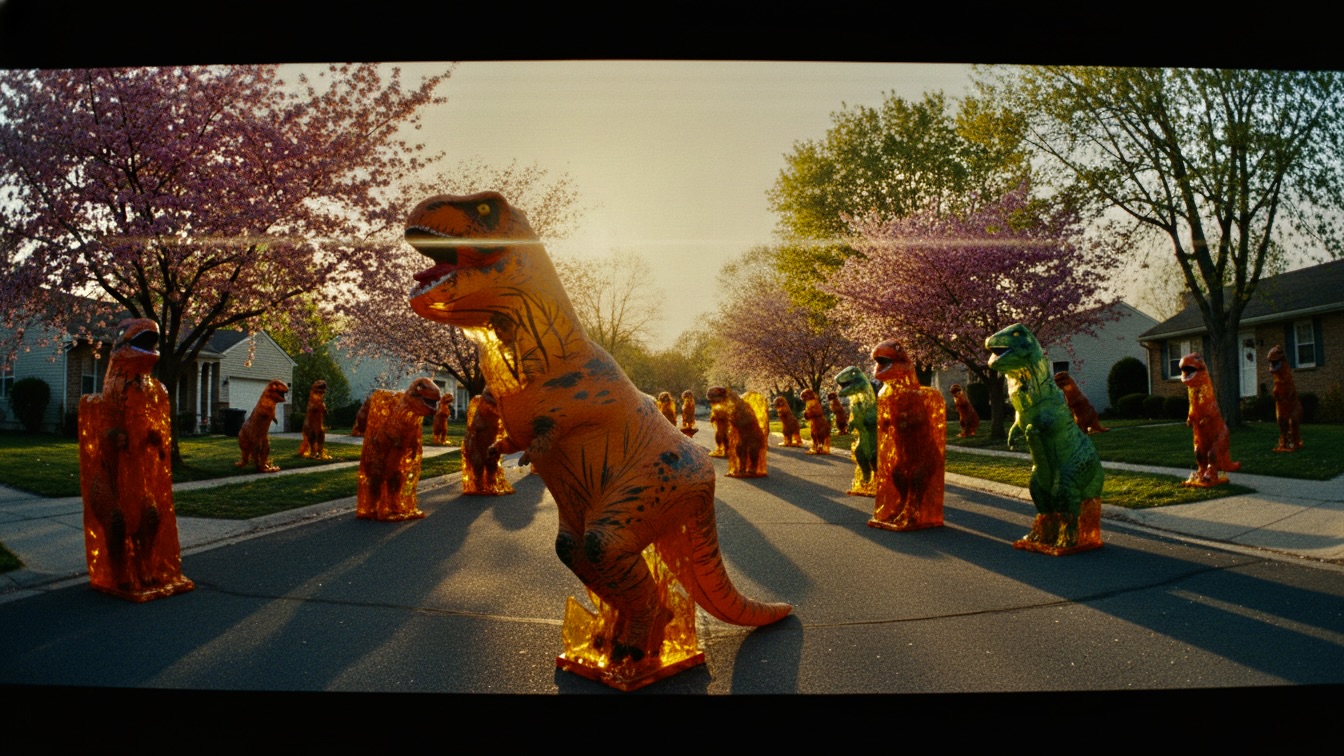
The story opens on a surreal neighborhood gathering known as the Third Annual Prehistoric Spring, where residents under thirty dress in dinosaur costumes. Cynthia finds herself physically caught in a maple tree by her neon green polyester tail, while her friend Mark attempts to assist her. The atmosphere is thick with a sense of wrongness, characterized by an unnaturally harsh sunlight and a mechanical, digital humming emanating from the trees.
As Mark tries to free Cynthia, they discover the trees are secreting a strange, cold, glass-like substance instead of normal sap. This fluid does not behave like water, instead appearing to absorb light and move with a predatory slowness. The situation escalates when they notice their neighbor Tara, who appears to have been perfectly preserved and frozen mid-motion by the substance. The chapter ends with the humming intensifying into a haunting, dissonant harmony that threatens Cynthia’s consciousness.
The primary theme of the narrative is the collision between performative irony and terrifying reality. The characters have engaged in a "Prehistoric Spring" as a joke, mocking the very concept of extinction and ancient history through cheap polyester and inflatable suits. However, the environment responds by imposing a literal, horrific version of preservation upon them. This creates a psychological tension where the characters' defense mechanism—humor—fails to protect them from a genuine existential threat.
Another central theme is the subversion of the natural world through the lens of the uncanny. The maple tree, traditionally a symbol of sweetness and seasonal change, becomes a source of mechanical noise and predatory fluid. The "singing" of the trees is described as a bass drop that never happens, suggesting a digital or manufactured corruption of nature. This reflects a modern anxiety regarding the loss of the "authentic" in a world increasingly dominated by the synthetic and the simulated.
The concept of stagnation and entrapment serves as a recurring motif throughout the text. Cynthia is physically tethered to a tree that should not be there, while Tara is transformed into a literal "window display," frozen in a moment of social performance. The clear fluid acts like a modern-day amber, suggesting that these characters are being preserved in their most ridiculous, artificial states. This highlights a fear of being caught in a permanent state of superficiality, unable to evolve or escape the "bits" they perform for others.
Finally, the story explores the fragility of human perception when faced with the inexplicable. Mark and Cynthia initially try to rationalize the phenomena through jokes and concerns about rental deposits. This psychological denial is a common response to trauma or the supernatural. By the end of the chapter, the sensory overload of the humming and the sight of the frozen Tara break through their denial, leaving them vulnerable to a force that defies biological logic.
Cynthia serves as the grounded perspective through which the reader experiences the mounting dread of the environment. She is initially characterized by her irritation and impatience, signaling a personality that values pragmatism over the whimsy of the neighborhood event. Her physical entrapment by her dinosaur tail acts as a metaphor for her inability to distance herself from the absurdity of her social circle. She is the first to notice the sensory discrepancies, such as the coldness of the fluid and the digital nature of the tree’s song.
From a psychological standpoint, Cynthia exhibits a high level of sensory awareness that makes her more susceptible to the environmental shift. While Mark tries to joke his way through the situation, she is the one who observes the way the light fails to refract in the fluid. Her focus on the "solid slickness" on her skin suggests a visceral connection to the horror unfolding around her. She is not just a witness to the change; she is being physically and mentally integrated into the new, dissonant reality of the cul-de-sac.
Mark functions as the comedic foil who uses irony as a psychological shield against a reality he cannot control. His choice of a dilapidated T-Rex onesie suggests a lack of concern for appearances, yet his trembling hands betray his internal state. He clings to the mundane, such as the cost of a rental deposit, to anchor himself in a world that is rapidly losing its familiar rules. This behavior is a classic displacement activity, where he focuses on a minor financial concern to avoid processing the literal freezing of his neighbors.
His dialogue is peppered with pop-culture references, such as the "Life finds a way" quote, which highlights his reliance on mediated experiences to understand the world. This reliance makes him ill-equipped for a situation that has no script or cinematic precedent. By the end of the scene, his bravado begins to crumble as the "bit" he expects Tara to be performing turns out to be a permanent, terrifying stasis. He represents the modern individual who is over-saturated with media but under-prepared for genuine crisis.
Although she does not speak, Tara represents the ultimate victim of the environment’s drive toward artificial perfection. As a wellness TikToker, her life is already a series of curated, frozen moments designed for consumption. The fluid that encases her merely externalizes her internal drive for a "perfect" image. She is described as a high-end window display, suggesting that in her frozen state, she has finally achieved the ultimate version of the brand she was trying to build.
Her paralysis serves as a grim omen for the rest of the group, illustrating the total loss of agency. The fact that the light bounces off her chest in a way that suggests she isn't breathing indicates that the "preservation" process is biological death in exchange for aesthetic immortality. She is the cautionary tale of the narrative, a symbol of what happens when the desire to be "seen" meets a force that can make that visibility permanent and lifeless.
The pacing of the chapter is masterfully handled, beginning with a slow, almost slapstick opening that gradually tightens into a suffocating horror. The transition from the "vibrating mess of irony" to the "dissonant, haunting lullaby" mirrors the characters' own realization that they are in danger. The author uses short, punchy sentences to punctuate moments of realization, contrasting them with longer, more descriptive passages that detail the strange behavior of the trees and fluid. This creates a rhythmic tension that mimics the mechanical humming described in the text.
Sensory details are the primary tool used to establish the story’s "off" atmosphere. The author avoids traditional horror tropes in favor of the uncanny, focusing on textures that shouldn't exist in nature, like "polished glass" sap and "plastic" leaves. The use of sound is particularly effective, describing a noise that is felt in the molars rather than just heard. This evokes a sense of physical violation, suggesting that the environment is affecting the characters' bodies on a cellular or even digital level.
The narrative voice maintains a cynical, modern edge that enhances the thematic focus on irony. By describing the onesie as looking like it survived a "dryer fire" and referring to the event as a "group chat" joke, the narrator establishes a contemporary setting that feels familiar to the reader. This familiarity makes the subsequent supernatural elements feel more intrusive and disturbing. The contrast between the neon green polyester and the deepening, solid shadows creates a visual palette that is both garish and bleak, perfectly capturing the story’s unique blend of dark comedy and environmental horror.


