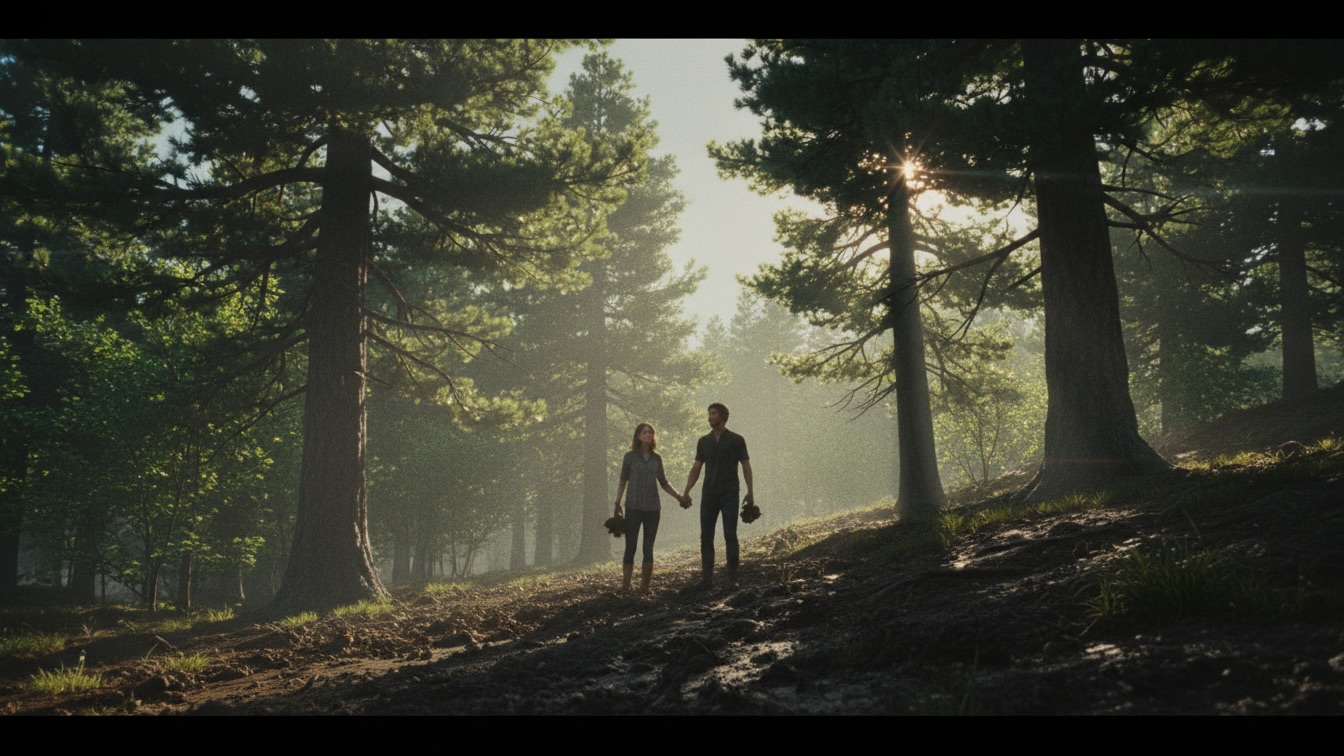
Sylvie and Ryan venture into the pine sector, a "grey zone" excluded from the technological optimization of their home city. While Sylvie embraces the harsh, unscripted environment, Ryan struggles with the physical and psychological withdrawal from his bio-monitors and the constant data streams that previously governed his life. They are on a mission to plant a rare, un-cloned seed, a task that represents a radical departure from the terraforming drones and algorithmic control of their society.
The journey takes a dangerous turn when a sudden landslide destroys their path and nearly claims their lives. This moment of raw, unbuffered terror forces Ryan to confront the emptiness of his managed existence. Rather than retreating, the couple chooses to plant the seed in the fresh, chaotic earth left by the disaster. The experience culminates in a messy, un-simulated moment of intimacy, leading them to abandon their maps and the city's expectations in favor of an uncertain, self-authored future.
The central theme of the narrative is the conflict between technological optimization and the inherent chaos of the human experience. The city represents a utopia of efficiency where every biological need is met, yet this perfection has resulted in a spiritual atrophy. By removing risk and irregularity, the society has also removed the capacity for meaning. The story suggests that for a life to be "real," it must possess the potential for failure and the unpredictability of the natural world.
Another significant theme is the reclamation of agency in a deterministic world. Ryan and Sylvie’s relationship was curated by a compatibility score, and their lives were guided by "optimized outcomes." The act of planting an un-cloned seed—a biological mystery with no guaranteed success—serves as a metaphor for their own lives. They are moving away from being "characters" in an algorithmic script to becoming "authors" who must navigate the world without the safety net of predictive data.
The narrative also explores the sensory and psychological impact of nature as a grounding force. The contrast between the "filtered vents" of the city and the "smell of rot and cold water" in the forest highlights the sensory deprivation of a high-tech existence. The story posits that physical discomfort, such as the bite of cold air or the grit of mud, is essential for a true connection to one's own body. Ryan’s heart becomes "irregular" not because of a malfunction, but because he is finally responding to the environment rather than a monitor.
Sylvie serves as the ideological anchor and the protagonist who drives the narrative toward authenticity. She is characterized by her rejection of the "smart" world, evidenced by her decision to disable her jacket's temperature regulation. She possesses a deep-seated craving for the "aggressive" qualities of the wild, viewing the forest's chaos as a reflection of how a human heart should truly function. Her perspective is one of liberation; she sees the lack of a safety protocol not as a threat, but as the very thing that makes life matter.
Psychologically, Sylvie is more advanced in her journey of detachment from the city's influence than her partner. She acts as a mentor to Ryan, guiding him through the "data-withdrawal" and teaching him to value the "scratch on her thumb" over a digital interface. Her strength lies in her willingness to embrace the finality of the wild. She finds beauty in the "shattered" trees and the "raw earth," understanding that growth requires the destruction of the old, rigid structures that previously defined her.
Ryan begins the story as a fragile product of his environment, experiencing a "phantom limb" sensation due to the absence of his bio-monitor. He is a man who has been "practiced" and "recorded," resulting in a flat, monotone existence where his own heartbeat feels like an alien intrusion. His initial reaction to the forest is one of fear and disorientation, as he lacks the internal tools to navigate a world without a "floor" or a "ceiling" provided by the algorithm.
His transformation is the emotional core of the chapter. The landslide acts as a psychological breaking point, stripping away his "theatrical mask" and forcing him to acknowledge his own mortality. When he finally digs into the mud with his bare hands, he undergoes a symbolic rebirth. By the end of the chapter, Ryan has shifted from a passive observer of his own life to an active participant. He recognizes that while the algorithm could optimize his pulse, it could never provide him with a reason to love or a sense of purpose.
The narrative employs a stark contrast in sensory details to emphasize the divide between the city and the wild. Descriptions of the city are characterized by words like "filtered," "composite," "grid," and "optimized," creating a sense of sterile, airless perfection. In contrast, the pine sector is described using visceral, heavy language such as "rot," "aggressive," "mud," and "visceral groan." This shift in vocabulary mirrors the characters' internal transition from a digital existence to a biological one.
The pacing of the story is deliberate, mimicking the physical exertion of the characters' hike. The author uses short, punchy sentences to convey Ryan’s anxiety and the suddenness of the landslide, which creates a sense of urgency and impact. Conversely, the scene where they plant the seed is described with a slower, more rhythmic flow, allowing the reader to feel the gravity and "revolution" of the simple act. This variation in pacing ensures that the external environment and the internal emotional states of the characters are perfectly synchronized.
The tone of the piece is one of somber reflection transitioning into raw hope. The narrative voice is observant and deeply psychological, often lingering on the "theatrical" nature of Ryan’s speech to highlight his struggle with authenticity. The final scene, marked by a "clumsy kiss" and the taste of "salt and grit," serves as a powerful stylistic choice. It rejects the polished tropes of romance in favor of something "un-simulated," reinforcing the story’s ultimate message that beauty is found in the messy, unscripted reality of the human condition.


