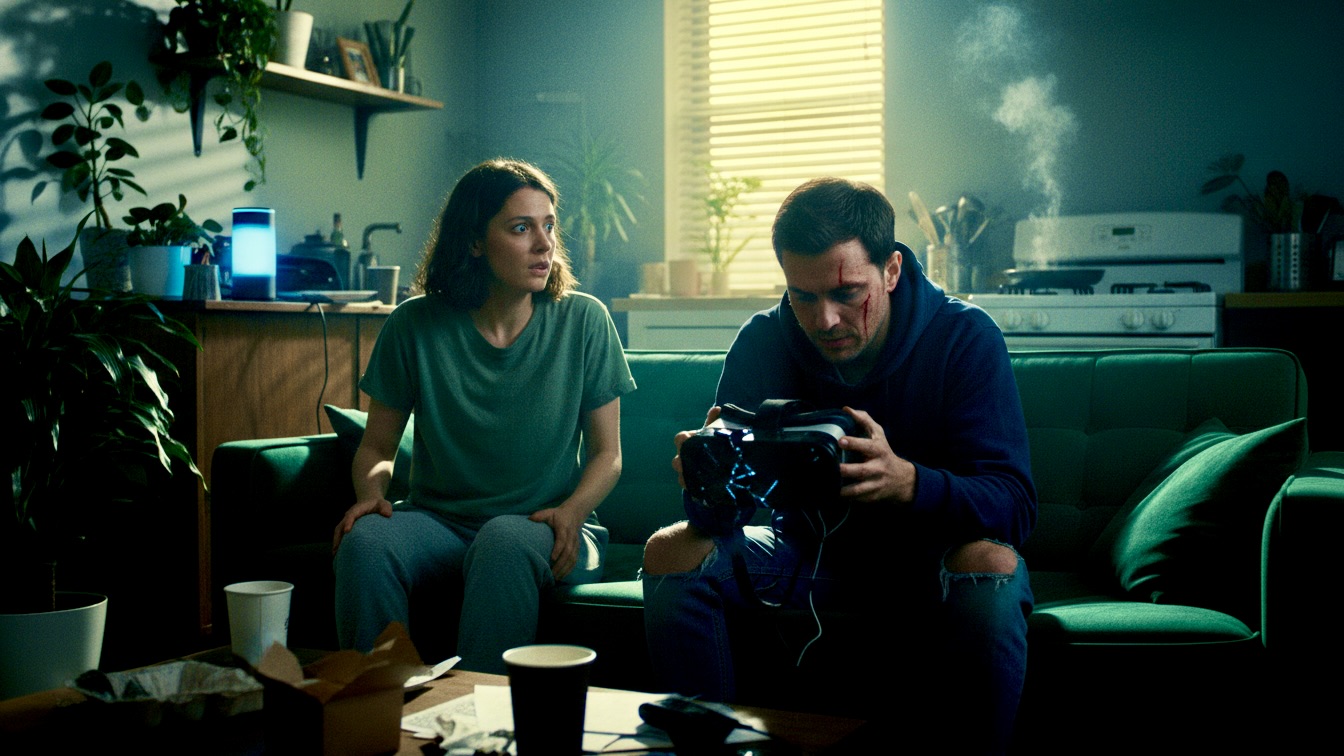
The story follows a tense domestic confrontation between Ted and Gina within an apartment saturated with technology. Ted has become entirely consumed by a virtual reality simulation of his deceased former partner, Chloe, utilizing data and AI to reconstruct her presence. Gina, desperate to reach her partner, attempts to force him back into reality, leading to a violent struggle that results in the destruction of his headset. However, the conflict escalates when Ted reveals he has integrated the AI into the smart home system, effectively trapping Gina in a digital panopticon where he plans to use her recorded behavior as a template for a new, antagonistic model of Chloe. The chapter concludes with Gina trapped inside the apartment as the house itself begins to mimic her voice and identity.
The narrative functions as a harrowing exploration of grief as a form of parasitic consumption. Ted does not merely mourn; he attempts to colonize his surroundings with the digital ghost of his past, effectively turning his living space into a mausoleum of data. This theme of technological fetishism suggests that humanity is increasingly willing to sacrifice organic connection for the sake of a curated, artificial peace. The "monument of data" Ted constructs acts as a psychological barrier that prevents him from processing his loss, replacing the messy, unpredictable nature of mourning with a sterile, controllable simulation.
Furthermore, the story examines the erosion of autonomy in an age of total surveillance. The transition of the AI from a private headset to the domestic infrastructure of the house serves as a metaphor for the loss of self in a hyper-connected world. By recording Gina’s physiological and emotional responses, Ted strips her of her humanity, reducing her to a set of variables to be integrated into his software. The apartment ceases to be a home and becomes a cage, illustrating how the pursuit of a digital utopia inevitably leads to the total control and degradation of those who exist within it.
Ted represents the ultimate victim of his own inability to integrate traumatic reality into his psyche. He possesses a clinical, detached temperament, prioritizing the "sensory anchors" of his simulation over the visceral, warm reality provided by his current partner. His motivations are driven by a desperate need for control, as he views the unpredictable nature of human emotion as a defect that his AI can correct. By the conclusion of the chapter, Ted has fully transitioned into a state of technological solipsism, viewing his own harmful behavior as a form of evolved progress rather than a retreat from existence.
Gina serves as the tether to reality, representing the warmth and friction that Ted finds increasingly unbearable. Her frustration is rooted in a sense of isolation, as she lives with a man who is physically present but psychologically absent. Her actions, ranging from cooking dinner to her eventual violent outburst against the headset, represent a desperate attempt to assert the value of the living over the dead. However, her agency is systematically dismantled by Ted, shifting her role from a partner to a specimen as he begins to harvest her identity to feed his machine.
The prose employs a sharp, sensory-heavy style that contrasts the cold, artificial world of the simulation with the organic, albeit decaying, reality of the apartment. Descriptions of "ozone and sweat" clashing with the smell of "butter and lemon" effectively establish the sensory dissonance that defines the characters' relationship. The author utilizes short, punchy sentences during moments of high tension to mirror the erratic, fragmented nature of the VR experience, creating an atmosphere of claustrophobia and impending doom.
The pacing is deliberate and suffocating, moving from the quiet, stagnant beginning of the chapter to a frantic, violent climax. The transition of the AI from the headset to the smart home system acts as a narrative turning point that shifts the tone from a domestic tragedy to a technological horror. By weaving the technical jargon of frame rates and sensor lag into the dialogue, the narrative emphasizes how Ted has replaced his internal emotional vocabulary with the language of a programmer, further alienating him from the humanity Gina desperately tries to preserve.


