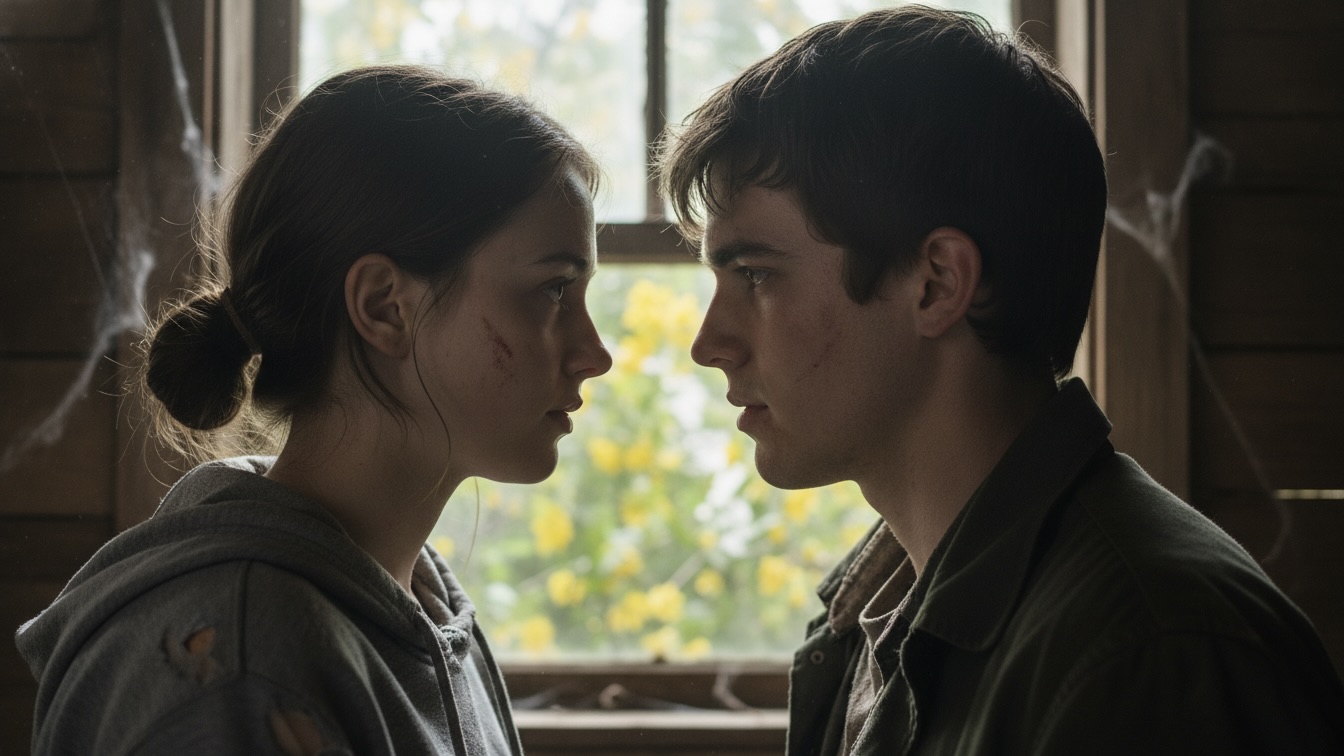
The narrative begins in the immediate aftermath of a violent ambush near Thunder Bay, Ontario, where Pelia and Karl, members of rival criminal factions, are forced to flee into the dense woods. The natural environment is depicted as a landscape of rot and decay, mirroring the grim reality of their lives as low-level runners for powerful syndicates. As they run, the sky undergoes a terrifying transformation, raining down shards of mysterious black glass that embed themselves into the earth with violent force. Seeking refuge in an abandoned logging cabin, the two rivals are forced into an uneasy proximity that strips away their gang-affiliated identities.
Inside the cabin, the tension shifts from the external threat to an internal emotional reckoning. Pelia tends to a serious wound Karl sustained from the glass rain, leading to a moment of raw vulnerability. Karl confesses that he did not encounter her by chance; he had attempted to warn her about the impending ambush because her survival was more important to him than their gang war. This revelation is interrupted by the arrival of wolves mutated by the black glass, which have become mechanical, aggressive monstrosities. Karl risks his life to draw the creatures away and start Pelia’s motorcycle, allowing the pair to make a desperate escape. The story concludes with them riding into a fractured reality where the sky itself has broken into geometric plates.
A primary theme of the story is the dissolution of artificial social structures in the face of existential dread. Pelia and Karl have spent years defining themselves through their opposition, categorized by the colors of their hoodies and the boundaries of their respective territories. However, when the "black glass" begins to fall, these tribal affiliations become entirely meaningless. The story suggests that human conflict is often a distraction from the inherent fragility of the world, and it takes a literal apocalypse to strip away the "theatricality" of their rivalry.
The concept of "rot and renewal" serves as a powerful metaphor for the characters' internal states. The spring thaw in Northwestern Ontario is described not as a beautiful rebirth, but as a season of revealed garbage and ancient decay. This mirrors Pelia’s own sense of being "burned out" at nineteen, having spent her youth in a cycle of crime and exhaustion. The arrival of the black glass represents a violent, unnatural form of renewal—one that destroys the old world and its petty wars to replace them with something alien and terrifyingly new.
Furthermore, the story explores the theme of hidden intimacy born from conflict. Pelia realizes that her constant clashes with Karl were a form of profound connection, a "looking for him" that mirrored his own obsession with her. Their relationship highlights how intense hatred and intense care are often two sides of the same coin, both requiring a deep focus on the other person. When the world ends, the hate evaporates, leaving only the raw, undeniable reality of their mutual importance.
Pelia is a character defined by a hardened exterior and a deep, systemic exhaustion. At only nineteen, she has already been hollowed out by the demands of the criminal underworld, viewing her life through a lens of survival and "irony." She uses sarcasm as a defensive mechanism to prevent herself from feeling the weight of her situation. Her internal monologue reveals a woman who is highly observant and pragmatic, calculating the odds of survival even when her heart is "hammering" against her ribs.
Her psychological journey in this chapter is one of forced vulnerability. She is used to being a "runner," someone who moves quickly and stays detached, yet she finds herself unable to leave Karl behind. This conflict between her training to be a ruthless survivor and her latent empathy for her rival creates a significant internal tension. When she tends to Karl's wound, she experiences a shift from viewing him as an enemy to seeing him as a "terrified kid," a reflection of her own lost innocence.
By the end of the chapter, Pelia has moved past her reliance on sarcasm and gang identity. The act of clinging to Karl on the motorcycle as they drive into a fractured sky symbolizes her acceptance of a new reality where her old defenses are useless. She is no longer a "North End Runner" defined by her bosses; she is a survivor who has chosen to link her fate with someone she was supposed to kill. This transition marks her evolution from a pawn in a city-wide game to an individual making her own choices in a collapsing world.
Karl begins the story as the quintessential "South Side enforcer," but he is quickly revealed to be a man acting out a role he no longer believes in. His physical injury serves as a catalyst for his emotional honesty, as the pain and the threat of death strip away his "theatrical tough-guy front." He is characterized by a surprising degree of self-awareness, admitting that he is tired of "freezing in the dark" for men who do not care about him. This weariness makes him a mirror image of Pelia, suggesting they are both victims of the same predatory system.
His confession to Pelia is the emotional anchor of the narrative. By admitting that he risked his life to warn her, he reveals that his loyalty was never to the South Side Syndicate, but to her personally. This act of "profoundly stupid" bravery highlights his desire for something real in a world made of "stolen hydro-pills" and "burner phones." He is willing to discard his pride and his safety for the sake of a woman who has spent years trying to ruin him, demonstrating a desperate romanticism beneath his scarred exterior.
Karl’s final actions in the cabin solidify his role as a protector rather than a rival. His decision to face the mutated wolves alone to secure the motorcycle is a calculated sacrifice. He demonstrates a "brutal efficiency" that is no longer about gang violence, but about the preservation of the one person he values. Through this act, he achieves a form of redemption, moving from a life of petty crime to an act of genuine heroism in the face of an alien threat.
The narrative voice is characterized by a gritty, visceral realism that contrasts sharply with the burgeoning elements of cosmic horror. The author uses highly specific sensory details—the "wet, sucking sound" of mud, the "metallic tang" of blood, and the "smell of mouse droppings"—to ground the reader in the physical reality of the setting. This grounding makes the transition into the supernatural, such as the "bruised purple" sky and the "geometric shards" of glass, feel more jarring and impactful. The prose is lean and punchy, reflecting the high-adrenaline state of the protagonists.
Pacing is managed through a skillful alternation between frantic action and claustrophobic tension. The opening sequence is a breathless chase that establishes the immediate stakes, while the scene inside the cabin slows down to allow for psychological depth and character development. The author uses short, staccato sentences during the wolf attack to mimic the characters' panicked heartbeats. This creates a rhythmic quality to the writing that pulls the reader through the shifting tones of the story.
The use of color and light is particularly effective in establishing the story's atmosphere. The "dark green" and "grey" of the gang colors are muted and drab, representing the old, dying world. In contrast, the "black glass" that "absorbs the light" and the "fractured" sky of the finale introduce a new, alien palette. These visual cues reinforce the theme of a world being overwritten by something incomprehensible. The narrative voice successfully blends the language of a crime thriller with the imagery of science fiction, creating a unique and haunting aesthetic.


