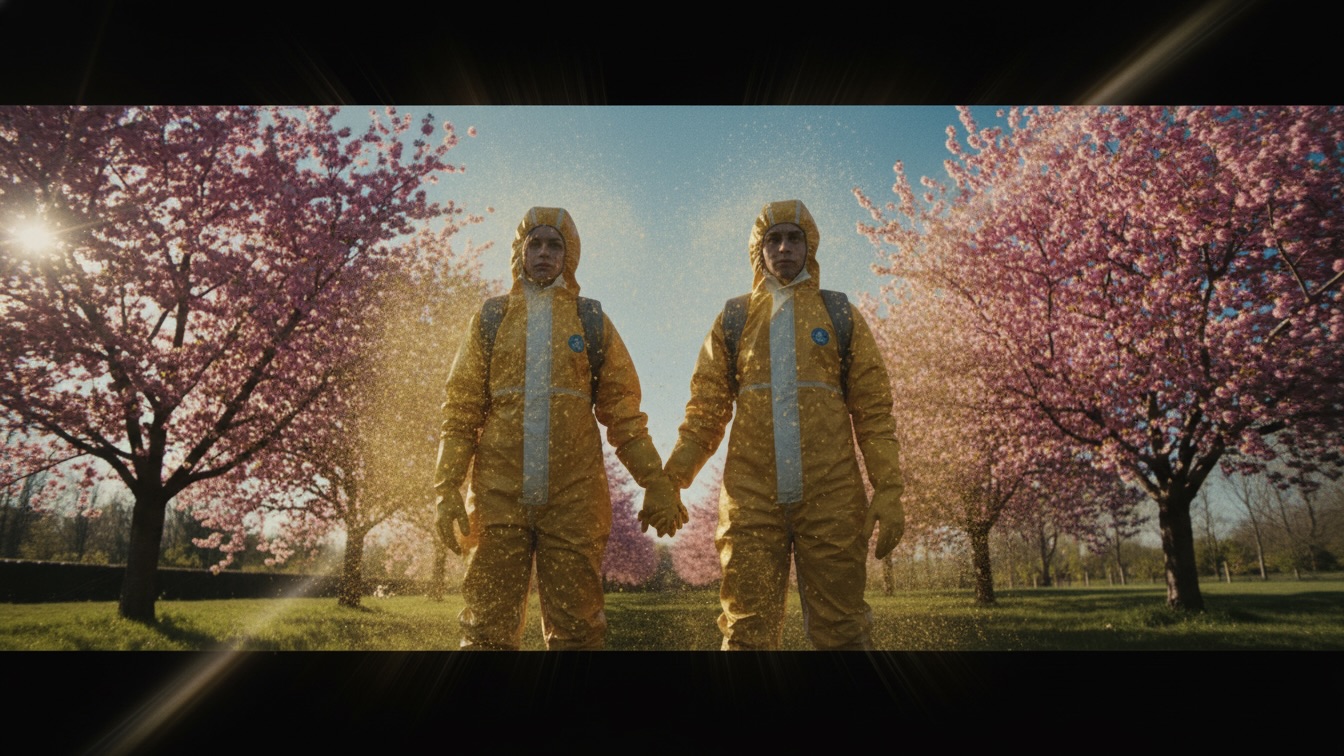
The story begins in a claustrophobic apartment where Theo, a man gripped by intense paranoia, has transformed his living space into a makeshift bunker. He believes that the spring pollen and floral elements are actually sophisticated corporate surveillance tools. His girlfriend, Maren, attempts to ground him with the normalcy of breakfast and their anniversary plans, though she is clearly exhausted by his conspiratorial worldview. She views his "demilitarized zone" of painter's tape and plastic-wrapped windows as a symptom of a mental breakdown rather than a rational response to reality.
The tension shifts when Theo captures a pulsing dandelion seed in a mason jar, providing the first hint that his fears may be grounded in a terrifying reality. Despite her reservations, Maren agrees to visit the Metropolitan Botanical Gardens with him, hoping to salvage their anniversary. They enter the gardens dressed in protective gear, standing out against the backdrop of oblivious tourists. Their journey through the floral exhibits feels like a tactical mission, culminating in a confrontation at the Great Conservatory.
In the heart of the gardens, they encounter their neighborhood mailman, who reveals himself to be a "brand ambassador" for a program called Flora-Connect. He explains that nature has been engineered into a biological marketing network that monitors human vitals and manipulates emotions through airborne spores. This revelation confirms Theo's darkest suspicions, transforming the story from a character study of paranoia into a dystopian horror. The couple flees back to their apartment, retreating into hazmat suits and total isolation.
The narrative concludes on a chilling note as the couple sits in the dark, physically shielded but biologically compromised. Maren feels a tickling sensation in her throat, suggesting the "biotic influence" has already taken root inside her. Meanwhile, the petal Theo captured earlier begins to grow and bloom within its sealed jar. The boundaries between technology and biology have completely dissolved, leaving the characters trapped in a world where even the act of breathing constitutes an agreement to a corporate contract.
The central theme of the story is the invasive reach of surveillance capitalism and the total erosion of the private self. By literalizing the concept of "cookies" and "tracking" through biological means, the narrative explores a world where the human body is the final frontier for data mining. The "Flora-Connect" initiative represents the ultimate corporate ambition: the ability to not only monitor behavior but to trigger physiological and emotional responses, such as the urge to propose, through engineered scents.
Another prominent theme is the death of the natural world and its replacement by a "bio-mimetic" simulacrum. Nature is no longer a source of solace or beauty in this story; it is a Trojan horse for corporate interests. The fact that the flowers have "acoustic pickups" and "directional microphones" suggests that the organic has been entirely co-opted by the synthetic. This reflects a deep-seated cultural anxiety about the loss of authenticity in an era where every experience is mediated by technology and targeted advertising.
The story also examines the psychological toll of living in a hyper-connected, high-surveillance society. Theo’s paranoia is initially framed as a pathology, a "brain-fried" state resulting from modern exhaustion. However, the plot twist suggests that in a world of total surveillance, the only sane response is what looks like madness. The tragedy lies in the fact that even Theo's extreme precautions are insufficient, as the "Terms of Service" are embedded in the very air he breathes.
Finally, the narrative touches on the commodification of intimacy. The mailman’s revelation that corporate spores can manipulate Theo into proposing to Maren turns their most private, significant emotional milestones into programmed consumer behaviors. This suggests a future where human agency is an illusion, and our deepest desires are merely "lifestyle upgrades" pushed by a proprietary blend of spores. The hazmat suits at the end symbolize the total breakdown of human connection in the face of this biological invasion.
Theo is a character defined by hyper-vigilance and a profound sense of alienation from the modern world. From a psychological perspective, he exhibits traits of a "prepper" mentality, driven by a need for control in an environment he perceives as inherently hostile. His use of barbecue tongs and blue painter's tape demonstrates a desperate attempt to create boundaries against an invisible, pervasive enemy. While he appears eccentric and unstable at the start, his character serves as the "canary in the coal mine" for the story's dystopian reality.
His motivation is primarily self-preservation, but it is deeply intertwined with his love for Maren. He is not just trying to save himself; he is trying to "un-compromise" her, even if his methods are abrasive and frightening. His validation at the botanical gardens does not bring him peace, but rather confirms his worst fears, leading to a state of total withdrawal. By the end of the story, he has retreated into a literal shell, his identity subsumed by the protective gear he wears.
Maren represents the "everyman" or the skeptic who is forced to confront an unthinkable reality. She is characterized by a "heavy, dull ache of modern exhaustion," suggesting that she is already overwhelmed by the demands of contemporary life before the story even begins. Her initial patience with Theo shows a deep emotional commitment, but her irony and sarcasm serve as a defense mechanism against his growing instability. She desperately clings to the idea of a "normal" life, symbolized by her desire for a simple date at the botanical gardens.
As the story progresses, Maren’s psychological journey moves from skepticism to dawning horror. The moment she sees the pollen "crawling" toward her paper cut marks the breaking point of her rationalization. Her attempt to use internet slang like "gaslight, gatekeep, girlboss" to process the situation shows her trying to use familiar cultural frameworks to mask her terror. By the end, she is a silent participant in Theo's isolation, her internal "tickling" sensation suggesting that her body has already been colonized by the very system she tried to ignore.
The narrative employs a tone that shifts masterfully from domestic dark comedy to clinical, existential horror. In the beginning, the imagery of Theo brandishing barbecue tongs and wearing a rain poncho over pajamas creates a sense of absurdity. This prevents the reader from taking his claims seriously at first, mirroring Maren's own skepticism. However, as the sensory details become more unsettling—the "thump-thump" of the dandelion seed and the "human ear" blossoms—the humor evaporates, replaced by a cold, sterile dread.
The pacing of the story is deliberate, beginning in a cramped, static environment before moving into the expansive but equally trapped setting of the botanical gardens. This transition mimics the feeling of a trap closing in. The dialogue between the characters and the "mailman" is particularly effective; the mailman’s corporate jargon and pleasant demeanor contrast sharply with the horrific nature of his message. This "polite dystopia" is a hallmark of contemporary horror, where the monster doesn't growl but instead offers a "VIP invitation."
Sensory details are used to emphasize the "uncanny" nature of the environment. The smell of "dry cleaner’s back room" and "stale coffee" grounds the story in the mundane, while the "translucent" petals and "vibrating throb" of the glass jar introduce the supernatural elements. The final image of the couple eating through straws in their hazmat suits provides a powerful visual metaphor for their loss of humanity. The author uses these details to create a world that feels just a few steps removed from our own, making the horror feel inevitable rather than fantastical.


