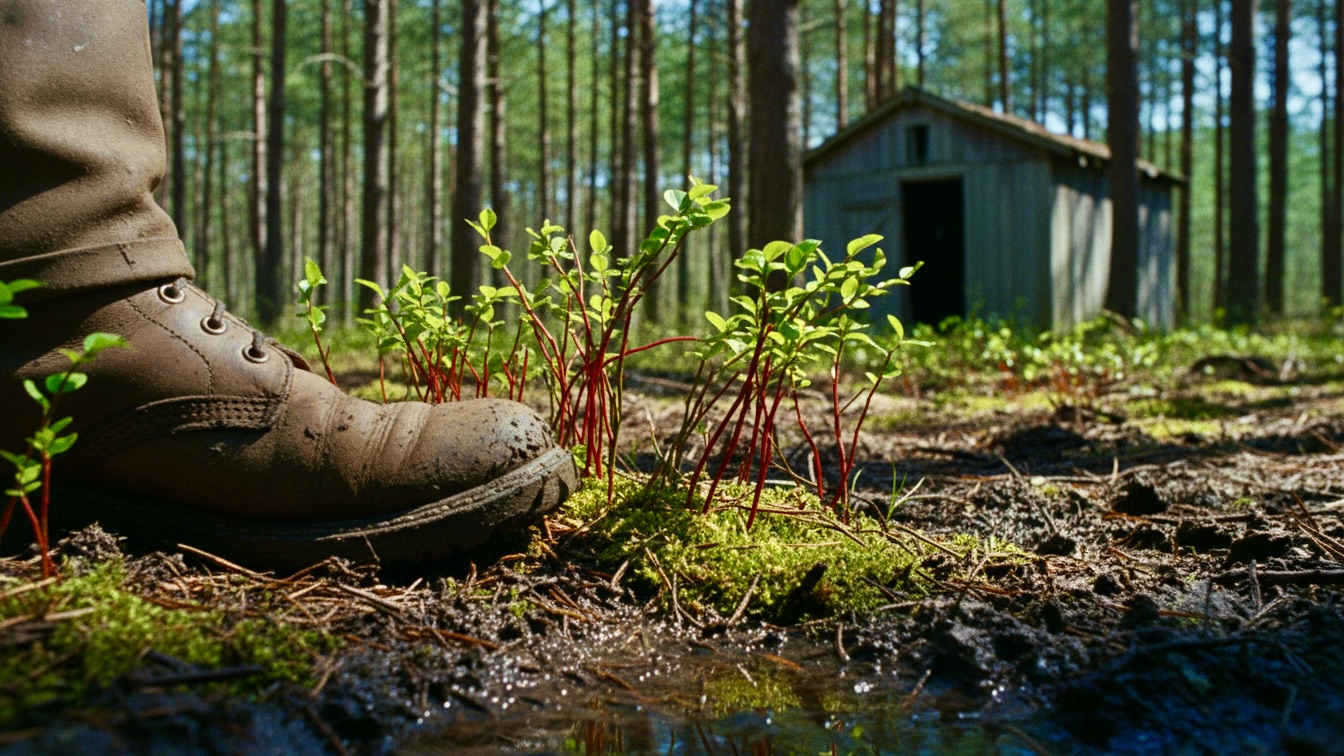
Detective Miller struggles through a hostile, muddy landscape in search of a man who has vanished in the jack pines. The environment itself seems to resist his presence, characterized by sucking muck and freezing temperatures. His discovery of a frayed piece of red flannel suggests a violent or hurried passage through the dense brush. This discovery is interrupted by Elissa, a local woman who emerges from the trees to challenge Miller’s presence and his investigation.
Their dialogue reveals a sharp divide between the detective’s duty to the law and Elissa’s primal loyalty to the land. She describes the missing man as an interloper who failed to respect the brutal reality of the wilderness. Elissa warns Miller that the woods do not tolerate those who treat nature as a commodity or a stage for social media. The encounter ends with an ominous suggestion of hidden secrets within the local community.
As Elissa departs, Miller is drawn toward a dilapidated storage shed by a sudden, metallic noise. The atmosphere grows increasingly heavy as he approaches the structure, feeling the weight of the isolation. The chapter reaches a climax when a pale, mud-caked hand reaches out from the darkness of the shed. This final image confirms that the missing man, or perhaps another victim, is caught within the literal and metaphorical rot of the patch.
The central theme of the narrative is the violent collision between modern civilization and the uncaring, primordial force of nature. Miller represents the structured world of law, evidence, and technology, all of which fail him in the face of the "living" mud. The missing man's desire for an "authentic experience" is portrayed as a fatal arrogance. This suggests that nature is not a curated museum for human consumption but a volatile system that demands sacrifice.
Another prominent theme is the insularity and protective nature of rural "outsider" cultures. Elissa acts as a spokesperson for a community that views itself as survivors rather than citizens. This "protective culture" is not merely about property lines; it is a psychological boundary that excludes anyone who has not "bled on the thorns." The land and the people are intertwined, sharing a history of fire and regrowth that outsiders cannot comprehend.
The concept of "The Wild Harvest" serves as a metaphor for the cost of true belonging. Elissa explains that the blueberry bushes only thrive where there has been a burn, suggesting that trauma and destruction are prerequisites for life in this valley. The red stems of the plants mimic the veins of the earth, reinforcing the idea that the soil is nourished by the blood of those who fail to adapt. This creates a grim cycle where the land literally consumes the unprepared.
Miller is a man defined by physical and professional exhaustion. His aching knees and the "heavy weight" of his damp socks reflect a psychological weariness with his role as a bringer of order to a chaotic world. He relies on the tools of his trade, such as his phone and the concept of a warrant, but finds them useless in the signal-dead woods. His struggle with the mud symbolizes his inability to gain a foothold in a community that views him as an invasive species.
Despite his fatigue, Miller possesses a dogged persistence that borders on the self-destructive. He is driven by a traditional sense of morality, insisting that a human life has inherent value regardless of the victim's "brand." However, his internal state is one of growing vulnerability. The chill he feels is not just environmental; it is a dawning realization that he is outmatched by the ancient, cold logic of the valley.
Elissa functions as the "genius loci" or the human manifestation of the hostile woods. She moves with a lightness that Miller lacks, demonstrating her physical and psychological synchronization with the environment. Her speech is described as having a "rehearsed intensity," suggesting that she plays a role to intimidate and deflect outsiders. She views the world through a Darwinian lens where only those who understand the "burn" deserve to remain.
Psychologically, Elissa exhibits a chilling lack of empathy for the missing man, whom she dismisses as a "ghost in a bright jacket." She prioritizes the sanctity of the land over human life, viewing the disappearance as a natural correction rather than a tragedy. Her warning to Miller is not just a threat of violence, but a psychological forecast of his inevitable failure. She represents the "old fires" of the valley, fueled by a history that refuses to be tamed or explained.
The pacing of the chapter is deliberate and heavy, mimicking the "wet, rhythmic sound" of boots in the mud. The author uses a slow build-up of sensory details to create a sense of mounting dread. The transition from the wide, silent woods to the cramped, dark interior of the shed shifts the tone from atmospheric mystery to visceral horror. This acceleration at the end of the chapter serves to shatter the stagnant, heavy feeling established in the opening paragraphs.
Sensory imagery is used effectively to blur the lines between the biological and the geological. The trees are described as having "skeletal fingers," and the blueberry stems are compared to "veins rising out of the mud." These personifications suggest that the landscape is a predatory entity watching Miller’s every move. The metallic tang of melting snow and the smell of wet bark ground the story in a harsh, tactile reality that makes the supernatural undertones feel more plausible.
The narrative voice is objective yet deeply colored by Miller’s discomfort, creating a claustrophobic perspective. The dialogue between Miller and Elissa is sharp and economical, highlighting their fundamental lack of common ground. Each sentence is crafted to reinforce the idea of the environment as an active antagonist. The final image of the mud-caked hand provides a powerful visual payoff to the earlier metaphors of the earth "opening up" for those who do not belong.


