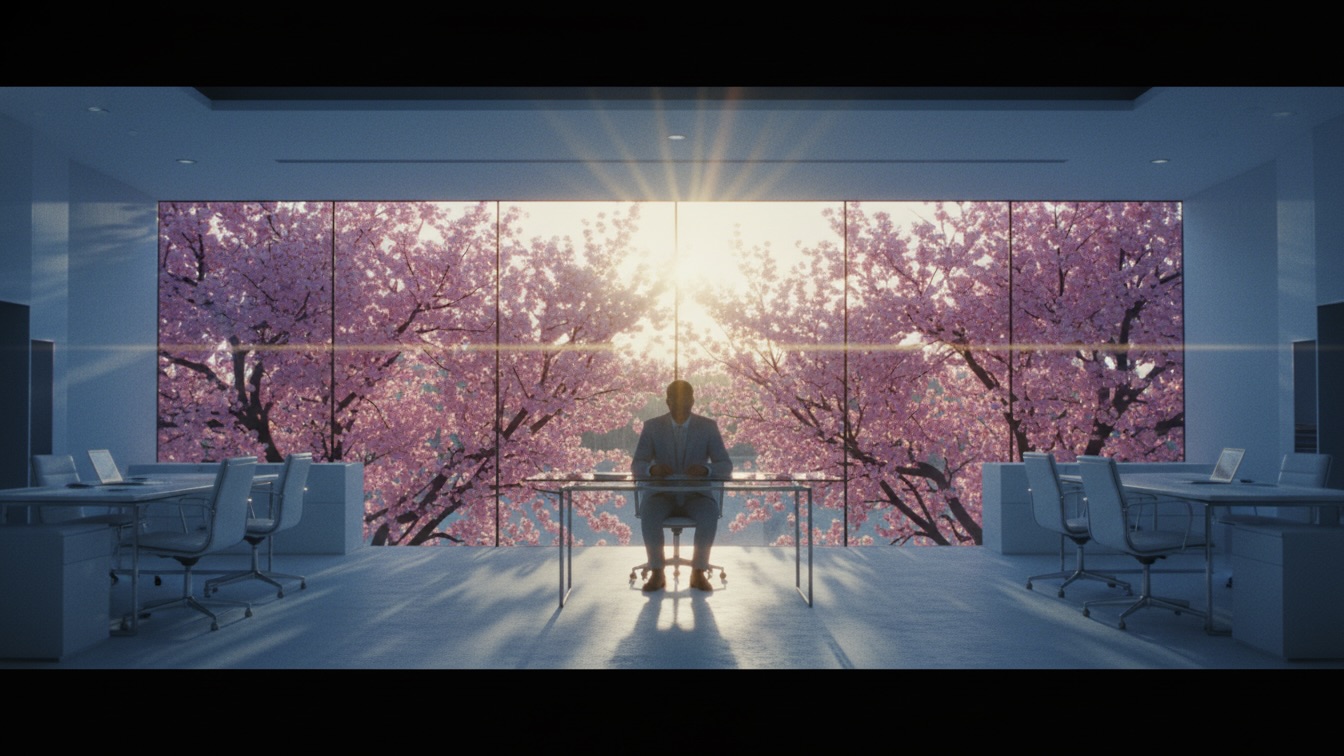
The story follows Len, a Vibe Consultant in a near-future dystopia where the state monitors and regulates the emotional output of its citizens through biometric data and "Vibe-Bands." Len is tasked with managing a "leak" of dissatisfaction in Sector 4, specifically focusing on an outlier named Maeva. Maeva is a gardener whose low civic engagement and refusal to participate in the mandatory "Share the Glow" social media campaign make her a perceived threat to the city's Harmony Rating. Under intense pressure from his superior, Director Richards, Len is ordered to prescribe high-level mood-altering drugs to Maeva to force her back into the network’s emotional frequency.
During their consultation, Maeva challenges Len’s reliance on data and screens, contrasting the artificial "Spring Renewal" with the reality of the natural world. She refuses the medication, choosing to remain authentic despite the threat of "Involuntary Recalibration." Overwhelmed by his own "Grey Weight" of anxiety and the fear of losing his status, Len ultimately consumes the pills himself to find relief. Though he achieves a hollow, drug-induced peace, Director Richards reveals that the system had already flagged Len’s internal conflict as a "Cognitive Breach." The chapter ends on a chilling note, suggesting that Len’s attempt to hide his dissent through medication has failed to save him from the state's scrutiny.
The narrative explores the terrifying intersection of state-mandated optimism and biometric surveillance. In this society, happiness is not a private emotion but a public utility and an economic driver. The "Harmony Rating" serves as a chilling metric where human feelings are commodified to ensure the stability of investment firms and infrastructure projects. This creates a world where "quiet" is viewed as a systemic threat, and silence is interpreted as a "vacuum" that the state must fill with synthetic joy.
The conflict between authenticity and performance is central to the story’s moral core. Maeva represents the last vestiges of the unmonitored human spirit, choosing "angry and real" over "happy and hollow." Her refusal to "perform" for the algorithm highlights the tragedy of a society that has replaced genuine connection with "Share the Glow" affirmations. The "Grey Weight" that Len feels is the psychological manifestation of this dissonance, representing the heavy toll of maintaining a facade of contentment while the soul is suffocating.
Furthermore, the story critiques the dehumanization inherent in data-driven governance. People are referred to as "nodes," "glitches," and "outliers," stripping them of their individuality and reducing them to points on a graph. The Ministry of Wellness optimizes nature itself, timing nutrient releases to ensure cherry blossoms bloom for political cycles. This suggests that when a system prioritizes "optimization" above all else, the messy reality of life—including grief, frustration, and even the natural death of bees—becomes an unacceptable error to be corrected.
Len is a tragic figure who embodies the "middle manager" of a dystopia, trapped between his remaining humanity and his survival instinct. He is acutely aware of the "Grey Weight" in his chest, suggesting he possesses a high degree of self-awareness that he finds increasingly burdensome. His physical description, with fingers that feel "thick and clumsy," hints at a man who is ill-suited for the sterile, digital world he is forced to maintain. He is driven primarily by fear, specifically the fear of losing his mortgage and his social score, which leads him to betray both Maeva and himself.
His decision to take the blue pills is the ultimate act of self-annihilation. By choosing to "flatten" his own emotions, he surrenders the very thing that made him a "Vibe Consultant" capable of understanding others. The transition from his jagged, red-line anxiety to the smooth, artificial "nice" feeling at the end marks his final integration into the system. However, his tragedy is compounded when he realizes that even his internal chemical submission cannot erase the data trail of his previous dissent.
Maeva serves as the narrative’s moral compass and a foil to the artificiality of the Ministry. She is defined by her connection to the earth, symbolized by the dirt under her fingernails and her focus on the health of the soil over the health of the "Harmony App." Unlike the other citizens, she does not perform for the HUD or the Vibe-Band; she simply exists. Her voice is "warm" and lacks the practiced inflection of the state-approved "Glow" users, marking her as a relic of a more authentic era.
Her resistance is not loud or violent, but stubbornly quiet, which makes her more dangerous to the state. She understands that by refusing to "fake it," she keeps a space open for the truth to exist. Her disappointment in Len at the conclusion of their meeting is profound, as she realizes he is too far gone to be saved by the beauty of the real world. Even as she faces "Involuntary Recalibration," she maintains a dignity that Len has long since traded for a paycheck and a steady heart rate.
Director Richards is the personification of the state’s cold, analytical eye. He is described as a man who "ate nothing but light," suggesting he has transcended human needs and emotions to become a pure instrument of the system. His voice is "flat" and "devoid of vibes," an irony considering his role in managing the emotions of millions. He does not see people; he sees "nodes" and "infectious" dead zones that must be harmonized or eliminated.
Richards represents the "Panopticon" effect, where the mere presence of his monitoring makes Len’s anxiety spike. He is not interested in genuine happiness, only in the "record" and the "Harmony Rating." His smirk at the end of the chapter reveals his predatory nature, as he takes pleasure in the "ownership" of Len’s broken spirit. He is the ultimate guardian of the "lie," ensuring that any dissonance is tuned out before it can threaten the grid.
The pacing of the chapter is masterfully handled, moving from a sense of pressurized stagnation to a frantic moral crisis. The opening imagery of the "jagged red line" cutting across the dashboard sets a tone of high-stakes tension that never truly dissipates. As Len’s anxiety increases, the prose becomes more claustrophobic, reflecting his internal "Grey Weight." The transition to the drug-induced calm at the end is signaled by a shift in the narrative’s sensory focus, as the grating hum of the air conditioner becomes a "lullaby" and the room's edges "soften."
The author uses vivid sensory contrasts to highlight the story’s themes. The "loud, aggressive pink" of the forced cherry blossoms stands in stark contrast to the "synthetic blue" of the pills and the "matte grey" of Richards’ suit. These colors are not natural; they are chemical and corporate, emphasizing the artificiality of Len’s environment. In contrast, Maeva is associated with "dirt," "twine," and "green," colors and textures that represent the reality the state is trying to overwrite.
The narrative voice is a third-person limited perspective that stays close to Len’s internal sensations, making the reader feel the physical toll of his stress. The use of medical and technical jargon, such as "skin conductance levels" and "Social-Harmonizers," creates a clinical atmosphere that feels both futuristic and oppressive. This language serves to distance the characters from their own humanity, mirroring the way the state uses data to distance itself from the people it governs. The final revelation from Richards brings the story full circle, returning to the biometric data that started the chapter and proving that in this world, there is no escape from the screen.


