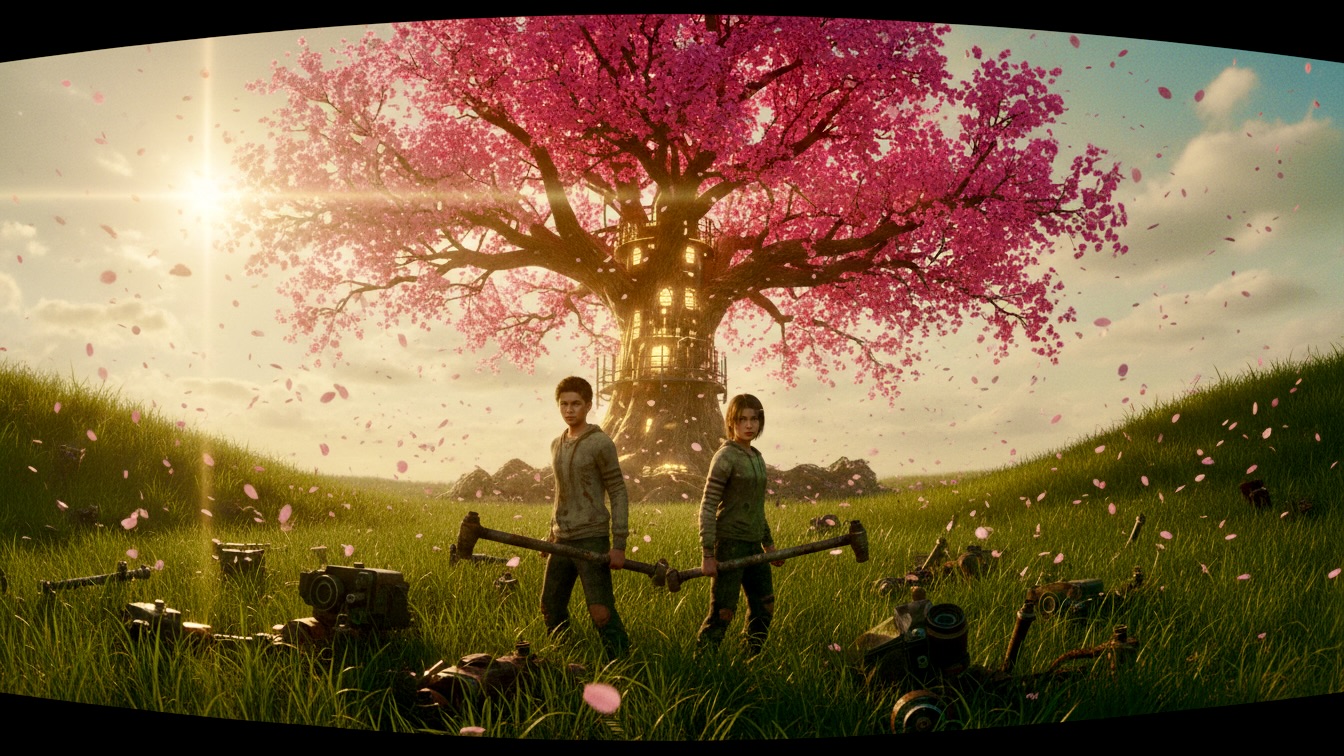
The story follows Tarek and Art, two contestants trapped within a high-stakes, corporate-controlled gauntlet designed for mass entertainment. As Art’s popularity rating plummets into the red zone, triggering an automated deletion protocol, Tarek defies the programmed narrative of the show. Instead of abandoning his friend to secure his own survival, he weaponizes the environment, using a piece of rusted rebar to destroy a broadcast drone. This act of defiance escalates into a full-scale rebellion against the arena’s infrastructure, as the pair decides to dismantle the central tower that governs the simulation. By sabotaging the broadcast system, they successfully force a system-wide shutdown, leaving the arena in darkness and signaling a desperate, uncertain end to their participation in the deadly game.
The narrative serves as a scathing critique of performative suffering and the commodification of human experience. The "Spring Equinox Gauntlet" functions as a metaphor for a society that values engagement metrics over human life, where beauty and tragedy are engineered for the consumption of an unseen, privileged audience. By juxtaposing the "sickeningly sweet" aesthetic of the environment with the brutal reality of the deletion protocols, the author highlights the dissonance between corporate branding and the violent reality of the lower-ring sectors.
Furthermore, the story explores the concept of agency within a deterministic system. The characters are initially puppets of an algorithm that dictates their emotional responses and social value. Tarek’s decision to commit "assault on broadcast property" is a rejection of the binary choice between becoming a winner through betrayal or being erased as a failure. This transition from passive contestant to active insurgent suggests that true freedom requires the destruction of the systems that define one's worth through quantitative data.
Tarek is a man defined by a shift from conditioned survivalism to radical, conscious rage. Initially, he operates within the parameters of the game, relying on his high viewership numbers and the hope of personal advancement. However, his loyalty to Art acts as the catalyst for his psychological awakening. His internal conflict is palpable; he recognizes the potential for his own success but finds the cost of that success—the erasure of his friend—to be morally repugnant. When he finally chooses to rebel, his rage is not merely an emotional outburst but a calculated rejection of the dehumanizing logic of the arena.
Art represents the victim of the system’s cruelty, initially paralyzed by the resignation that comes with being labeled "dead air." She possesses a keen understanding of the rules, which serves both as a source of her despair and, eventually, a tool for their insurrection. Her transformation from a broken, defeated contestant to a tactical partner illustrates her resilience. By the time they reach the central tower, she has regained her sense of self, replacing the fear of deletion with a defiant determination to sabotage the very mechanism that sought to discard her.
The pacing of the narrative is relentless, mirroring the frantic urgency of the characters' escape. The author utilizes a high-octane, visceral prose style that emphasizes physical exhaustion and the sensory overload of the arena. By focusing on the contrast between the synthetic environment—the "genetically modified oak" and "fake pollen"—and the raw, cold weight of the iron rebar, the narrative grounds the reader in the tactile reality of the characters' rebellion.
The tone is one of claustrophobic tension that gradually expands into a spirit of chaotic liberation. The first-person perspective keeps the reader confined to Tarek’s immediate experience, effectively conveying his confusion, pain, and eventual clarity. The sensory details, such as the smell of battery acid and the sound of mechanical shrieks, ensure that the stakes feel immediate and lethal. This stylistic choice effectively strips away the polished veneer of the broadcast, revealing the gritty, mechanical guts of the system underneath.


