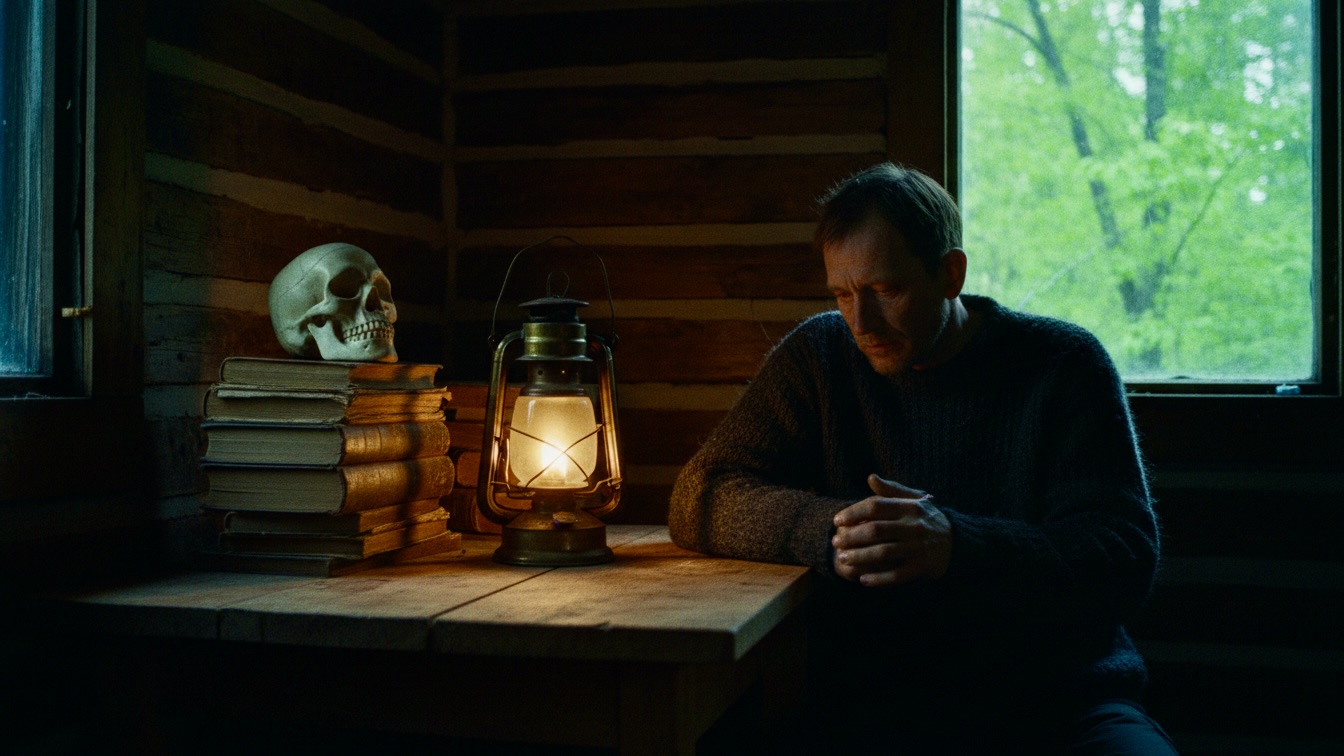
The story follows Simon Tanner, a struggling digital influencer who has moved to a remote cabin in Kenora, Ontario, to rebrand himself as a "New Gothic" storyteller. Simon meticulously stages his environment with props like plastic skulls and vape-smoke "fog" to create an atmosphere of supernatural dread for his live-streaming audience. During a broadcast, he discovers large, distorted tracks in the slush outside his cabin and immediately claims they are evidence of a bipedal manifestation of "psychic rot." Even when a local hunter informs him that the tracks belong to a neighbor's elderly labradoodle with a bad hip, Simon doubles down on his narrative to maintain his online engagement and financial hopes.
The tension culminates in a nighttime stream where Simon waits in a kerosene-scented gloom for the "beast" to arrive, fully submerged in his self-created persona. The climax occurs not with a monster, but with the arrival of Brenda, a neighbor who enters the unlocked cabin to retrieve her lost dog, Marshmallow. Brenda’s mundane concerns about her pet and Simon’s health are broadcast live to his audience, effectively shattering his "tortured explorer" facade. The story ends with Simon sitting in the dark, his career likely ruined, staring at his own reflection in a dead phone screen.
The central theme of the narrative is the pervasive conflict between digital artifice and physical reality. Simon views the natural world not as an ecosystem to be respected, but as a backdrop for his personal brand, manipulating light and sound to fit a pre-determined aesthetic. This commodification of the "primeval" highlights a modern obsession with curation over genuine experience. The story suggests that when reality is filtered through a lens for profit, the truth becomes an inconvenient obstacle to be ignored or reframed.
Another prominent theme is the irony of the "urban gaze" upon rural environments. Simon arrives in Kenora with a set of literary expectations, hoping to find a "descent into the void" that mirrors the works of Robert W. Chambers. He interprets the landscape through a Gothic lens because he lacks the practical knowledge to understand the actual environment. This disconnect is exemplified by his refusal to accept the hunter’s logical explanation for the tracks, as he prefers a terrifying lie to a mundane truth.
The story also explores the fragility of identity in the age of social media. Simon’s sense of self is entirely dependent on his "view count" and the comments of strangers, leading him to adopt a "haunted" voice and a "tortured" persona. His psychological stability is tied to a bank account of twelve dollars and forty cents, making his performance a desperate act of survival. When the performance fails, he is left with nothing but the "empty" silence of a reality he never truly inhabited.
Simon Tanner is a man defined by his performative narcissism and a deep-seated fear of mediocrity. He is a psychological study in the "influencer" mindset, where every action is weighed against its potential for algorithmic success. He is not merely lying to his audience; he is actively trying to deceive himself into believing he is a "protagonist of a story that ends in blood." This self-delusion is a defense mechanism against his looming financial failure and the threat of returning to his parents' basement in Mississauga.
His interactions with the world are filtered through a layer of practiced condescension, which he uses to mask his own insecurity. When he dismisses the local hunter as an "NPC," he reveals a profound inability to view other people as complex individuals with their own agency. To Simon, everyone else is a prop or a supporting character in his curated drama. This lack of empathy eventually becomes his downfall, as he fails to account for the simple, unscripted actions of his neighbors.
In the final moments of the story, Simon’s internal world collapses under the weight of the mundane. The presence of Marshmallow the labradoodle is a direct assault on his carefully constructed "New Gothic" identity. He is forced to confront the fact that he is not a "storyteller" or an "artist of the unreal," but a man sitting in a smelly cabin with a leaking lantern. His silence at the end of the text signifies a total loss of narrative control, leaving him alone with the "pale, ridiculous" reality of his own existence.
The narrative style of the story is characterized by a sharp, satirical tone that highlights the absurdity of the protagonist's actions. The author uses a first-person perspective to allow the reader to see the gap between Simon’s grandiose descriptions and the pathetic reality of his surroundings. For example, the description of his "sickly blue" ring light making his skin look like "raw dough" immediately establishes a sense of artificiality. This stylistic choice ensures that the reader remains an observer of Simon’s folly rather than a participant in his manufactured horror.
Sensory details are used effectively to contrast the "aesthetic" Simon wants with the "truth" of the Kenora spring. Simon focuses on the "amber, flickering, and ancient" light of his lantern, while the narrative consistently reminds us of the "smell of kerosene" and the "oily discharge of the melting snow." These grounding details serve as a persistent reminder that nature is messy and uncooperative. The "wet, wheezing sound" of the hunter’s laughter and the "neon-pink leash" of Brenda provide a vivid, colorful intrusion into Simon’s self-imposed monochrome world.
The pacing of the story builds tension through the structure of the live stream, mimicking the "hook" and "engagement" tactics of modern content creators. The transition from the "haunted" woods to the "thud on the porch" creates a genuine sense of anticipation that is expertly deflated by the entrance of Brenda. This bathos—the sudden shift from the sublime to the ridiculous—is the story's primary structural tool. It leaves the reader with a sense of empty silence that mirrors the protagonist’s own hollowed-out career.


