The story opens with Gabe standing in the freezing slush of the Trapper’s Spring Revival, an annual event that serves as a painful reminder of a forty-year land dispute between his family and Chloe’s. Gabe feels the crushing weight of a heritage he cannot afford to maintain, symbolized by a heavy willow crown and a farm on the brink of financial ruin. As the town gathers to watch the snow melt and reveal the legal boundary marker, the tension between the two rival fathers reaches a fever pitch. Gabe and Chloe stand as reluctant participants in a ceremony that feels more like a funeral for their futures than a celebration of spring.
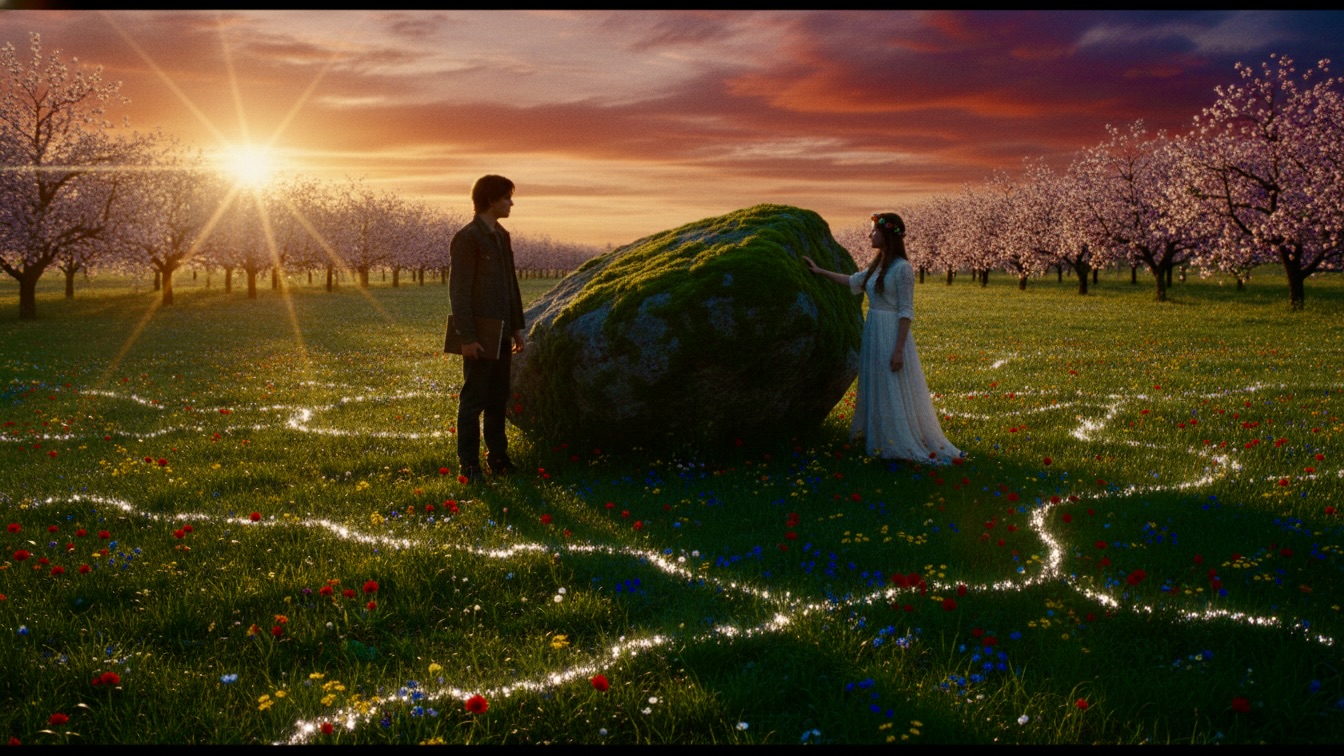
When the snow finally recedes, it reveals a massive Boundary Stone in an unexpected location, releasing a magical, golden pollen that transports Gabe and Chloe into a visionary state. In this altered reality, the land itself demands a performance of the traditional Snowshoe Dance, forcing the two teenagers to work in tandem. As they struggle through the rhythmic, physical demands of the dance, a map of the original 1880s survey appears in the form of glowing wildflowers. This vision reveals that both families have been fighting over land that belongs to neither of them, following a stream that dried up decades ago.
In the heat of this supernatural encounter, Gabe and Chloe finally speak the truths they have suppressed for years. Chloe confesses her desire to leave for the city to become a designer, while Gabe admits his paralyzing fear of being a failure and a traitor to his father. Their mutual honesty triggers a transformation in their ceremonial crowns, causing fresh buds to bloom amidst the dead wood and wheat. They resolve to end the feud by selling the land together and splitting the proceeds, effectively breaking the cycle of generational trauma. Returning to reality, they confront their fathers and the Judge with their newfound clarity, standing united as the first signs of a true spring emerge from the mud.
The central theme of the narrative is the burden of inherited legacy and the psychological toll of generational trauma. Gabe and Chloe are not merely individuals; they are treated as extensions of their fathers' decades-old grudges. The "heritage crowns" they wear are literal representations of this weight, described as scratchy, heavy, and composed of dead materials. The story suggests that when children are forced to carry the unfinished battles of their parents, their own identities become stifled and brittle, much like the old farm equipment held together by duct tape.
Another prominent theme is the conflict between human-made boundaries and the objective truth of nature. For forty years, the two families have engaged in a "civil war" over legal lines and survey maps that the land itself does not recognize. The revelation of the Boundary Stone and the subsequent vision of the dried-up stream highlight the absurdity of human greed. The narrative posits that the land has its own memory and rhythm, which exists independently of deeds and depositions. True "revival" only occurs when the characters stop trying to impose their will on the earth and instead listen to its inherent reality.
Finally, the story explores the theme of personal agency and the courage required to break a cycle. Gabe and Chloe’s decision to "plant the hope rows" for themselves rather than their families is a radical act of rebellion. By choosing to be "accomplices" rather than rivals, they reclaim their futures from the stagnant past. The blooming of the crowns at the moment of their honest confession signifies that growth is only possible when the "ghosts of the parents" are laid to rest. The transition from the red and blue flowers of the feud to a single unified row of green shoots symbolizes the healing power of shared truth.
Gabe is a character defined by intense internal pressure and a sense of entrapment. His physical manifestations of anxiety, such as his clenched jaw and the frantic tapping of his foot, reveal a young man who is psychologically exhausted by a life he never chose. He views himself as a potential traitor, fearing that abandoning the failing farm will render him "nobody." This crisis of identity is rooted in his desire to please a father who is more invested in a legal victory than in his son’s well-being.
Throughout the supernatural experience, Gabe undergoes a profound psychological shift from passivity to assertion. Initially, he tries to lead the dance with the same controlling aggression he learned from his father, but he eventually learns that cooperation is the only way to survive the "waist-deep honey" of the land’s resistance. His admission of fear is his most significant moment of growth, acting as the catalyst for the magical bud on his willow crown. By the end of the chapter, he has found the strength to interrupt his father and reject the false surveys of the past, standing with a newfound lightness of spirit.
Chloe serves as the pragmatic and vocal counterpart to Gabe’s silent suffering. She is more disillusioned with the town’s traditions, viewing the pageant and the "Snowshoe Dance" with a cynicism that masks her deep-seated resentment. Unlike Gabe, who is paralyzed by the fear of being a "nobody," Chloe has a clear vision of who she wants to be: a designer in the city. Her misery stems not from a lack of identity, but from the fact that her identity is being held hostage by a fence line and a college fund spent on legal fees.
Her role in the narrative is to force the confrontation with reality. She is the one who first articulates the desire to leave and the futility of their parents' struggle. When she declares herself "done" with the revival, she provides the emotional opening Gabe needs to voice his own fears. Her transformation is marked by the white flower in her wheat crown, symbolizing a purity of purpose that transcends the muddy conflict of her upbringing. By the story's conclusion, she has evolved from a miserable participant into a steady, authoritative figure who speaks truth to power.
The author employs a rich, sensory-driven style that effectively bridges the gap between gritty realism and the ethereal quality of magical realism. The opening descriptions of soaked leather, cracked boots, and the smell of "wet dogs and pine needles" ground the reader in the unpleasant physical reality of a northern spring. This starkness makes the subsequent shift into the magical realm—characterized by the scent of "ozone and crushed violets" and "vibrant, electric green"—feel more impactful. These sensory contrasts mirror the internal transition the characters experience as they move from the "gray slush" of their lives into a moment of transcendental clarity.
Pacing in the chapter is masterfully handled through the use of rhythmic movement and atmospheric tension. The "countdown" to the snow-melt creates a ticking-clock element that builds suspense, while the description of the dance as a "tactical wrestling match" slows the action down to emphasize the difficulty of change. The author uses the physical environment to reflect the characters' internal states, such as the "static in the brain" Gabe feels as the crowd surges forward. This alignment of internal psychology and external atmosphere ensures that the magical elements feel like a natural extension of the characters' emotional breakthroughs.
The narrative voice is intimate and observant, focusing on small, telling details like the "map of deep-set wrinkles" on Judge Miller’s face or the "duct tape and prayers" holding the farm together. These details provide a sense of history and weariness without the need for extensive backstory. The dialogue is sharp and carries a weight of unspoken history, particularly in the exchange between Gabe and Chloe during the dance. By the end of the chapter, the tone shifts from one of heavy, stagnant despair to a cautious but resilient hope, signaled by the simple image of a single green shoot pushing through the freezing mud.


