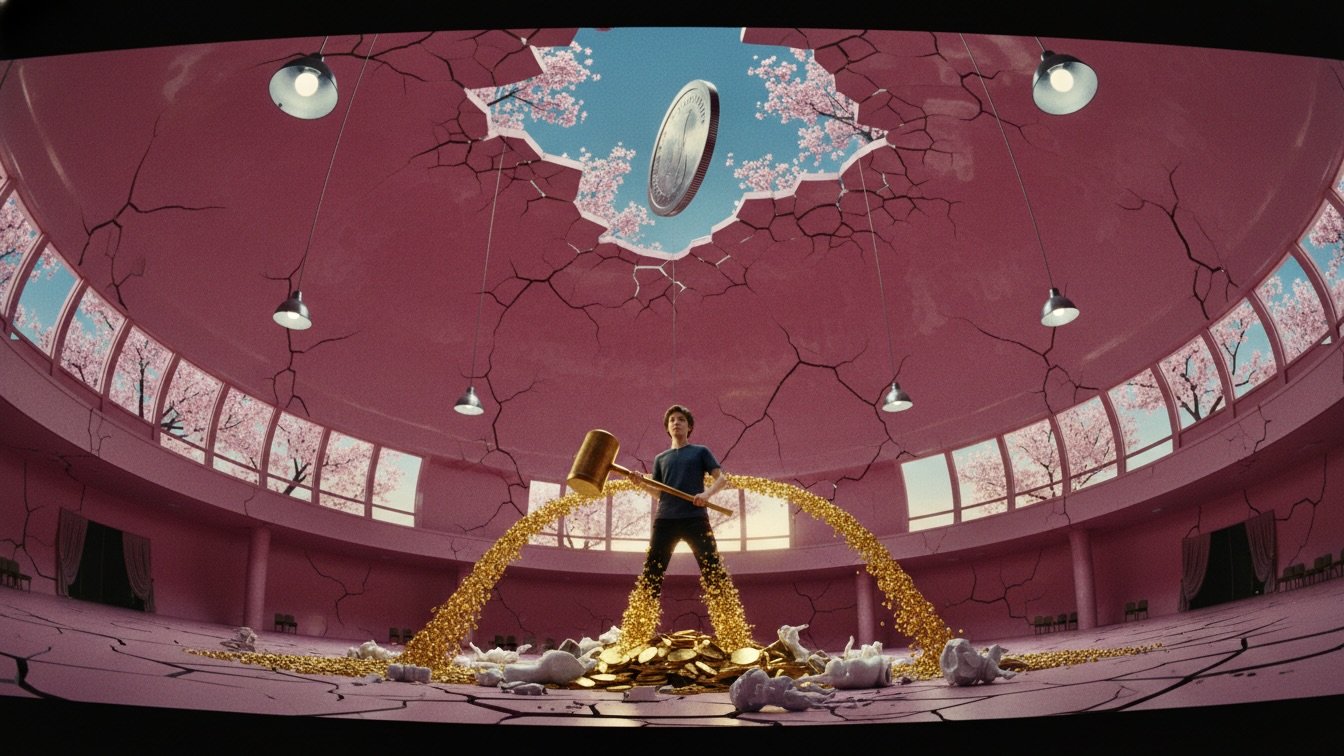
The narrative opens in a surreal, high-stakes gala where the protagonist, Mark, finds himself positioned on a dais as his own biological components are auctioned off to a crowd of shadowed elites. The auctioneer, a literal vulture in a tuxedo, facilitates the sale of Mark’s left kidney for twelve million dollars to a venture capital group. As the sale concludes, Mark experiences a physical and ontological shift, feeling a hollow absence where his organ used to be. His body begins a terrifying transformation, turning into a collection of currency and data; his legs become stacks of quarters that spill as he moves, and his fingernails morph into glowing microchips.
Mark attempts to flee the auction but discovers his former business partner, Leo, consuming his childhood memories in the form of iridescent marbles at an obsidian bar. Leo dismisses Mark’s protests, reminding him that he signed away these parts of his soul in exchange for corporate advancement. The horror escalates when the environment is revealed to be the interior of a giant, pink ceramic piggy bank. A massive, external force begins to shake the structure, tossing the occupants into a chaotic whirlwind of coins and porcelain.
In the midst of the destruction, Mark finds a golden hammer that feels more real than his diminishing body. He chooses to reject the artifice of his surroundings by physically shattering the other guests, who are revealed to be hollow ceramic dolls containing nothing but "Valued Customer" slips. After destroying the vulture and Leo, Mark stands amidst the ruins of his former life. He notices a crack in the piggy bank wall leading to the outside world. He walks toward the exit, leaving a trail of loose change behind him as he seeks a reality that is no longer defined by monetary value.
The central theme of the story is the total commodification of the human experience under the pressures of modern capitalism. Mark is not merely a worker selling his labor; he is a product being liquidated for the benefit of "venture capital groups." The transformation of his body into quarters and microchips serves as a visceral metaphor for how professional life can strip an individual of their humanity, replacing meat and bone with cold, transactional assets. Even his most private internal life—his memories of his father and his sense of humor—is packaged as a luxury hors d'oeuvre for those who have already ascended the corporate ladder.
Another profound theme explored is the inherent artifice of success and the "winning" lifestyle. The gala, despite its expensive ozone and silk-draped silhouettes, is revealed to be a fragile, hollow container. The revelation that the characters are inside a piggy bank suggests that the entire ecosystem of high-end corporate achievement is a childish, contained game played for the benefit of an outside observer. The "god" looking for bus fare represents an indifferent universe where even the most prestigious human lives are reduced to mere pocket change.
The narrative also examines the reclamation of agency through the act of destruction. Mark’s journey from a passive victim on an auction block to a "wrecking ball" with a golden hammer suggests that the only way to escape a dehumanizing system is to break it entirely. By shattering the ceramic dolls that represent his peers and tormentors, he strips away the polite veneer of the gala to reveal the emptiness beneath. His escape is not a return to his old self, but a move toward an uncertain, more authentic existence where the air might finally taste like something other than copper and ozone.
Mark serves as a tragic figure of corporate alienation who begins the story in a state of profound dissociation. He initially perceives his own body as a heavy burden, a physical manifestation of the "existential dread" and "middle-management endurance" he has accumulated over years of labor. His reaction to the auction is one of muted horror and disbelief, indicating a man who has long been disconnected from his own agency. He understands that he is losing parts of himself, yet he is initially too "heavy" and "stiff" to mount a meaningful resistance against the vulture or the bidders.
Psychologically, Mark represents the "burnout" phase of professional life where the self becomes a spreadsheet and the past becomes a commodity. His use of modern slang like "mid" and "fr" suggests a character who is trying to maintain a sense of contemporary identity even as he is being physically dismantled. This linguistic choice highlights the gap between his internal youthful spirit and the rigid, "woven lead" suit of his professional exterior. He is a man who wanted the "corner office" and "stock options," only to realize too late that the cost of entry was his very substance.
Mark’s transformation into a destructive force is his ultimate psychological breakthrough. By picking up the golden hammer, he moves from being an object of trade to a subject of action. He stops trying to argue with the logic of the contract and instead embraces the "cold, hard clarity" of shattering the system that consumed him. While he ends the story physically diminished—leaving a trail of his own currency behind—he achieves a state of spiritual lightness. He chooses the "radioactive" beauty of the real world over the "expensive" safety of the ceramic cage.
The author employs a surrealist tone that blends the mundane with the grotesque to heighten the sense of psychological unease. Descriptions such as the vulture’s feathers being "slicked back with high-end pomade" and a Rolex on a "scaly wrist" create a jarring contrast between animalistic predation and human luxury. This sensory detail anchors the metaphor of the "predatory" businessman in a way that feels both literal and symbolic. The pacing of the story mirrors Mark’s internal state, starting with a slow, suffocating dread and accelerating into a frantic, violent climax as the world begins to tilt and break.
The use of color and light is particularly effective in establishing the narrative's emotional landscape. The "radioactive" pink of the cherry blossoms outside stands in sharp contrast to the "clinical glint" of the gala and the "obsidian" bar. This suggests that reality is overwhelming and threateningly alive, whereas the corporate world is dark, polished, and dead. When the "bubblegum pink" walls of the piggy bank are revealed, the color shifts from a symbol of natural beauty to one of artificial, manufactured confinement. This reversal reinforces the idea that Mark’s environment is a deceptive trap designed to look like a high-end sanctuary.
The narrative voice is intimate yet detached, reflecting Mark’s own sense of being an observer of his own tragedy. The transition from the "perfect, mid-Atlantic English" of the vulture to the "breaking glass" screams of the guests illustrates a breakdown of civilized order. By the end of the chapter, the prose becomes leaner and more focused on physical action, shedding the elaborate metaphors of the auction for the "dull thud" of the hammer. This stylistic shift mirrors Mark’s own journey from a complex, commodified being to a simple, singular man seeking the exit.


