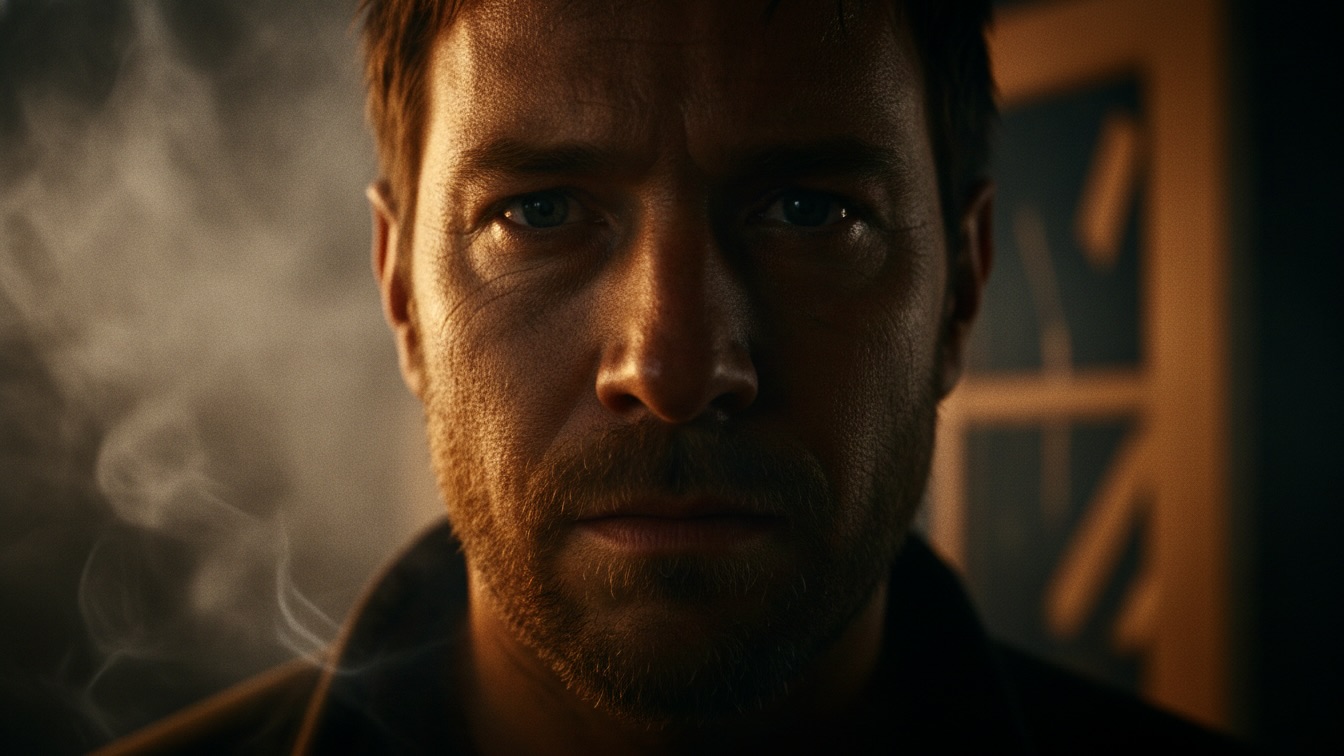
The story follows Mike, a man living in a dystopian, hyper-surveilled city who has spent a decade in self-imposed isolation. His stagnant existence is interrupted when Peter, a young man suffering from the effects of sonic weaponry, collapses at his door seeking refuge. Mike reluctantly lets him in, attempting to mask their heat signatures from the omnipresent Peacekeeper drones. The situation escalates when a Peacekeeper breaches the apartment, forcing Mike into a violent confrontation. After disabling the officer and realizing the cruelty of the state, Mike chooses to abandon his safe, ghost-like existence. He escapes onto the roof with Peter, choosing the risk of a perilous jump over the slow death of continued compliance.
The central theme of the narrative is the dehumanizing nature of a technological surveillance state. The city is portrayed not as a habitat for human beings, but as a system of data points, quotas, and algorithms that prioritize efficiency over life. By framing the world as a place where even a whisper is a potential data leak, the author illustrates how the state forces individuals to retreat into a state of "nothingness" to survive. This forced isolation serves as a metaphor for the erosion of identity under totalitarian control.
Another significant theme is the tension between grief and engagement. Mike’s apartment is a museum of his loss, defined by the missing presence of Chloe and the dust that has settled over his life. The system weaponizes this grief, using artificial intelligence to mimic the voices of the dead to lure targets out of hiding. Mike must ultimately decide if he will remain a prisoner to his memories or accept the dangerous reality of the present. By smashing the phone and choosing to jump, he rejects the state's synthetic version of his past.
The story also explores the loss of agency in a world governed by infrasound and algorithms. The characters are physically and psychologically broken by the system, with Peter literally vibrating from the sonic assault and Mike feeling like he is floating outside his own body. The realization that the Peacekeeper is merely a terrified, exploited youth highlights the cycle of oppression. The system effectively turns the populace against itself, making every citizen both a victim and a potential instrument of the state.
Mike is a man who has spent ten years refining the art of not existing. His psychological state is one of profound dissociation, evidenced by his description of himself as a ghost and his reliance on the rhythm of the power grid rather than his own vitality. He is a survivor who has traded his humanity for safety, keeping his world small and quiet to avoid the notice of the drones. His internal conflict arises when the external world forces its way into his sanctuary, challenging his apathy with a demand for empathy.
His transition from a passive observer to an active rebel is marked by his decision to fight the Peacekeeper. When he sees the face of the young officer, Mike experiences a moment of profound clarity that bridges the gap between his own pain and the suffering of others. He is not motivated by a grand political ideology, but by the raw, visceral realization that he is tired of being a ghost. By the end of the chapter, he has reclaimed his agency, choosing the uncertainty of the sky over the guaranteed suppression of the tenement.
Peter represents the new generation of the oppressed who are still physically and mentally raw from the system’s cruelty. He is frantic, traumatized, and deeply vulnerable, serving as the catalyst that forces Mike to abandon his isolation. His physical state, characterized by tremors and clawed hands, mirrors the internal damage inflicted by the city's sonic weaponry. He is a stark contrast to Mike, possessing a desperate desire to keep living despite the overwhelming odds stacked against him.
The unnamed Peacekeeper serves as a tragic foil to both Mike and Peter. Though he appears as a terrifying, monolithic force of the state, the removal of his helmet reveals a boy who is merely another cog in the machine. He is driven by the same basic human needs as the protagonist, such as the desire to support his sister, yet he is trapped in a system that demands his total compliance. His defeat by Mike is not just a tactical victory, but a symbolic stripping away of the state's mask, revealing the fragile, scared humanity hidden beneath the armor.
The author utilizes a sharp, sensory-heavy prose style that mirrors the mechanical and cold environment of the city. Descriptions of the apartment as a place of "safe nothingness" and the comparison of the city to a motherboard establish a consistent tone of claustrophobia. The pacing is deliberate, oscillating between the suffocating quiet of the apartment and the explosive, adrenaline-fueled moments of the breach. This rhythm effectively keeps the reader in a state of high tension, reflecting Mike’s own cognitive static.
The narrative voice is detached yet observant, perfectly suited to a protagonist who has spent years distancing himself from his own emotions. By focusing on tactile details, such as the cold weight of the wrench or the crinkling sound of the emergency blanket, the author anchors the abstract horror of the surveillance state in physical reality. These sensory anchors make the eventual moment of human connection—when Mike sees the kid under the helmet—all the more impactful, as it contrasts sharply with the metallic, sterile descriptions that precede it.
The use of dialogue is sparse and utilitarian, reflecting a world where words are dangerous liabilities. The interplay between the characters is defined by what is left unsaid, emphasizing the constant threat of the algorithm. By concluding the chapter with a literal and metaphorical leap into the dark, the author maintains a momentum that suggests a shift from the static, ghost-like existence of the beginning to a future defined by chaotic, unpredictable resistance.


