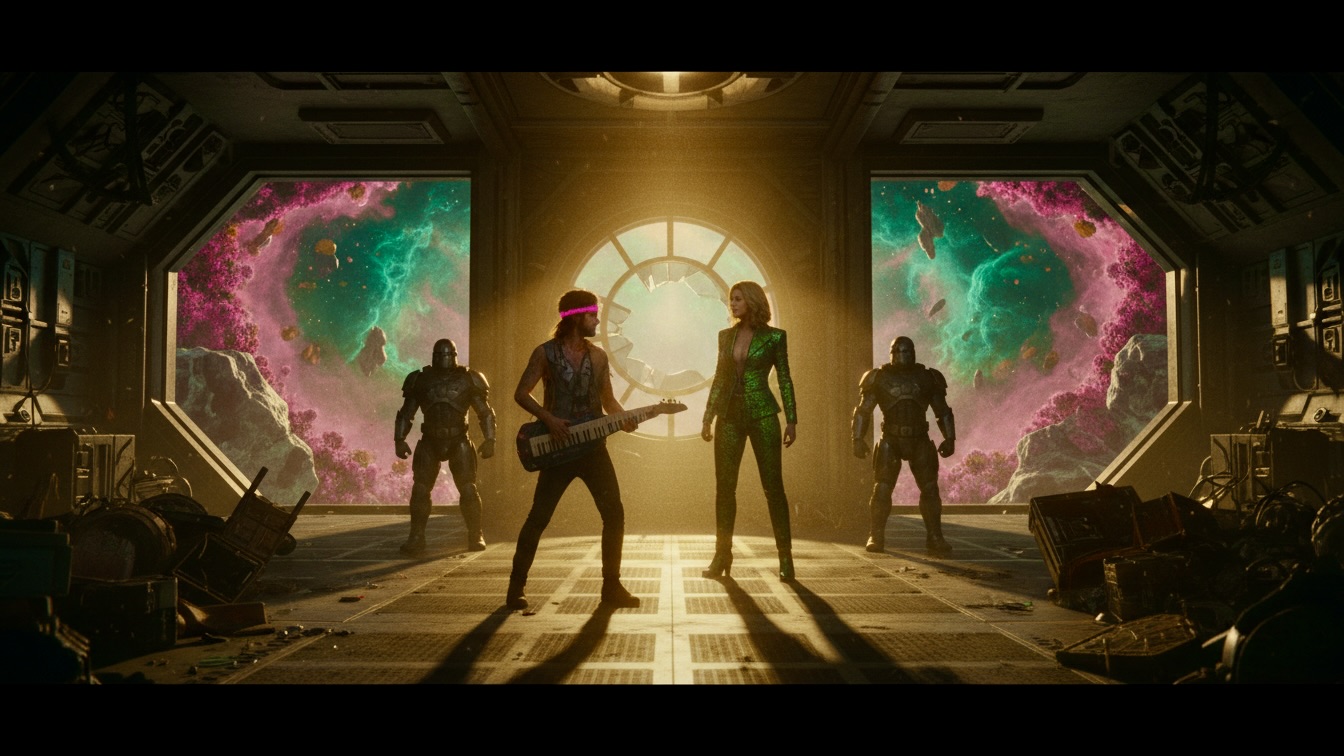
The story follows Pete, a disillusioned trash hauler aboard the SS Dumper, who is far more invested in his aspirations of Martian pop stardom than his actual duties. While practicing a trendy dance routine called the "Solar Flare," Pete accidentally strikes a lever that jettisons his ship's high-value cargo and its primary fuel supply. This catastrophic error leaves him drifting helplessly in an asteroid belt, where he is quickly intercepted by a pirate vessel commanded by the formidable Captain Kwan.
Faced with the threat of death or abandonment, Pete attempts a desperate gambit by offering his music as a form of tribute. He performs a live rendition of his song "Nebula Nights" for the pirate crew, hoping his artistic passion will outweigh his lack of tangible goods. To his surprise, Kwan finds his performance "interesting" enough to offer him a job. Instead of hauling trash, Pete is recruited to serve as a theatrical distraction during the pirates' future heists, leading him to abandon his old life for a dangerous new career in the stars.
A primary theme of the narrative is the conflict between utilitarian labor and the pursuit of personal identity. Pete exists in a world defined by "other people's leftovers," where his value is measured in tons of scrap iron and the preservation of fusion cores. His neon pink headband and synth-heavy music represent a psychological rebellion against this drab, mechanical existence. By choosing to dance instead of pilot, he prioritizes his internal self over his external responsibilities, suggesting that art is a necessary escape from the crushing weight of a mundane life.
The story also explores the subjective nature of value within a cold and uncaring universe. To the company, Pete’s value is tied to the cargo he carries, but to Captain Kwan, his value lies in his ability to be "interesting." The fusion cores are a liability and a source of stress, whereas Pete’s "catchy" music offers a different kind of currency: the power of distraction and novelty. This shift in perspective highlights how human creativity, even when it is "terrible," can be more precious than industrial hardware in a galaxy starved for genuine entertainment.
Finally, the narrative touches upon the theme of radical reinvention through failure. Pete’s "oops" moment is the catalyst for his liberation from a job he hates. His incompetence as a trash hauler is exactly what facilitates his entry into a world of adventure and performance. The story posits that sometimes, the total collapse of one's professional life is the only way to break free from a soul-crushing routine. Pete does not find success through hard work, but through a spectacular mistake that forces him to embrace his true, albeit absurd, calling.
Pete is a classic dreamer struggling with a profound sense of environmental displacement. He views his surroundings—the "dirty potatoes" of the asteroids and the "wet dog" smell of the cockpit—with a mixture of disdain and detachment. This psychological distancing allows him to maintain his sanity, but it also leads to the negligence that causes his ship's cargo ejection. He is a man who defines himself not by what he does, but by the person he imagines himself to be on a Martian stage.
His decision to perform for the pirates reveals a core of desperate courage hidden beneath his superficial vanity. When he sings, he is not merely trying to save his life; he is attempting to validate his existence. The sweat and the missed notes during his performance show a character who is vulnerable and raw, moving past his "visualizing" phase into a moment of true action. He chooses the uncertainty of a pirate’s life over the safety of his "steady paycheck" because he craves a stage, no matter how crooked it might be.
V-9 serves as the pragmatic, cynical foil to Pete’s whimsical nature. As a robot, he is literally built for the utility that Pete rejects, and his constant reminders about tonnages and deadlines represent the reality Pete tries to ignore. He possesses a dry, sardonic wit that suggests a high level of artificial intelligence, allowing him to judge Pete’s artistic efforts with biting accuracy. Despite his criticisms, he remains a loyal companion, quickly adapting his own "eye-light" capabilities to fit Pete’s new career path.
Psychologically, V-9 represents the survival instinct that Pete lacks. He is the one who calculates the odds and identifies the "black market" value of his own parts, showing a grim awareness of their precarious situation. However, his quick transition to becoming a "light technician" suggests that even a machine can find a sense of purpose in a more "interesting" environment. He provides the necessary grounding for Pete, ensuring that while the pilot’s head is in the clouds, someone is still watching the sensors.
Captain Kwan is an opportunistic leader who values strategic novelty over traditional loot. She is introduced as a figure of menace, but she quickly reveals herself to be a weary professional who is tired of the "nightmare" of pirate logistics. Her scar and her "shiny green scales" jacket mark her as a veteran of the outer rims, yet she possesses the aesthetic sensibility to recognize the hook in a catchy song. She is a pragmatist who understands that a good distraction is often more effective than a heavy blaster.
Her decision to hire Pete is a calculated risk. She does not see him as a great artist, but as a functional tool for her trade. By calling him "terrible" but "interesting," she strips away his delusions of grandeur while offering him the one thing he wants most: an audience. Kwan represents the harsh reality of the entertainment industry, where talent is often secondary to how well one can serve a specific, often predatory, purpose. She provides Pete with a path forward, but it is one that requires him to be a "distraction" rather than a star.
The pacing of the story is brisk and kinetic, mirroring the frantic energy of a pop song. The narrative moves quickly from the quiet, smelly confines of the cockpit to the high-stakes confrontation in the cargo hold. This rapid progression prevents the reader from dwelling too long on the absurdity of the situation, instead sweeping them along with Pete’s own impulsive decision-making. The transition from the "thunk" of the cargo release to the arrival of the pirates creates a sense of escalating tension that is resolved through the unexpected medium of a dance-off.
Sensory details are used effectively to establish a vivid, if unpleasant, atmosphere. The author contrasts the "fake smell of cut grass" with the "wet dog" odor of the ship, creating a visceral sense of Pete’s daily misery. The visual imagery of the "dirty potatoes" in a "dark soup" reinforces the theme of the mundane versus the magical. These gritty details make Pete’s neon headband and the "bloop-bloop-whirr" of the synth music stand out even more sharply, emphasizing the clash between his reality and his dreams.
The tone of the story is a blend of sardonic humor and genuine pathos. The dialogue, particularly the banter between Pete and V-9, provides a comedic layer that softens the life-or-death stakes of the pirate encounter. However, the description of Pete’s performance—his "shaky" voice and his "chest heaving"—adds a layer of sincerity to the narrative. The author successfully balances the ridiculousness of a "pirate singer" with the very human desire to be seen and appreciated for something more than the trash one hauls.


