The narrative begins in the heart of a chaotic urban protest, where an elderly man named Lex is meticulously planting bioluminescent moss in the cracks of a library wall. He is accompanied by Gera, a young social media streamer who is documenting the surrounding riot for her digital audience. As the conflict between protesters and police intensifies, Lex remains focused on his botanical mission, viewing the environmental degradation caused by urban development and tear gas as the true tragedy of the evening.
To escape a cloud of tear gas, the pair seeks refuge in a dry Victorian fountain before Lex reveals his primary objective: infiltrating the Sterling Building to rescue a rare Sun-Sleeper lily. This building is slated for demolition at dawn, and Lex is determined to save this piece of biological history from being buried under rubble. Despite the danger of surveillance drones and the physical toll of climbing thirty flights of stairs, he persists in his quest to preserve life amidst the city's destruction.
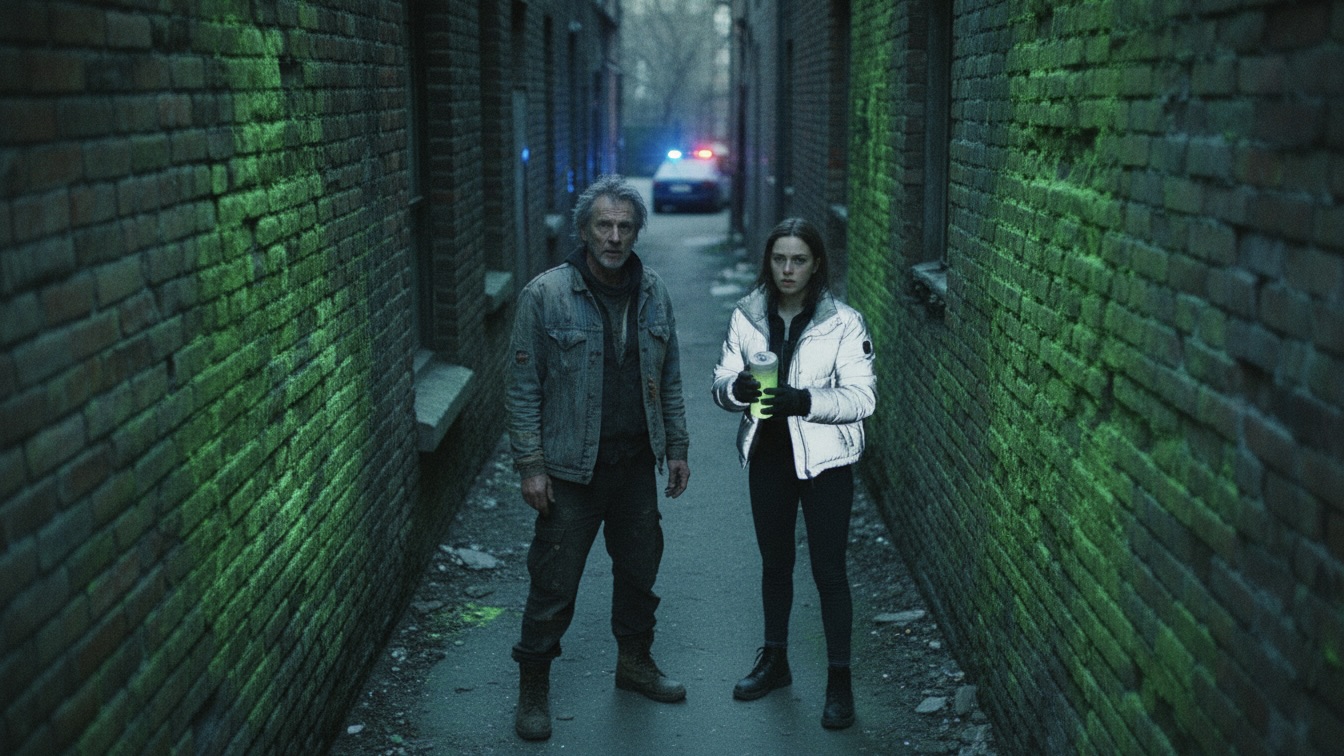
After a tense confrontation with a security drone, which Lex disables using a customized seed-launcher, he successfully retrieves the lily. The story concludes in a quiet alleyway where Lex creates a glowing sanctuary of moss before entrusting the lily to Gera. He chooses to stay behind and face the approaching police, viewing his arrest as a final performance in his lifelong pursuit of botanical rebellion.
The central theme of the story is the conflict between organic resilience and artificial imposition. Lex views the city's expansion, specifically the high-speed rail project, not as progress but as a "cold" assault on the natural world. His act of planting moss is described as a "correction," suggesting that nature is the original state of being that the city has erroneously overwritten with concrete and steel.
Another prominent theme is the juxtaposition of the digital ephemeral against the biological eternal. Gera represents the modern obsession with "optics" and the viral moment, where reality is only valuable if it can be captured and broadcasted. In contrast, Lex focuses on the survival of the Sun-Sleeper lily, a physical entity that requires tangible care and carries historical weight. This tension highlights a generational divide in how value is perceived and preserved in a crumbling society.
The narrative also explores rebellion as an act of creation rather than destruction. While the protesters respond to displacement with fire and shattered glass, Lex engages in "botanical insurgency." He believes that focusing solely on the "fire" of conflict causes one to forget what is worth saving. His rebellion is quiet, green, and generative, providing a psychological counterpoint to the loud, destructive anger of the masses.
Finally, the story touches on the theme of legacy and the defiance of mortality. Lex, at fifty-four, is acutely aware of his physical limitations, yet he finds purpose in ensuring that something smaller and more fragile than himself survives. His willingness to be arrested at the end suggests that his personal freedom is secondary to the survival of the lily and the memory of the "sanctuary" he created in the alley.
Lex is a complex figure who functions as both a romantic and a radical. Psychologically, he appears to be driven by a deep-seated need to exert agency over an environment he perceives as hostile and sterile. His "theatrical flair" suggests a man who has long felt ignored by the systems of power, leading him to adopt the persona of a "botanical insurgent" to validate his existence. He finds solace in the slow, predictable growth of plants, which offers him a sense of control that the chaotic political landscape of the city cannot.
His physical struggle during the climb up the Sterling Building reveals a stubborn refusal to succumb to the limitations of age. He views his potential death not as a tragedy, but as a "noble end" if it occurs in the service of life. This indicates a martyr complex rooted in a profound love for the natural world. He is a man who has traded social conformity for a dirt-stained thumb, finding more kinship with a "stubborn" clump of moss than with his fellow citizens.
Gera serves as the psychological foil to Lex, initially characterized by a frantic, artificial energy. Her identity is inextricably linked to her digital persona, and she perceives the world through the lens of how it will be viewed by "chat." This suggests a level of dissociation where her immediate physical reality is less important than the digital narrative she constructs. She represents the anxiety of a generation that feels the need to document everything to prove its significance.
However, as the night progresses, Gera undergoes a subtle transformation. When she encounters the Sun-Sleeper lily and later the glowing alleyway, she lowers her camera and experiences a moment of genuine, unmediated awe. This shift indicates a latent desire for authentic connection that has been buried under her "silver plastic" jacket and gimbal-mounted camera. By accepting the lily at the end, she inherits Lex’s mission, suggesting a bridge has been formed between her digital world and his biological one.
The pacing of the story is masterfully handled, alternating between moments of quiet, sensory-focused reflection and high-stakes action. The opening scene is slow and tactile, focusing on the cold brick and damp mud, which establishes Lex’s grounded perspective. This is quickly interrupted by the "roar of the crowd" and the "sharp crack" of canisters, propelling the reader into the urgency of the riot. This rhythmic shifting keeps the reader engaged while allowing for thematic depth.
The author makes excellent use of sensory details to create a vivid, atmospheric setting. The contrast between the "sickly grey smudge" of the city and the "spilled neon" of the bioluminescent moss creates a strong visual motif for the story's core conflict. Smells are particularly evocative, such as the "acrid" and "chemical" scent of tear gas clashing with the implied freshness of the garden. These details ground the more fantastical elements of the story, like the high-frequency seed-launcher, in a recognizable reality.
The narrative voice is third-person limited, primarily filtered through Lex’s cynical yet poetic worldview. This allows for a sophisticated tone that balances weary observation with a sense of wonder. The language used to describe the city is often mechanical or predatory—drones are "mechanical hornets" and the city is a "wounded animal"—which reinforces Lex’s psychological alienation from urban life. This stylistic choice ensures that the reader perceives the environment exactly as the protagonist does: as something that needs to be healed.
The ending provides a powerful tonal shift from the frantic escape to a serene, almost religious conclusion. The description of the alleyway becoming a "cathedral of green" elevates Lex’s work from simple gardening to a spiritual act. The final image of Lex stepping toward the blue lights of the police cruiser provides a poignant resolution. It reinforces the idea that while the man can be captured, the "sanctuary" he created remains a luminous, living testament to his defiance.


