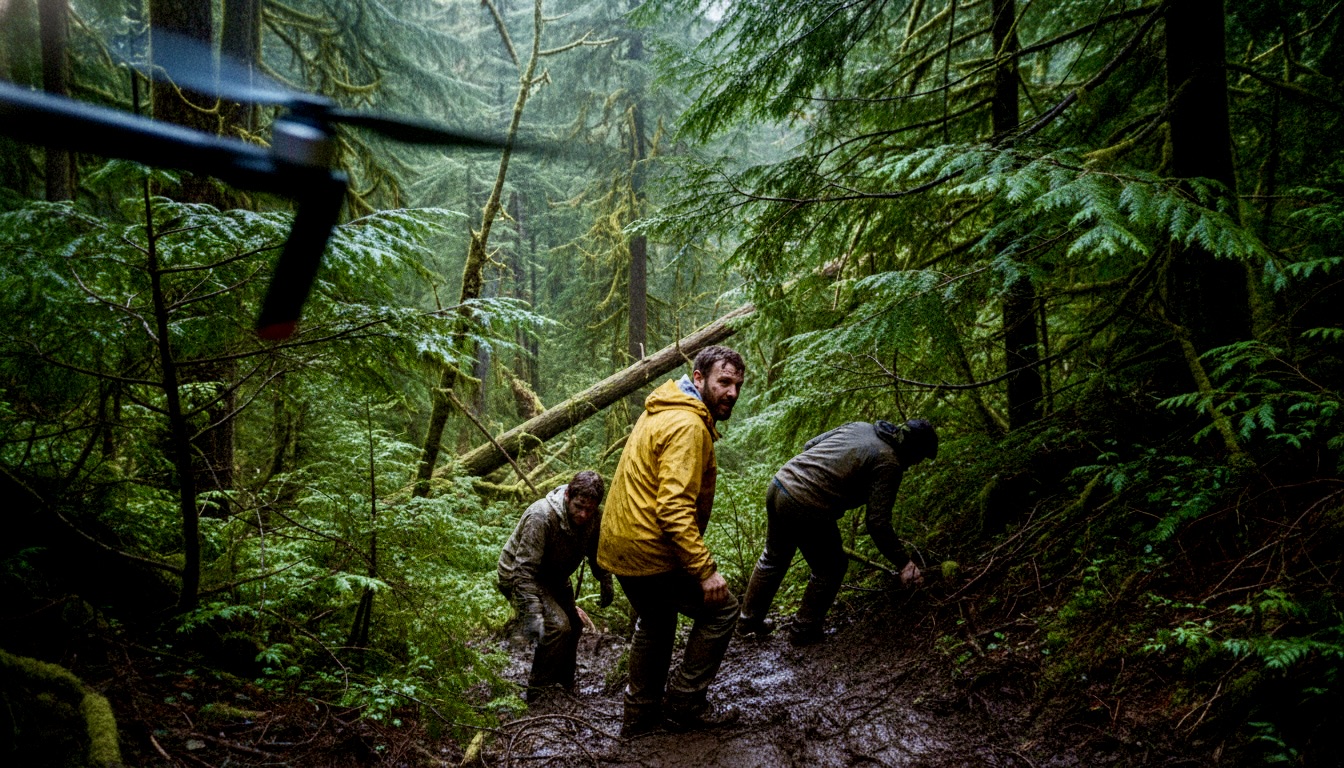
The story follows Gage, Sarah, and her brother David as they attempt a desperate flight through a rain-slicked gorge while being hunted by an unknown, technologically advanced group. David is suffering from severe hypothermia, forcing Gage to adopt a brutal, pragmatic approach to keep the group moving toward a distant logging road. Throughout the journey, they are tracked by small, consumer-grade drones that serve as the eyes for a ground-based extraction team. After reaching the ridge, the trio is cornered by hunters in a modified truck, leading to a split-second decision to hide the corporate data they are carrying. Gage eventually sacrifices himself by drawing the pursuers away, only to find himself trapped on a crumbling cliff edge as the unstable earth gives way beneath him.
The narrative explores the intersection of human endurance and the cold, unfeeling nature of modern surveillance. The drones act as a persistent, mechanical judgment that strips the characters of their privacy and forces them into a state of constant, high-stakes navigation. This environment transforms the wilderness from a place of refuge into a trap, where the very terrain—mud, rock, and thorns—becomes an active antagonist.
Another core theme is the psychological cost of survival and the necessity of suffering as a grounding force. Gage perceives his own pain as a tether to reality, using it to combat the numbness of his withdrawal and the apathy brought on by the grueling conditions. The contrast between David’s physical surrender and Gage’s militant focus highlights how trauma and exhaustion test the limits of individual will. The story posits that survival is not merely a physical act but a psychological battle against the urge to quit.
Gage is a man defined by a recent, arduous transition toward sobriety, which informs his hyper-vigilance and his disdain for weakness. He views his own physiological cravings as a secondary enemy, constantly battling the desire for chemical numbness while maintaining a hardened exterior to protect his companions. His leadership style is abrasive and unsympathetic because he believes that empathy is a luxury they cannot afford. By framing pain as information, he demonstrates a stoic detachment that allows him to remain functional in the face of near-certain death.
Sarah serves as the emotional anchor of the group, balancing a desperate, protective instinct for her brother with an evolving capacity for violence. While she initially appears overwhelmed by the harsh reality of their escape, her transformation into a hardened participant is marked by her willingness to manipulate David’s resolve. She experiences a profound shift from panic to cold determination, showing that she is capable of enduring the same brutal conditions as Gage. Her resilience is not born of stoicism but of a fierce, protective love that she eventually weaponizes to save her brother.
David represents the vulnerability of the uninitiated, having lived a life removed from the visceral dangers of the physical world. His hypothermia is more than a medical condition; it is a symbolic surrender of his identity as he loses the ability to fight back against the elements. Throughout the ordeal, he remains a catalyst for the others, forcing Gage and Sarah to operate at their peak capacity to keep him alive. His transformation from a capable person into a burden underscores the cruelty of the situation and the high price of the secrets he carries.
The author employs a clipped, urgent prose style that mirrors the characters' frantic pace. Short, staccato sentences create a sense of claustrophobia, effectively placing the reader inside the dense, dripping woods alongside the trio. The sensory details—the smell of river water and fear, the sting of devil’s club, and the metallic buzz of the drones—anchor the high-tension plot in a tangible reality.
The tone is relentlessly grim and focused, eschewing sentimentality in favor of survivalist pragmatism. By shifting between the immediate physical threats and Gage’s internal struggle with his past, the narrative maintains a high level of tension. The use of the red light on the drone as a recurring, judgmental motif provides a cohesive visual thread that ties the mechanical, indifferent pursuit to the characters' deteriorating physical states.


