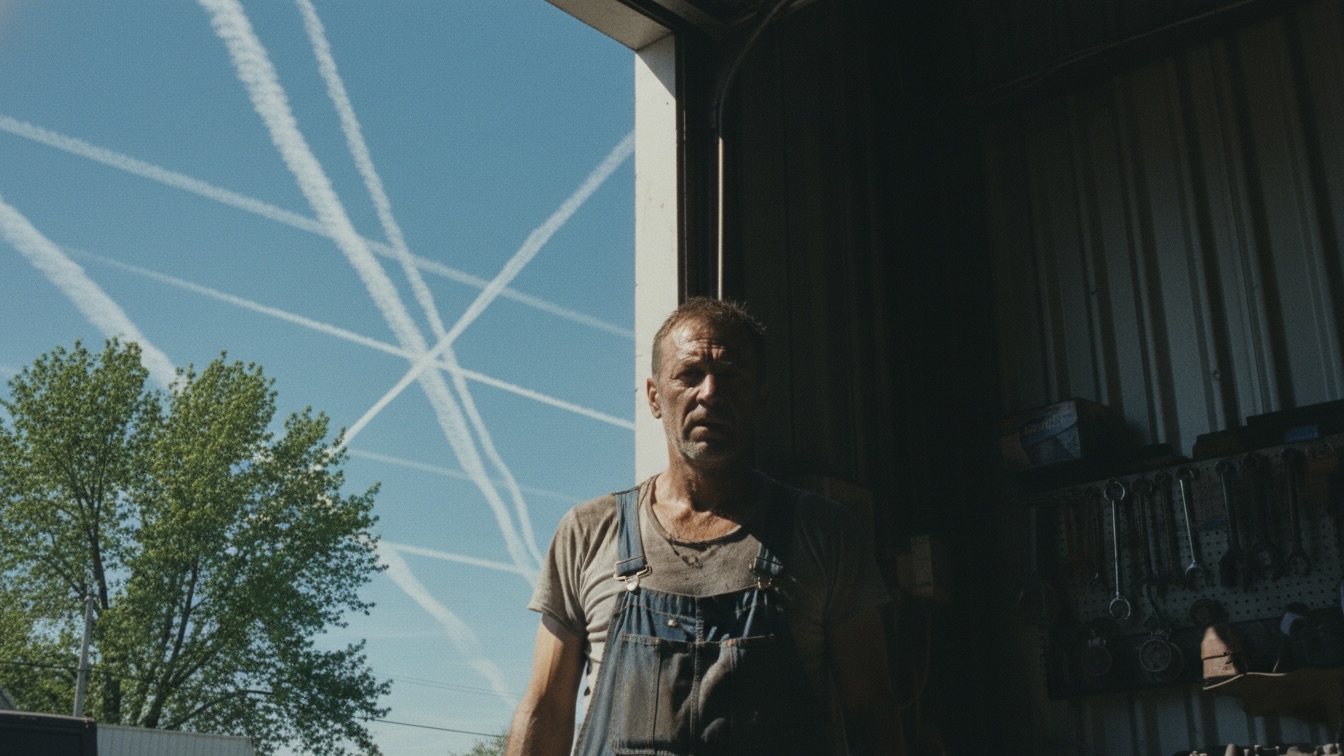
In the decaying border town of Oakhaven, a mechanic named Viktor and his eleven-year-old son, Mika, witness the atmospheric signs of an impending disaster. While the government dismisses the strange lights and ozone smells as seasonal storms, Viktor recognizes them as the byproduct of high-voltage energy tests from nearby military silos. The arrival of Officer Kiran, a representative of the oppressive magistrate, brings a damaged armored vehicle to Viktor for immediate, secretive repair.
During the repair process, Viktor discovers a hidden map revealing that Oakhaven has been designated as a "discharge exclusion zone." The town is not merely near the tests; it is the intended ground for bleeding off excess electrical voltage to protect the capital's power grid. Realizing they have been marked for death, Viktor sabotages the officer's vehicle and instructs Mika to gather their survival gear. As the first lethal energy strikes hit the town, Viktor and Mika flee toward the mountains, leaving behind the burning remains of their home.
One of the central themes explored in this text is the cold utilitarianism of a technocratic state. The magistrate views the residents of Oakhaven not as citizens, but as insulation for the more valuable assets in the capital. This hierarchy of human worth is physically manifested in the map Viktor finds, where his entire community is shaded in a crimson "red zone" with no routes for evacuation. The story suggests that in a world driven by industrial necessity, the marginalized are often used as literal grounding rods for the mistakes and excesses of the elite.
The relationship between fatherhood and survival also serves as a primary thematic pillar. Viktor attempts to shield Mika from the harshness of their reality by framing their existence around "the work," which he claims is the only thing that remains true. However, the transition from this stoic philosophy to the desperate reality of "The Great Escape" shows the limits of parental protection in a collapsing world. Viktor must eventually trade his quiet lies for the brutal truth to ensure his son's physical safety, illustrating the painful evolution of a father's role during a crisis.
Finally, the narrative touches upon the corruption of the natural world through human interference. The birds flying in the wrong direction and the sky taking on the hue of a "bruised peach" or a "short-circuit" indicate that nature has been knocked off its axis by the energy discharges. The environment is no longer a backdrop for human life but has become a volatile antagonist. This theme highlights the terrifying consequences when technological advancement outpaces ethical consideration, leading to an atmosphere that feels like a "live wire" ready to snap.
Viktor is a man defined by the grit under his fingernails and a profound, weary intelligence. He possesses a psychological resilience built through decades of manual labor, which he uses as a shield against the encroaching dread of his environment. His primary motivation is the preservation of his son, a goal that forces him to maintain a "theatrical calm" even as he realizes his world is about to be incinerated. He is a pragmatist who understands the mechanics of both machines and power, knowing exactly how to manipulate a cooling line to disable a vehicle or how to lie to an officer to buy time.
Psychologically, Viktor operates through compartmentalization, focusing on the "bolts" and "gaskets" to avoid being overwhelmed by the scale of the magistrate’s betrayal. When he finds the map, his internal shift from a passive observer to an active saboteur is instantaneous, showing a hidden capacity for rebellion. He does not seek to be a hero, but his love for Mika transforms him into a tactical operative. He is a man who has lost faith in the world's "magnetic pull," choosing instead to trust in his own hands and the heavy tools of his trade.
Mika represents the loss of innocence in a world that demands premature maturity. At only eleven years old, he displays a focus that is "too intense" for his age, suggesting that he has already been shaped by the anxiety of his surroundings. He looks to his father for stability, yet he is perceptive enough to recognize that their "games" of escape are becoming a reality. His discovery of the pipe wrench indicates a subconscious readiness to fight, even if his voice still trembles with the fear of a child.
His psychological state is one of quiet observation and deep-seated loyalty. He mirrors his father’s stoicism, polishing metal as a way to anchor himself while the sky turns violet. Despite his fear, Mika is capable of quick action, as seen when he prepares the bug-out bag without hesitation. He is the emotional heart of the story, acting as the catalyst for Viktor’s defiance against the state. His questions about the car and the map show a mind trying to reconcile the safety of his father's garage with the lethal reality of the world outside.
Officer Kiran serves as the personification of the magistrate’s arrogance and detachment. He is described as looking like a recruitment video, a stark contrast to the "grease pit" of Oakhaven, which emphasizes his disconnect from the people he supposedly serves. He views Viktor as a mere extension of the machinery he repairs, demanding "absolute discretion" and "silence" without regard for the mechanic's humanity. His psychology is rooted in a sense of superiority that makes him blind to the very real danger Viktor poses to his mission.
Kiran's behavior is characterized by a theatrical weight and a physical aversion to his surroundings, as if he is afraid to touch the dust of the border town. This detachment is his fatal flaw; he is so focused on his "directive" and his "handheld device" that he fails to notice the sabotage happening right beneath him. He represents the bureaucratic machine—polished, demanding, and ultimately hollow. His departure in a vehicle that is "melting its own brain" is a fitting metaphor for the self-destructive nature of the regime he represents.
The pacing of the chapter is masterful, beginning with a slow, atmospheric dread that gradually tightens into a high-stakes escape. The initial descriptions of the "jagged and desperate" birds set a tone of unease, which is then amplified by the arrival of the Aegis-class vehicle. The discovery of the map acts as the narrative's fulcrum, shifting the energy from a quiet character study into a frantic race against the clock. This acceleration mirrors the "hum" of the atmosphere, building in frequency until the final, explosive climax.
Sensory details are used with surgical precision to ground the reader in the industrial rot of Oakhaven. The author frequently employs metallic and chemical imagery, such as the smell of "hot copper" and "burnt rubber," to create a visceral experience of the setting. These descriptions make the air itself feel heavy and "suffocating," reflecting the characters' psychological state. The use of color is also significant, with the shifting hues of the sky—from "bruised peach" to "violet" to the "color of a short-circuit"—providing a visual countdown to the disaster.
The narrative voice is stoic yet deeply evocative, echoing Viktor’s own personality. It avoids flowery language in favor of sharp, punchy sentences that feel like the impact of a mallet. The dialogue is sparse and loaded with subtext, particularly in the exchanges between Viktor and Kiran, where every word is a calculated move in a deadly game. This stylistic choice reinforces the themes of silence and survival, making the moments of actual violence, like the "boom" that shatters the windows, feel all the more jarring and significant.


