The temperature plummeted fifteen degrees in a single second, shattering two centuries of unbroken, manufactured summer.
Jared wedged the titanium spanner between the tertiary grating and the main exhaust port of Vent 88. The friction of metal on metal shrieked through the narrow service corridor. He leaned his entire body weight against the handle. Nothing gave. The perpetual, seventy-eight-degree heat of Neo-Denver pressed against his skin, slicking his coveralls to his shoulder blades. The city had maintained this exact temperature for two hundred and fourteen years. It was a stagnant, unyielding warmth that crept into the joints and stayed there.
He wiped a streak of industrial grease from his forehead using the back of his wrist. The digital readout on his bracer flickered, displaying the ambient humidity. Sixty percent. Always sixty percent. The environmental consistency was supposed to be a triumph of human engineering. To Jared, it felt like living inside a lung.
He readjusted his grip on the spanner. He planted his boots against the corrugated steel wall. He pulled. The bolt gave a fraction of an inch. A microscopic victory in a city defined by rigid, unbreakable systems. He let out a harsh breath, the sound swallowed by the low, omnipresent drone of the climate-control turbines spinning three levels below. He reached into his utility belt for a sonic driver, intending to blast the rusted threads of the bolt into submission.
Then, the turbines stopped.
It was not a gradual deceleration. It was an instant, violent cessation of sound. The silence hit Jared's eardrums with the force of a physical blow. He froze, his hand still hovering over the sonic driver. The vibration beneath his boots vanished. The structural hum of the dome ceased.
Before he could process the mechanical failure, the temperature plummeted.
It was a sudden, violent drop. From seventy-eight degrees to sixty-three degrees in the span of a single heartbeat. The shift was so aggressive that Jared gasped, his lungs constricting in shock. The air suddenly felt jagged. It lost the humid, suffocating viscosity of the perpetual summer. It was thin. It was sharp. It felt like sudden oxygen flooding a sealed vault. A physical burden he had not realized he was carrying vanished from his shoulders.
He dropped the spanner. It clattered against the grating. He did not look at it. He looked at his arms. Goosebumps erupted across his forearms. The hair on his skin stood on end. It was an entirely foreign biological response. He watched his own body react to an environmental stimulus he had never encountered in his twenty-four years of life. His muscles tightened automatically, trying to generate friction. He shivered.
An alarm shattered the silence. It was not the standard yellow-alert chime of a minor malfunction. It was the deep, resonant klaxon of a Class-1 Systemic Failure. Red strobe lights ignited along the ceiling of the service corridor, painting the steel walls in rhythmic, violent flashes.
Jared shoved his tools into his belt and sprinted for the access hatch. He hit the manual release lever with the heel of his palm. The hatch hissed open, revealing the primary pedestrian concourse of Sector Four.
He stepped out onto the polished plasteel walkway and stopped dead.
The synthetic foliage lining the concourse was actively dying.
The towering, genetically modified oak replicas that flanked the walkway were designed to maintain a perfect, vibrant green indefinitely. Their chlorophyll nanobots were hardwired to absorb the artificial UV light and convert it into aesthetic perfection. Now, the nanobots were misfiring in catastrophic sequence.
Jared watched as the broad leaves above him turned a sickly, bruised purple. The color bled through the synthetic veins, racing from the stems to the tips. Within seconds, the purple ignited into a fiery, violent copper. The leaves began to curl inward, the metallic edges drying and fraying.
"The array is collapsing," Jared muttered to himself.
He broke into a run. The concourse was mostly empty, the citizens of Neo-Denver likely sheltering in place at the sound of the klaxons. His boots pounded against the plasteel, the sound sharp and isolated in the newly thinned air. The drop in temperature was accelerating. His bracer flashed a warning. Fifty-eight degrees. He wrapped his arms around his chest as he ran, fighting the involuntary tremors shaking his core.
He needed to reach the central botanical hub. The manual override for the sector's climate array was housed in the sub-basement of the glass-domed structure. If a thermal pipe had burst in the main artery, the resulting coolant leak could theoretically trigger a localized freeze and scramble the nanobot logic gates. He ran through the possibilities, his mind racing to find a mechanical explanation for the impossible.
The massive glass doors of the botanical hub loomed ahead. They were designed to slide open seamlessly upon detecting a bio-signature. Jared did not slow down. He assumed the sensors would catch him.
They did not.
The doors remained locked in their default closed position. Jared threw his hands up at the last possible second, bracing for impact.
Simultaneously, a figure rushed out from behind a massive, dying fern on the other side of the glass. The person was staring down at a glowing diagnostic pad, walking at a frantic pace directly toward the exit.
Jared hit the glass. The doors, sensing the sudden, violent kinetic impact and the internal proximity of the figure, spasmed and parted exactly as the figure stepped through the threshold.
They collided. It was a hard, uncoordinated crash of limbs and velocity.
Jared went down, his shoulder slamming into the polished floor. The figure tumbled over him, a tangle of high-tier white fabric and frantic movement. The diagnostic pad flew from their hands, skittering across the floor and slamming into a steel planter with a sharp crack.
Jared pushed himself up onto his elbows, his shoulder throbbing. He looked at the person sprawled on the floor a few feet away. It was a woman. She wore the pristine, structured white coat of the High-Tier Botanical Division. Her dark hair was pulled into a severe knot, though several strands had escaped during the fall. She was already scrambling to her knees, completely ignoring him, her eyes locked on the shattered diagnostic pad by the planter.
"You broke my sequencing interface," she said. Her voice was sharp, breathless, and laced with absolute panic.
"You walked blindly into a high-speed transit vector," Jared said. He stood up, brushing the dirt from his knees. "And the doors malfunctioned. The whole grid is malfunctioning."
She lunged for the pad, scooping it up. The screen was fractured, a spiderweb of dead pixels masking half the data. She tapped the glass frantically. "It is not a malfunction. It is a targeted deployment. And you are standing in my way."
"I am trying to fix a blown thermal pipe," Jared said. He took a step toward the interior of the hub. "Move aside. I need the sub-basement override."
The woman stood up, blocking his path. She clutched the broken pad to her chest like a shield. "You are not touching the override. Do you even know what you are looking at? The chlorophyll nanobots are not failing. They are executing a highly specific degradation algorithm."
Before Jared could respond, a heavy, mechanical grinding sound echoed through the concourse. He turned his head. Heavy blast doors were sliding down from the ceiling at the far ends of the walkway. The entire sector was sealing itself off.
"Quarantine protocol," Jared said. He looked back at her. "The system thinks there is a biological contaminant. We are locked in Sector Four."
"It is not a contaminant," she said. She lowered the pad, her hands shaking slightly. "It is a seasonal shift code. My code."
Jared stared at her. The words did not immediately compute. He looked at her pristine white coat, then at his own grease-stained coveralls. The social division between them was supposed to be absolute. High-tier academics did not interact with low-tier maintenance. They certainly did not confess to catastrophic system sabotage.
"Your code," Jared repeated slowly.
"I am Dr. Martha Lin," she said, standing a little taller, adopting a formal, theatrical posture despite the chaos. "I am the lead architect for the botanical stabilization project. And I wrote a sequence to simulate Autumn."
"Autumn," Jared said. It was a historical term. A word found in archived text files. It had no practical application in Neo-Denver.
"A period of biological decay and temperature reduction preceding a dormant phase," Martha said, her tone defensive, as if delivering a lecture to a hostile audience. "It is essential."
"You crashed the climate array to simulate a history lesson?" Jared asked. His voice rose, the exhaustion and the sudden cold sharpening his temper. "Do you understand what is happening out there? The turbines are off. The temperature is dropping. People are going to panic."
"They are not going to panic," Martha insisted. "They are going to wake up."
Suddenly, the ventilation shafts above them engaged, but not with the slow, steady push of recycled warm air. The fans roared to life, pushing a massive, pressurized current of cold air directly into the hub. It was a synthetic breeze, but it hit with the force of a natural gale.
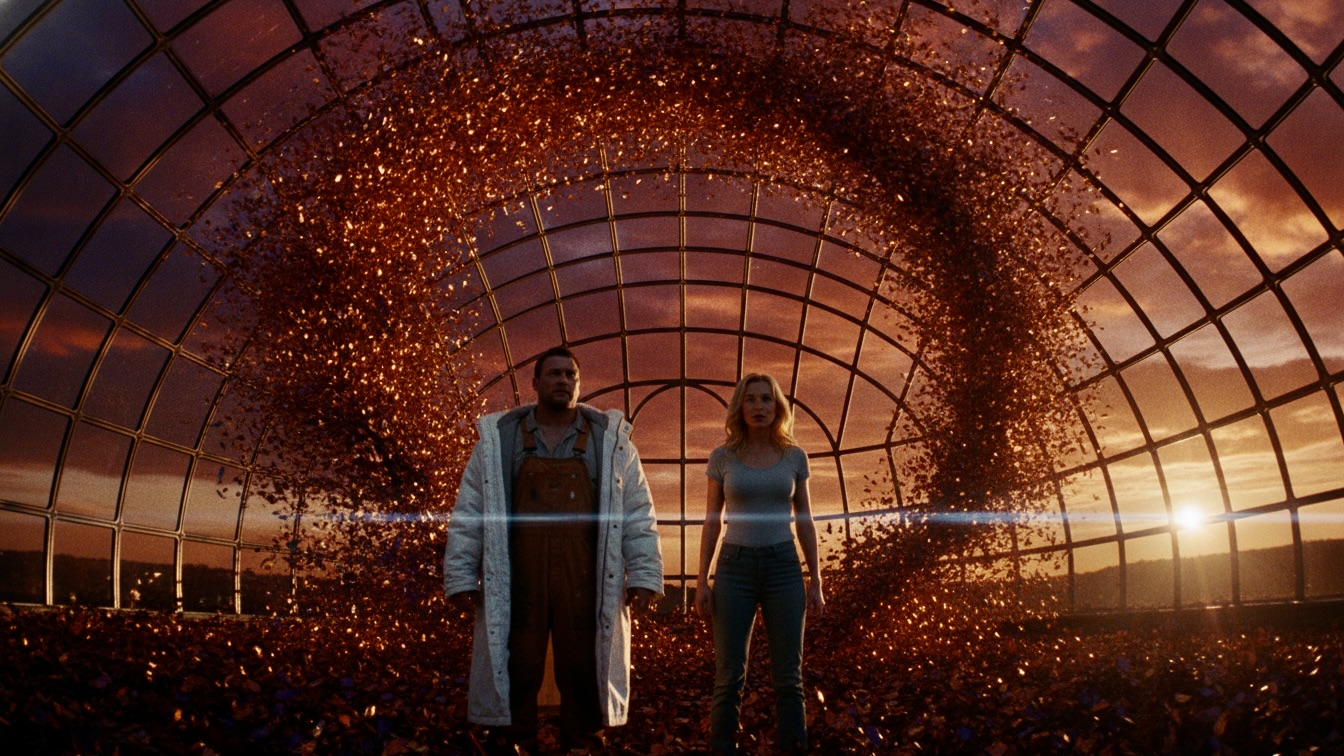
The wind caught the newly dead leaves on the trees inside the hub. The copper and bruised-purple foliage tore away from the synthetic branches. Thousands of leaves swirled into the air, caught in the artificial vortex. They scraped against the glass walls of the dome, a chaotic, swirling storm of dry, brittle metal and polymer.
Jared stumbled back, raising his arm to shield his face from the flying debris. The temperature plummeted again. His breath caught in his throat. The cold was aggressive now, biting through the thin fabric of his coveralls. He shivered violently, his teeth clicking together.
Martha stood perfectly still in the center of the swirling copper leaves. She was shivering too, but her eyes were wide, tracking the chaotic flight of the foliage. She looked mesmerized.
"Look at it," she said. Her voice was barely audible over the roar of the fans. "It is exactly how the archives described it."
"It is a structural nightmare," Jared yelled over the noise. He grabbed her arm, pulling her out of the center of the artificial storm. "The citizens have lived in a controlled seventy-eight degrees for their entire lives. You introduce a massive drop in temperature and dying infrastructure, and you will have a riot in ten minutes."
Martha ripped her arm out of his grasp. "The perpetual summer is a psychological cage!" she shouted back. "The suicide rates in the lower sectors. The lethargy. The dome-fever. The human brain was not designed for a static environment. We need cycles. We need friction. We need change to remind us we are alive."
"So you decided to play god with the thermostat?" Jared asked.
"I ran the simulation," Martha said, holding up the broken pad. "I petitioned the upper management for a controlled trial. They denied it. They said stability is paramount. But stability is just a slower form of death. I bypassed their security. I leaked the code into the mainframe."
"You are insane," Jared said. He turned away from her, scanning the walls for the manual access panel to the sub-basement. "I am going down there. I am flushing the coolant lines, and I am purging your virus from the nanobots."
"You cannot purge it," Martha said. She stepped in front of him again. "The code is deeply integrated into the root architecture. If you forcefully reboot the array now, you risk permanently frying the thermal regulators. We would freeze to death in three days."
Jared stopped. He looked at her, searching for a bluff. She stared back, completely resolute.
"We need to use the central console to gracefully halt the sequence," Martha said, her tone softening slightly, recognizing she needed his physical access keys to reach the console. "We can lock the protocol where it is. Prevent the temperature from dropping below fifty degrees. But I need you to help me interface with the hardware."
Jared looked at the swirling copper leaves. He felt the cold air scraping his skin. It was brutal, but for the first time in his life, he felt entirely awake.
Jared walked toward the reinforced glass wall of the hub. The quarantine blast doors had sealed the far ends of the concourse, but a section of the pedestrian walkway remained visible through the transparent plasteel. He pressed his hand against the cold glass.
"You think you cured us," Jared said, his back to her. "You think dropping the temperature and killing the trees is going to magically fix the rot in this city."
"I believe it is a catalyst," Martha said. She walked up behind him, her boots clicking sharply on the floor. "We have been preserved like museum exhibits. Nothing grows in a museum."
"Look out there," Jared said. He pointed through the glass.
Citizens were emerging from the alcoves and transit stations. They wore the thin, lightweight fabrics standard for the perpetual summer. They looked confused. But they were not running. They were not rioting.
A young man in a grey tunic stepped into the center of the concourse. A gust of the synthetic wind blew down the corridor, carrying a flurry of the copper leaves. The man flinched initially, raising his hands. But as the brittle, metallic leaves hit his chest and fell to his feet, he stopped. He reached down and picked one up. He turned it over in his hands, staring at the alien color.
Further down the walkway, a group of maintenance workers—Jared's colleagues—had stopped their transit cart. They were standing on the seats, reaching up to try and catch the falling purple foliage.
"They are not panicking," Martha whispered. There was a profound relief in her voice, mixed with awe. "They are observing."
"They are freezing," Jared corrected. He watched a woman cross her arms tight against her chest, her shoulders hunched. The physical reality of the cold was setting in.
Jared felt his own core temperature dropping. The adrenaline of the initial shock was wearing off, leaving him exposed to the fifty-five-degree air cycling aggressively through the hub. His fingers were stiffening. The grease on his coveralls felt like a layer of ice against his skin. He rubbed his arms violently, trying to force blood into his extremities.
Martha noticed his violent shivering. She looked at his thin coveralls, then down at her own heavy, insulated white coat. The high-tier uniform was designed with thermal micro-fibers, a luxury meant for prolonged work in the refrigerated seed-storage vaults.
She reached up and unclasped the collar of her coat.
"What are you doing?" Jared asked, watching her shrug out of the heavy garment.
"Your physiological response to the temperature drop is more acute than mine," Martha said. She held the coat out to him. "You lack the necessary insulation."
Jared stared at the white coat. It was pristine. It was a symbol of authority, of access, of the sanitized upper levels of Neo-Denver. His hands were covered in industrial grime.
"I am not wearing that," Jared said. "I will ruin it."
"The structural integrity of the fabric is irrelevant right now," Martha said. She stepped closer and practically shoved the heavy coat into his chest. "Take it. If your motor skills degrade due to hypothermia, you will not be able to bypass the sub-basement security locks."
Jared hesitated, then grabbed the coat. The fabric was dense, woven with microscopic heating coils that retained her body heat. He pulled it on over his grease-stained coveralls. The contrast was absurd. He looked like a vandal wearing a stolen artifact. But the immediate warmth was undeniable. It spread across his shoulders and down his spine, easing the violent tremors in his muscles.
"Thank you," Jared muttered, refusing to meet her eyes.
"Do not thank me," Martha said. She was left standing in a fitted grey undershirt. She crossed her arms, rubbing her own shoulders as the cold bit into her. "Just open the access hatch."
Jared walked to the structural pillar in the center of the hub. He knelt by a flush metal panel near the floor. He pulled his sonic driver from his belt, adjusted the frequency, and pressed it against the panel's locking mechanism. A high-pitched whine filled the air, followed by a heavy clack. The panel popped open, revealing a manual ladder descending into the dark.
"After you, Doctor," Jared said, gesturing to the hole.
Martha did not hesitate. She climbed down the ladder, her movements quick and efficient. Jared followed, pulling the panel shut behind them to block out the roaring fans of the hub.
Below the hub, the sub-basement was a cathedral of machinery. Massive steel pipes, frosted with condensation, crisscrossed the ceiling. The air down here was even colder, smelling faintly of ozone and old metal. Wait, no. The air was just sharp. It held a metallic tang, a harshness on the tongue that felt like chewing on foil.
They navigated the labyrinth of pipes until they reached the central console. It was a massive, antiquated terminal, relying on physical switches and heavy dials rather than holographic interfaces. It was designed to survive a total grid collapse.
"This is it," Jared said, stepping up to the console. He wiped a layer of dust from the main screen. "The root architecture."
He pulled a datalink cable from his bracer and jacked it directly into the terminal. The screen flickered to life, bathing their faces in a harsh, green light. Lines of code cascaded down the monitor.
"I see your sequence," Jared said, his fingers flying across the heavy, mechanical keyboard. "It is overriding the primary thermal regulators. It is instructing the nanobots to degrade at a rate of ten percent per hour."
"Can you halt it?" Martha asked, stepping up right beside him, her shoulder brushing against his arm.
"I can isolate the command string," Jared said. He stared at the green text. He saw the exact line of code where Martha had fractured the eternal summer. It was a beautiful piece of sabotage. Elegant. Destructive.
He placed his hand on the heavy red lever on the right side of the console. The master override.
"If I pull this," Jared said, "the system will trap your code in a sandbox. The temperature will stabilize at fifty degrees. The leaves will stay copper. But the progression stops."
"Do it," Martha said.
Jared did not move. He kept his hand on the lever. He looked away from the screen, staring into the dark, cavernous space of the sub-basement. He thought about the heat. The endless, suffocating, seventy-eight-degree heat. He thought about the sweat, the lethargy, the feeling of waking up every day for twenty-four years to a world that never changed.
He let go of the lever.
"What are you doing?" Martha demanded. "Lock it down!"
"You said we needed cycles," Jared said. He turned to face her. The green light from the monitor caught the sharp angles of his face. "You said we needed to see things end to know we are alive."
"I did," Martha said, her voice dropping. "But if we let the sequence run to completion, the temperature will drop to thirty degrees. We have no infrastructure for freezing temperatures. The water pipes might burst. The grid might fracture."
"You are terrified of the upper management," Jared said. "You built a revolution, and now you want to pause it halfway because you are afraid of the consequences."
"I am a scientist," Martha said, her voice tightening. "I calculate risk. Letting it run is a catastrophic risk."
"Living in a museum is a catastrophic risk," Jared countered. He stepped away from the console. "You showed them the leaves falling. If you freeze the system now, it just becomes another static exhibit. A permanent, fifty-degree diorama. That is not a cycle. That is just a colder cage."
Martha stared at him. The cold air between them felt charged, heavy with the weight of the decision. She looked at the green screen, then down at her own trembling hands.
"If we let it run," Martha said slowly, her words measured and deliberate, "they will hunt us down. The management will classify this as an act of systemic terrorism. They will strip my credentials. They will erase you."
"They already do not see me," Jared said. He crossed his arms, the heavy fabric of her high-tier coat rustling in the quiet sub-basement. "I am just a wrench in their machine. And you are just a brain in their jar. We are already erased."
He walked back to the console. He bypassed the master override lever entirely. Instead, he typed a new command into the terminal. He locked the administrative permissions behind a randomized, encrypted firewall.
"What did you just do?" Martha asked.
"I revoked my own access," Jared said. He pulled the datalink cable out of the terminal. The screen flashed red, displaying a massive 'ACCESS DENIED' warning. "Nobody can stop the sequence now. Not me. Not you. Not the management. The cycle has to finish."
Martha let out a breath that was half a laugh, half a gasp of pure anxiety. She reached out and gripped the edge of the metal console, steadying herself. "You are entirely reckless."
"I am a pragmatist," Jared said. "You cannot un-ring a bell. Let us go see what we broke."
He led the way back to the ladder. They climbed up, pushing the access panel open and stepping back into the central botanical hub. The fans had slowed down, the violent synthetic wind reducing to a steady, biting chill. The air in the hub was now hovering around forty-five degrees.
The copper and purple leaves had settled, carpeting the polished floor in a thick, metallic layer of decay. It was messy. It was chaotic. It was profoundly beautiful.
Jared walked to the main doors of the hub. He punched his maintenance code into the wall keypad to bypass the quarantine lockdown. The heavy glass doors shrieked in protest, the sudden drop in temperature already affecting the hydraulic fluid in their mechanisms. They parted sluggishly.
Jared and Martha stepped out of the hub and back onto the main concourse.
The alarm klaxons had finally silenced. The blast doors at the ends of the sector remained shut, but the people trapped inside had not rioted. They were sitting on the benches, standing by the dying trees, or walking slowly through the fallen leaves. The crunch of the metallic foliage beneath their boots echoed off the glass dome above.
Jared stopped. He looked up at the massive, transparent ceiling of the dome.
The artificial lighting of Neo-Denver, which normally simulated a blinding, cloudless noon, was failing. The nanobot glitch had bled into the optical arrays. The harsh white light was dimming, shifting down the spectrum.
It turned orange. Then a deep, bloody crimson. Then a rich, bruised violet.
It was the first sunset Neo-Denver had seen in two centuries.
The crimson light washed over the concourse, casting long, dramatic shadows behind the citizens. The fallen copper leaves glowed like embers on the floor. The architecture of the city, usually sterile and blinding, suddenly looked ancient, weathered, and alive.
Martha stepped up beside him. She was shivering violently now in her thin undershirt, but she did not ask for her coat back. She was staring up at the shifting sky, her eyes wide, reflecting the fiery light.
"It is completing the sequence," Martha whispered.
Jared turned his head to look at her. As she spoke, a small cloud of white vapor escaped her lips.
Jared stared at it. He breathed out, forcefully. A corresponding plume of white mist materialized in the air in front of him, swirling briefly before vanishing into the cold.
He watched his own breath. He was seeing the invisible machinery of his own body laid bare by the cold. It was proof of life. A visceral, undeniable friction against the environment.
"We are going to have to hide," Jared said, his voice quiet, his breath pluming in the air.
"I know," Martha said. She did not look away from the sky.
"They will send the enforcers when the temperature hits freezing."
"Let them come," Martha said. She finally turned to look at him, the crimson light carving sharp shadows across her face. "We gave them a sunset."
Jared looked back out over the concourse. The citizens were still quiet, mesmerized by the dying light and the biting cold. They were wrapping their arms around themselves, huddling together for warmth, experiencing a collective, undeniable vulnerability for the first time in their lives. The perfect, stagnant machine of their reality was fundamentally broken, and from the fractured pieces, something wild and unpredictable was taking root. Jared zipped the heavy white coat up to his chin, feeling the microscopic heating coils hum against his chest, and stepped forward into the falling dark.
“Jared zipped the heavy white coat up to his chin, feeling the microscopic heating coils hum against his chest, and stepped forward into the falling dark.”


