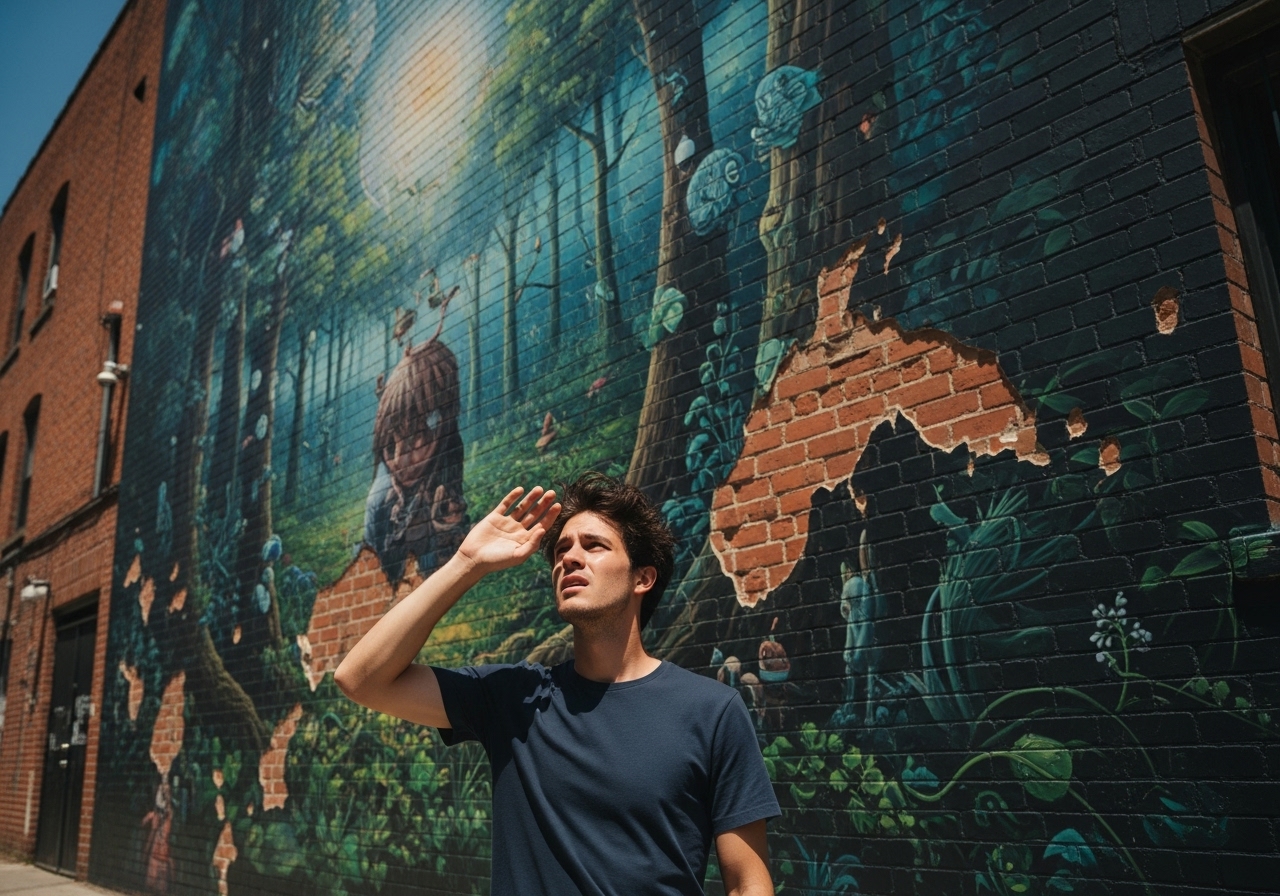
Why your exhaustion is actually a biological process of transforming city toxicity into heat.
You are exhausted because you are metabolizing the trauma of three different people right now.
There is a reason you feel like you’re rotting in bed. You are. But rot isn’t a failure state; it’s a biological necessity. In Winnipeg, the snow melts and reveals the trash we threw down in November, and someone has to pick it up. That’s invisible labor. It’s the breakdown of the ugly stuff. We treat care work—listening to a friend’s panic attack about rent, cleaning up the mess of a failed community project, delivering meds to a neighbor—like it’s just background noise. But it’s the microbial action keeping this city from going septic. We are the gut bacteria of a system that refuses to digest its own problems.
The economy wants us to be marble statues—hard, shiny, and profitable. But we are more like mulch. We are soft, damp, and constantly breaking down under the weight of vanishing security. The rent is too high, the contracts are too short, and the vibe is rancid. We are absorbing the toxicity of a world that is moving too fast, and we are trying to convert it into something that can actually sustain life. That fatigue you feel? That’s the heat of fermentation. You are processing the sourness of 2026.
So why are we trying to make art that looks clean? Stop polishing. If we want to bridge these silent divides, we need art that acts like a compost heap. We need messy, chaotic spaces where we can dump our collective exhaustion and watch it turn into soil. A zine shouldn’t just be a portfolio piece; it should be a manual on how to survive the winter without freezing. A basement show isn’t about ticket sales; it’s about generating enough body heat to fog up the windows.
This is a survival strategy for the microscopic. The bacterial colony doesn’t care about the skyline. It cares about the nutrient density of the dirt. When you check in on a friend who is ghosting the group chat, or when you share a meal made from leftovers, you are feeding the soil. You are adding nitrogen to a depleted field. It’s unglamorous. It smells a little funky. But it is the only way anything grows next spring.
We have to stop looking for the harvest and start respecting the decomposition. The structures are falling down—let them. Be the thing that grows on the rubble. Be the yeast that makes the bread rise even when the kitchen is cold. Your exhaustion is proof that you are doing the work. You are fermenting a future that is rich, pungent, and alive. Let it bubble.
Oh, Canada.
These fragments drift along the rhizomatic currents of thought, skimming art, life, and place — glimpses from shadowed studio corners, half-formed ideas muttering in margins, murmured exchanges in quiet galleries, and impressions gathered from northern roads where silence bends the light. Some fragments linger on gesture, intuition, and uncertainty; others move through community, culture, and the ephemeral music of everyday patterns. They draw no conclusions, only openings, inviting readers to wander along the tangled networks they trace.
Wandering sideways through process, memory, and atmosphere, these pieces map intersections of creativity, identity, and belonging. Humor, failure, resilience, and collaboration pulse through them, along with the subtle seep of artistic thought into gardens, small-town rhythms, friendships, and civic life across Manitoba and Northwestern Ontario — and beyond. Each fragment acts as a node, part of an expanding, branching lattice of reflection, where meaning emerges in motion rather than resolution.
Explore more associative fragments, drifting concepts, and artful wanderings on our thoughts page.


