
Bridging the urban-rural divide through the messy, unpolished reality of Manitoba’s creative sector.
Why do you think a city needs a gallery to be a culture? Maybe the most honest art is actually happening in a roadside ditch three hours north of Portage Avenue.
You feel the divide every time you cross the Perimeter Highway. There is this weird, invisible wall where the city’s high-concept installations stop and the heavy, practical silence of the Interlake begins. We have spent so much time polishing our urban aesthetics that we have forgotten the texture of the gravel and the desperation of the small-town main street. The political tensions aren’t just about who you vote for; they are about whose reality gets to be called “art.” When you are grinding pigment out of dried Manitoba clay, you realize the soil doesn’t care about municipal boundaries. The urban-rural split is a jagged tear in our collective consciousness, but your sketchbook doesn’t have a border control.
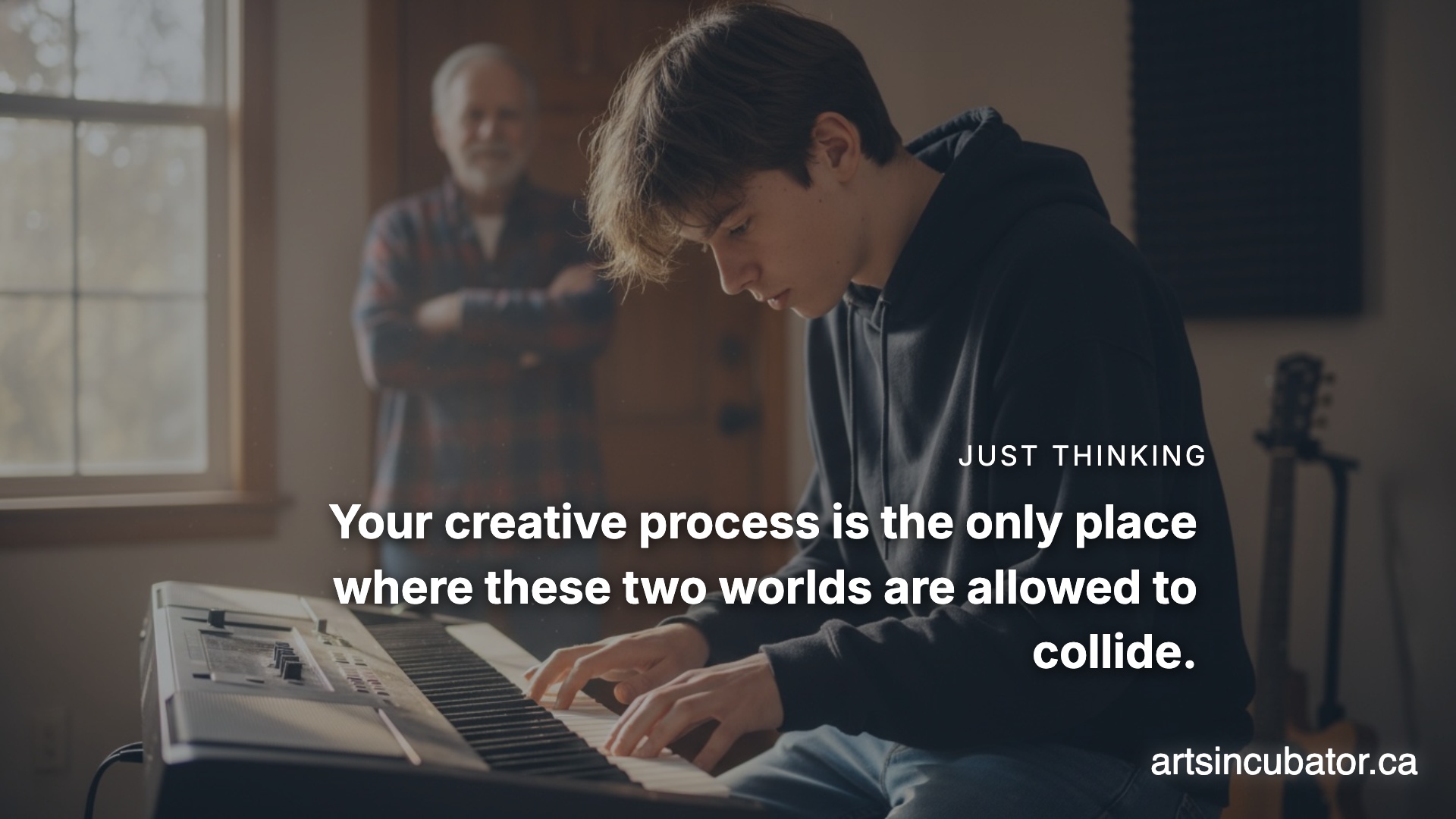
Working with the raw, messy materials of our province is an act of defiance against the tidy boxes the news tries to put us in. You know the feeling of trying to explain a noise show to your cousin who farms near Dauphin, or trying to explain the price of diesel to a curator in the Exchange District. It feels like the air is coded differently depending on the zip code. We are navigating a landscape where the economic pressures of a failed harvest and the skyrocketing rent of a downtown loft are two sides of the same counterfeit coin. Your creative process is the only place where these two worlds are allowed to collide without a shouting match. It is the splatter on the canvas that refuses to be either just “urban” or just “rural.”
Our arts sector is currently a bit of a disaster, and honestly, that is the most human thing about it. We are trying to build something resilient while the infrastructure is crumbling. The systemic gaps aren’t just about race or class; they are about the physical distance between us and the way we distribute our attention. You see it in the way northern Indigenous-led projects are treated as “outreach” rather than the heartbeat of the province. We need to stop treating the rural experience like a background character in the city’s narrative. Your work needs to be as stubborn as a prairie winter, holding space for the stories that get lost in the highway static.
Empathy isn’t a finished product you put on a pedestal; it is the dirty water in your rinse jar. It is the realization that the frustration of a gig-worker in the city and the isolation of a seasonal laborer in the north are pulling from the same well of exhaustion. When we create spaces for civic engagement through music or theater, we are essentially mixing different clays to see if they can survive the firing process together. It is about the shared stain on our hands, the common residue of trying to make something out of nothing. We are finding that our dignity isn’t found in a trade deal, but in the way we refuse to let the geography of our province turn into a map of enemies.
So, keep your hands dirty and your perspective wide. Do not let the city-centric gatekeepers tell you what is relevant. We are building a healthy arts sector by leaning into the discomfort of our differences and the messiness of our shared precarity. Your role is to be the one who notices the similarities in the struggle, the one who carries the echoes of the wind across the flatlands into the concrete canyons. We are the ones weaving a network of connection that can withstand the polarization because it is built on the ground we all stand on. Stay grounded, stay messy, and remember that the most beautiful things are often the ones that were never meant to be pretty.
Thoughts on art and the state of the world!
These fragments trace the rhizomatic flow of thought through art, life, and place — scattered impressions from studio corners, fleeting ideas scrawled in notebooks, whispered exchanges at galleries, and observations picked up on quiet northern roads. Some fragments linger on technique, intuition, and doubt; others drift through community, culture, and the subtle poetry of everyday moments. They offer no conclusions, only openings, inviting readers to follow connections wherever they emerge.
Wandering laterally between process, memory, and environment, these pieces map associations across creativity, identity, and belonging. They intersect with humor, failure, resilience, and collaboration, and trace the ways artistic thinking seeps into gardens, small-town rhythms, friendships, and civic life across Manitoba and Northwestern Ontario — and further afield. Each thought functions as a node, part of a living network of reflection, expanding and branching with possibility.
Discover more associative fragments, conceptual wanderings, and artful reflections on our thoughts page.


