
Embracing the beautiful mess of rural art-making and the power of the creative oops.
When was the last time you let a mistake actually lead the way instead of fixing it immediately?
You’re staring at that canvas or that grant application or that half-finished sculpture in the shed, and all you see are the seams showing. Up here in the north, where the winter stretches long and the resources feel thin, there’s this massive pressure to make everything look polished and professional the first time around. We get caught up in trying to match the vibe of some high-end Toronto gallery when our reality is a lot more chaotic and raw. But here’s the thing: the most interesting parts of your work are usually the accidents you tried to hide. It’s the paint drip that ran the wrong way or the sentence that didn’t quite land but somehow captured a feeling you couldn’t plan. That’s not a failure; it’s a glitch, and in 2026, the glitch is where the soul lives.
If you’re feeling stuck, it’s probably because you’re practicing avoidance disguised as quality control. Using Acceptance and Commitment Therapy logic, we have to acknowledge that the ugliness of the process is just part of the deal. You can’t have the breakthrough without the fifty versions that sucked. When you’re working in a small arts collective or trying to start something in a town of two thousand people, the mess is your greatest asset. It shows you’re actually doing the work. Instead of fighting the frustration, try to invite it in. Treat your frustration like a weird, lumpy piece of clay. You don’t have to love it, but you do have to work with it.
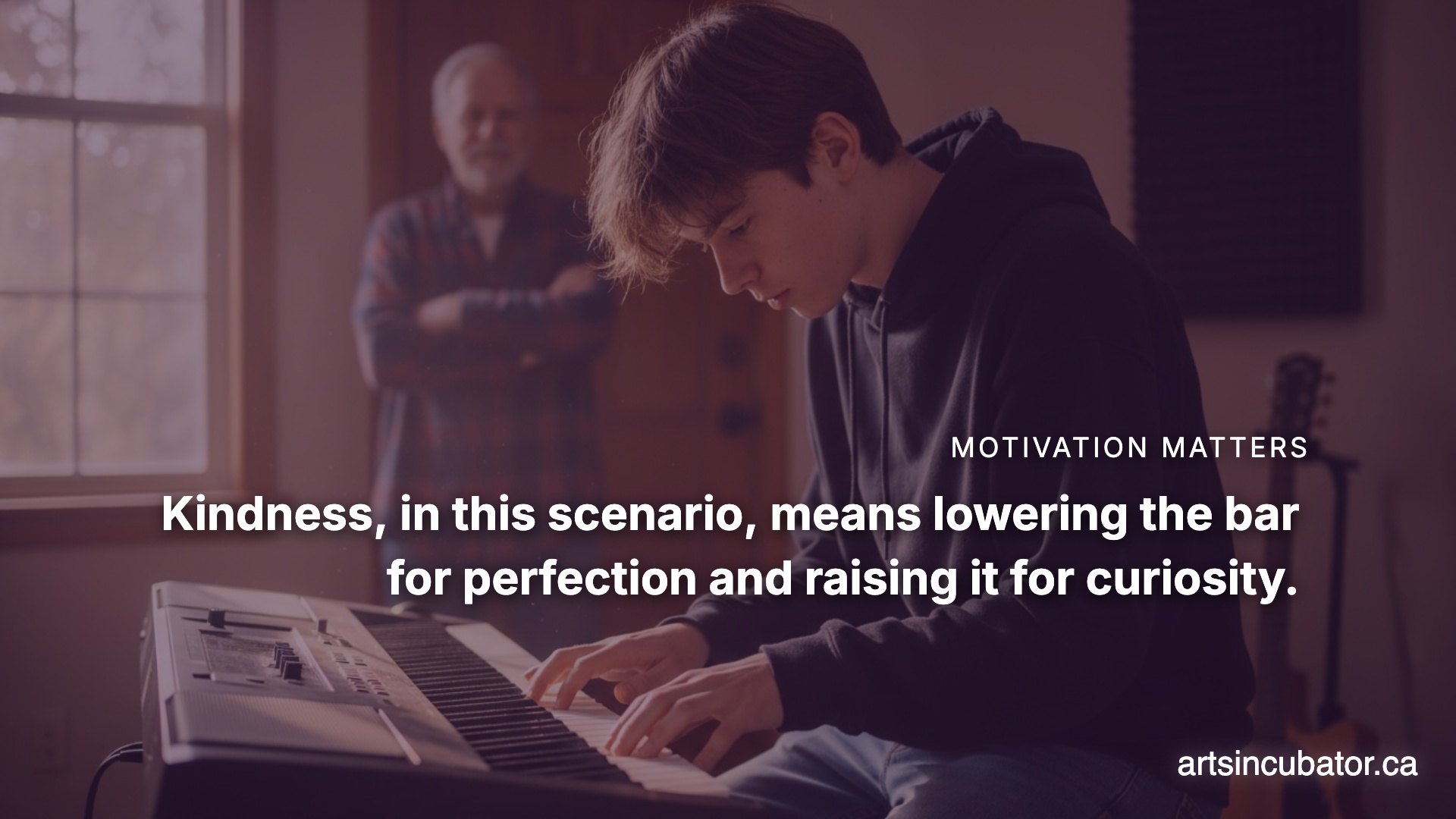
Let’s talk about the undo button mentality. We’ve spent so much time in digital spaces that we expect life to have a shortcut for every error. But real, gritty, northern art doesn’t work like that. Resilience isn’t about never making a mess; it’s about what you do when the paint spills on your favorite rug. In a rural context, we often have to be our own curators, our own tech support, and our own cheerleaders. That’s exhausting. Kindness, in this scenario, means lowering the bar for perfection and raising it for curiosity. Ask yourself: what happens if I keep this mistake? It takes the pressure off your nervous system and lets your brain actually solve problems instead of just panicking.
Try a tiny exercise today. Take five minutes to make something objectively bad. Scribble, write a terrible poem, or record a voice memo of a song with all the wrong notes. Don’t delete it. Don’t paint over it. Just sit with it for a moment. This is exposure therapy for your perfectionism. It reminds your brain that the world doesn’t end when the output isn’t a masterpiece. You’re building the muscle for the long haul. Northern artists are built different because we have to be. We handle the isolation and the limited supplies by being resourceful. That resourcefulness starts with accepting the glitch.
Your worth isn’t tied to your finished pile. It’s tied to the fact that you’re showing up in the studio—even if the studio is just your kitchen table—and getting your hands dirty. Be gentle with your weird, experimental phases. They are the foundation of everything good that’s coming next. Keep your hands messy and your heart open to the accidents. They are the only things that are actually real anymore.
Thoughts on art and the state of the world!
These fragments trace the rhizomatic flow of thought through art, life, and place — scattered impressions from studio corners, fleeting ideas scrawled in notebooks, whispered exchanges at galleries, and observations picked up on quiet northern roads. Some fragments linger on technique, intuition, and doubt; others drift through community, culture, and the subtle poetry of everyday moments. They offer no conclusions, only openings, inviting readers to follow connections wherever they emerge.
Wandering laterally between process, memory, and environment, these pieces map associations across creativity, identity, and belonging. They intersect with humor, failure, resilience, and collaboration, and trace the ways artistic thinking seeps into gardens, small-town rhythms, friendships, and civic life across Manitoba and Northwestern Ontario — and further afield. Each thought functions as a node, part of a living network of reflection, expanding and branching with possibility.
Discover more associative fragments, conceptual wanderings, and artful reflections on our thoughts page.


