
Navigating the high-cost noise of 2026 through the power of creative disruption.
How much of your pulse is actually just the sound of a rising grocery bill? You are vibrating at the frequency of a spreadsheet that never quite balances.
The signal is jammed. Between the rent hikes at the apartment on Osborne and the price of a head of lettuce at the Superstore, the data stream is nothing but distortion. Your brain attempts to process the algorithm of survival, but the bandwidth is capped by the sheer cost of existing. We are all living in a high-latency environment where the lag between working a shift and feeling secure is growing wider every single month. The noise of the city isn’t just the construction on Portage Avenue; it’s the hum of collective anxiety about the next hydro bill, a low-frequency vibration that rattles your teeth while you sleep.
Art becomes a circuit breaker in a system that demands constant flow. When the world is designed to keep you in a loop of panic-consumption and burnout-recovery, the only way out is to introduce a deliberate glitch. Making something—a zine, a noise set, a mural on a back alley door—isn’t about ‘self-care’ in that sanitized, corporate sense that companies like to sell back to us. It is about signal interference. You take the static of your financial dread and you re-route it through a distorted pedal. You turn the white noise of the housing crisis into a physical object that the world cannot ignore. It is messy, and it should be.
In Winnipeg, the concrete remembers everything. We walk through the Exchange District and see the echoes of old industries, now replaced by the digital ghost of the gig economy and precarious contracts. Our mental health isn’t a private failure or a solo glitch; it is a public frequency we are all tuned into. When you feel that high-pitched whine of stress behind your eyes, you are picking up a broadcast that isn’t yours alone. The resilience isn’t in fixing the radio so it plays a happy tune; it’s in learning to dance to the static. We find each other in the gaps between the official broadcasts, in the DIY spaces where the rent is still a negotiation and the coffee is communal.
There is dignity in the malfunction of a broken world. The pressure to be a seamless, productive unit in the 2026 economy is a lie designed to keep you quiet and compliant. Use the jagged edges of your frustration. If the world feels like a broken television flickering in a dark basement, don’t try to fix the picture to make it pretty. Lean into the distortion instead. Collect the fragments of your day—the grocery receipts that look like phone numbers, the rejection emails, the transit delays—and collage them into a weapon of perspective. Art in this city has always been about making something vital out of the debris left behind by the boom-and-bust cycles.
We are wiring a new network right now. It doesn’t look like a neat hierarchy; it looks like a mess of tangled cables under the floorboards of a basement venue on Main Street. Connection happens when we stop pretending the signal is clear. It happens when we admit the noise is deafening and we start making our own sound to cut through it. Your worth is not a number on a balance sheet, even when the bank tries to tell you otherwise through automated texts. Stay glitchy, stay loud, and keep the feedback loop going until the old system can’t hear itself think anymore.
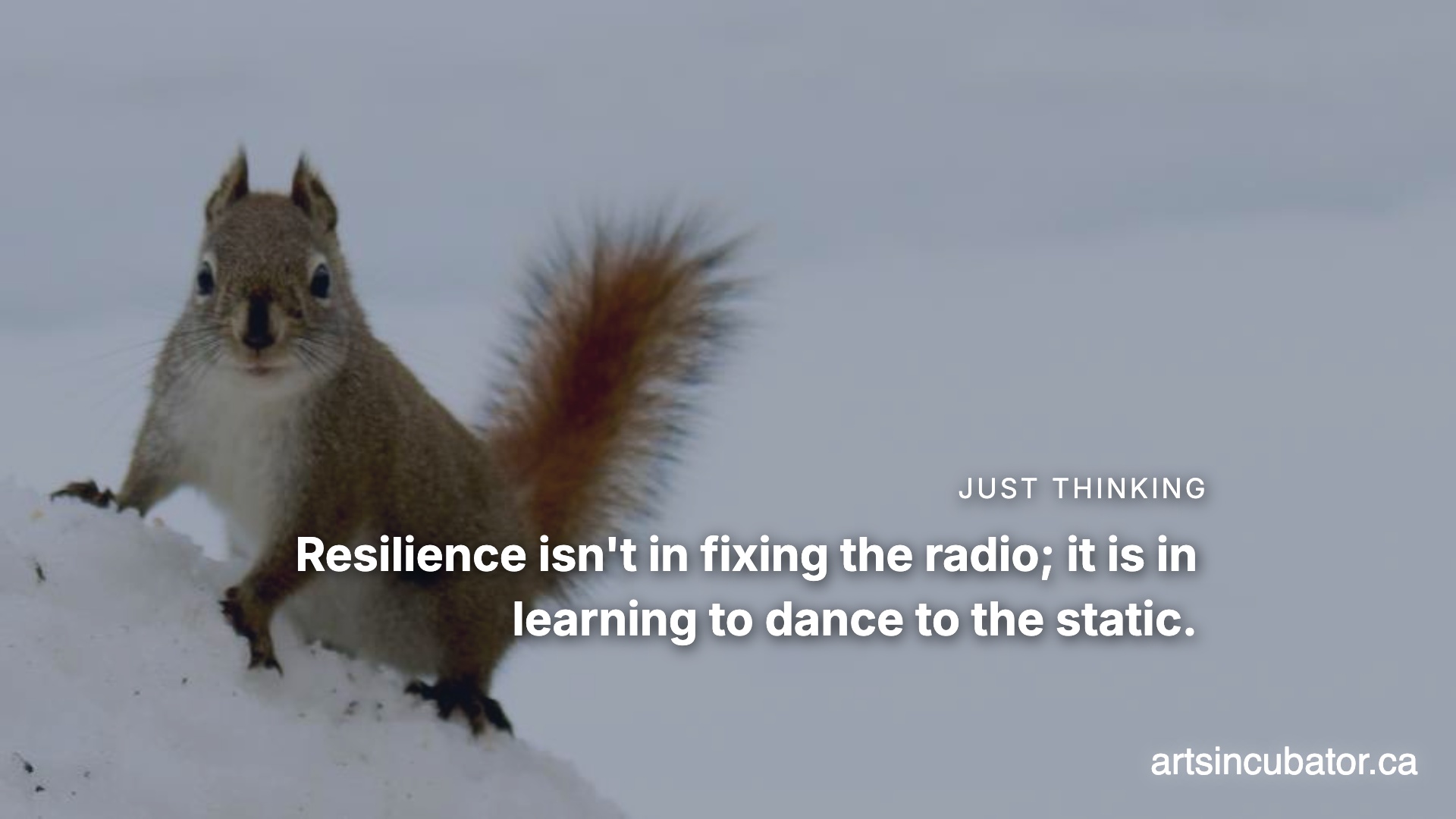
Oh, Canada.
These fragments drift along the rhizomatic currents of thought, skimming art, life, and place — glimpses from shadowed studio corners, half-formed ideas muttering in margins, murmured exchanges in quiet galleries, and impressions gathered from northern roads where silence bends the light. Some fragments linger on gesture, intuition, and uncertainty; others move through community, culture, and the ephemeral music of everyday patterns. They draw no conclusions, only openings, inviting readers to wander along the tangled networks they trace.
Wandering sideways through process, memory, and atmosphere, these pieces map intersections of creativity, identity, and belonging. Humor, failure, resilience, and collaboration pulse through them, along with the subtle seep of artistic thought into gardens, small-town rhythms, friendships, and civic life across Manitoba and Northwestern Ontario — and beyond. Each fragment acts as a node, part of an expanding, branching lattice of reflection, where meaning emerges in motion rather than resolution.
Explore more associative fragments, drifting concepts, and artful wanderings on our thoughts page.


