
Reclaiming civic trust and mental clarity in an age of automated digital distortion.
Why do we keep acting like the digital future is something we haven’t already survived before?
You are staring at a deepfake of a local politician on your feed while waiting for the Blue line on Graham Avenue, and the pixels are starting to bleed into your sense of reality. The algorithm is feeding you a version of Winnipeg that feels like a polished, sterilized ghost of the city you actually walk through every day. It is the uncanny valley of civic life. We are losing the collective ability to distinguish between a real neighbor and a bot programmed to make us spiral about transit safety or property taxes. This isn’t just a technological shift; it is a systemic haunting. The civic trust that used to be the bedrock of our community is dissolving into a fine, digital dust that coats every interaction we have online. It is a low-grade vertigo that never quite goes away.
Your brain has become an archive of these fragmented, simulated interactions. The digital transformation of 2026 is less of a revolution and more of a massive, automated deletion of our human nuances. We are haunted by the echoes of a time when a conversation didn’t feel like a series of prompts and responses. In the Winnipeg arts community, this hits differently. There is a persistent fear that the hand-drawn line, the slightly off-key vocal, or the captured moment of genuine hesitation is being averaged out by generative models that have no memory of what it feels like to be cold. But there is a specific, spectral power in the things that AI cannot replicate. It is in the gaps, the silences, and the dust motes dancing in the light of an old basement studio in the Exchange.
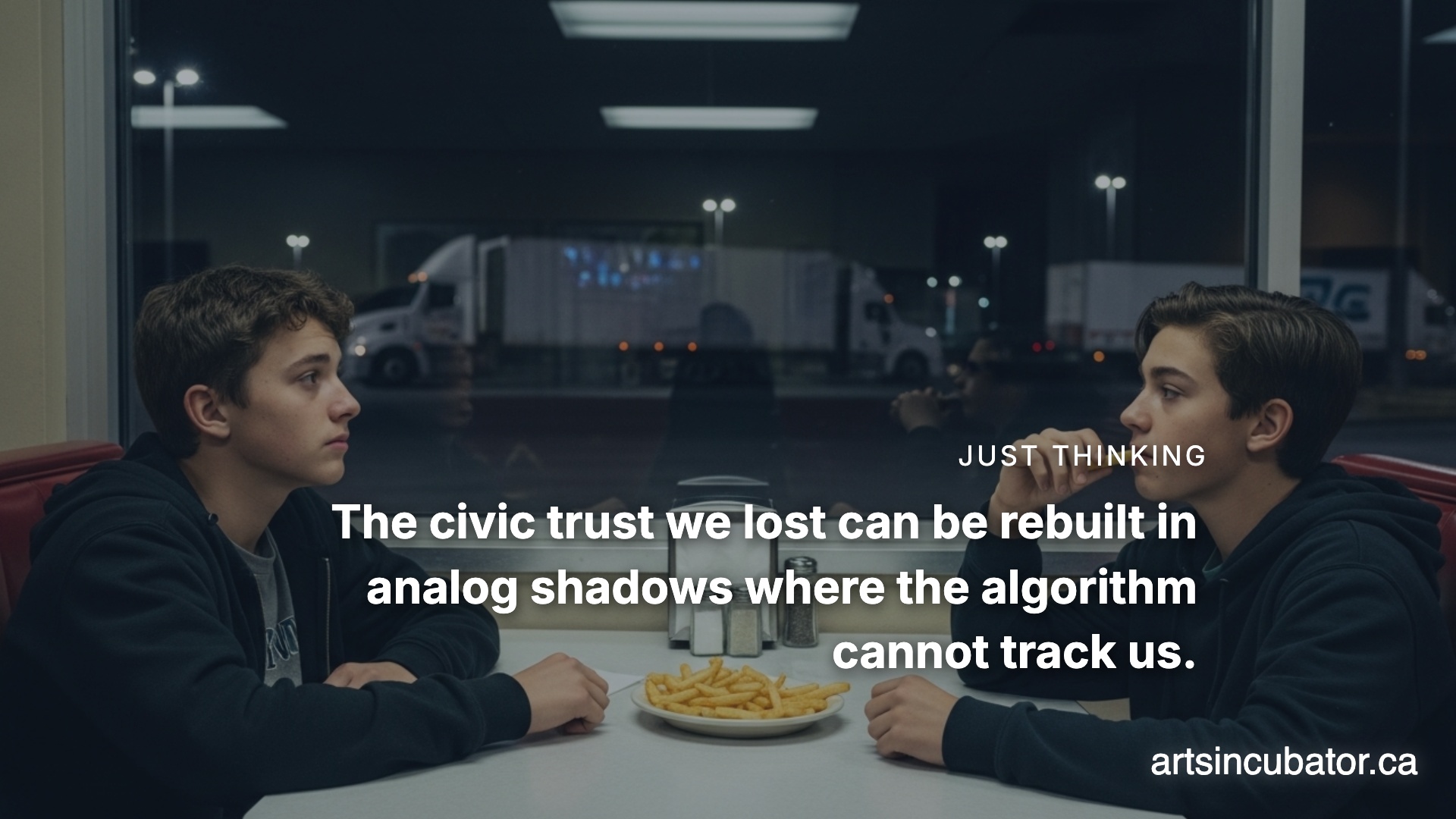
Art in this city is evolving into a form of digital archaeology. We are digging through the noise to find the human residue that hasn’t been scrubbed clean. When you choose to make a physical zine, or perform a set where the feedback is intentional and messy, you are preserving the imperfections that prove your existence. It is a necessary act of resistance against the high-definition lies of your social media feed. We are rebuilding a community based on the low-resolution reality of being human—vulnerable, inconsistent, and deeply localized. The civic trust we lost can be rebuilt in these analog shadows, where the algorithm cannot track the warmth of a shared look or the weight of a hand-printed flyer passed between friends.
It is perfectly valid to feel like a ghost in your own timeline right now. The sheer velocity of AI disruption makes the present moment feel like a memory before it even fully lands. But being a ghost has its advantages; you can move through the walls they are trying to build between us with polarization and misinformation. We aren’t just data points for a platform; we are the ghosts in the machine, the persistent glitches that refuse to be optimized for maximum engagement. Your mental health depends on finding these off-grid spaces of the soul where you don’t have to be a productive unit of the digital economy. Look for the projects that feel a bit dusty, a bit slow, and a bit too strange to be profitable.
The future is just a collection of echoes we haven’t quite decoded yet. We don’t need to outrun the automation or the social fragmentation; we need to out-haunt them. We need to fill our streets and our galleries with so much specific, weird, and un-indexable human energy that the system simply doesn’t know what to do with us. Keep archiving the small moments of kindness that the internet is designed to forget. Keep making things that are meant to be felt with the skin, not just processed with the eyes. We are the stewards of the archive, and the dust we leave behind is the only evidence of life that actually matters.
Oh, Canada.
These fragments drift along the rhizomatic currents of thought, skimming art, life, and place — glimpses from shadowed studio corners, half-formed ideas muttering in margins, murmured exchanges in quiet galleries, and impressions gathered from northern roads where silence bends the light. Some fragments linger on gesture, intuition, and uncertainty; others move through community, culture, and the ephemeral music of everyday patterns. They draw no conclusions, only openings, inviting readers to wander along the tangled networks they trace.
Wandering sideways through process, memory, and atmosphere, these pieces map intersections of creativity, identity, and belonging. Humor, failure, resilience, and collaboration pulse through them, along with the subtle seep of artistic thought into gardens, small-town rhythms, friendships, and civic life across Manitoba and Northwestern Ontario — and beyond. Each fragment acts as a node, part of an expanding, branching lattice of reflection, where meaning emerges in motion rather than resolution.
Explore more associative fragments, drifting concepts, and artful wanderings on our thoughts page.


