
Why the most vital culture in Winnipeg is happening in the margins and the shadows.
How long does a memory last before the city paves over it? You walk past the ghosts of old venues every day without looking down.
Winnipeg is becoming a graveyard of good ideas. We have this habit of letting beautiful things decompose because the funding cycle ended or the rent hiked up again. You see it in the Exchange District—windows that used to display local fashion or weird experimental art are now covered in “For Lease” dust. It is a specific kind of haunting. We aren’t just losing small businesses; we are losing the containers where we learned how to be human. The archives are thinning out, and the city feels less like a home and more like a transit station where everything we love is just passing through on its way to being forgotten.
It feels like we are living in the reverb of a shout that happened five years ago. The “silent divides” aren’t just about politics; they are about the silence left where the music used to be. But here is the trick about echoes: they don’t disappear; they just get quieter. You have to listen harder. The basement shows are still happening, but they’ve gone underground, hidden behind encryption and word-of-mouth because visibility is too expensive. The culture isn’t dead; it’s just operating on a phantom frequency. We are improvising in the dark.
Think about the invisible labor it takes to keep a scene alive when the lights go out. The person sweeping the floor after the unauthorized gallery show. The friend driving the gear across town in a rusted-out van during a blizzard. This work doesn’t get a plaque. It disappears into the ether, becoming part of the dust that settles on the rafters. But that dust is holy. It is the residue of effort. We need to stop looking for the shiny, funded, government-approved art and start honoring the spectral, messy effort of just keeping the door open for one more night.
So, how do we adapt to this fading landscape? We become archivists of the temporary. If the venue is going to be demolished, you document the cracks in the wall. If the band breaks up, you hum the bassline until it sticks in your neighbor’s head. We need art that functions like a ghost story—something that insists on being told even when the physical proof is gone. Don’t mourn the loss of the “official” spaces. Build a shrine in the corner of your living room. Make the memory heavy enough that it leaves a dent.
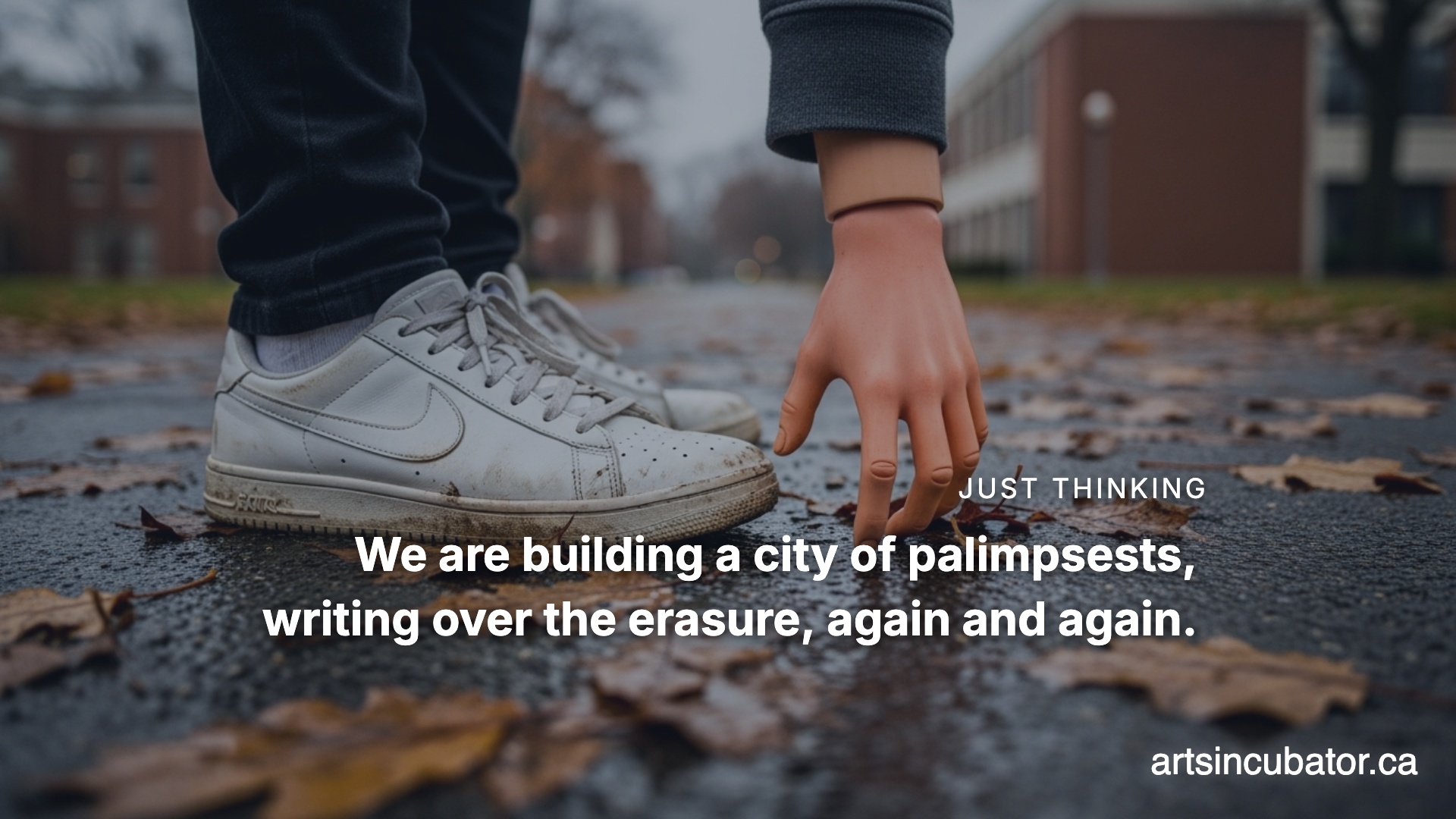
The flickering culture is actually the strongest kind. A flame that flickers is fighting the wind. That struggle is the art. When you paint over a tag, you are just adding another layer to the geology of the wall. We are writing over the erasure, again and again. The borders of our creativity are shifting, moving from the center to the margins, but the margins are where the ghosts live. And the ghosts have the best stories.
Oh, Canada.
These fragments drift along the rhizomatic currents of thought, skimming art, life, and place — glimpses from shadowed studio corners, half-formed ideas muttering in margins, murmured exchanges in quiet galleries, and impressions gathered from northern roads where silence bends the light. Some fragments linger on gesture, intuition, and uncertainty; others move through community, culture, and the ephemeral music of everyday patterns. They draw no conclusions, only openings, inviting readers to wander along the tangled networks they trace.
Wandering sideways through process, memory, and atmosphere, these pieces map intersections of creativity, identity, and belonging. Humor, failure, resilience, and collaboration pulse through them, along with the subtle seep of artistic thought into gardens, small-town rhythms, friendships, and civic life across Manitoba and Northwestern Ontario — and beyond. Each fragment acts as a node, part of an expanding, branching lattice of reflection, where meaning emerges in motion rather than resolution.
Explore more associative fragments, drifting concepts, and artful wanderings on our thoughts page.