Navigating the tension between economic survival and the preservation of our collective creative memory.
Have you ever wondered which of your discarded sketches will outlast the buildings they were drawn in? The answer is probably more of them than you think.
We are obsessed with the direct economic impact of the arts, citing the billions added to the GDP as if numbers could ever hold the weight of a single meaningful afternoon. In early 2026, the sector feels like a series of flickering candles against a very cold wind, but the light they cast is longer than any three-year budget cycle. You feel the strain of the municipal cuts and the AI-generated noise, yet you keep pressing ink into paper. This is not just a career choice; it is a ritual of documentation. We are recording the frequency of a city that is constantly trying to overwrite itself with luxury developments and digital ghosts.
Think about the posters layered six deep on the telephone poles near Osborne Village. Each layer is a fossil of a night that mattered to someone, an interlocking grain of sound and sweat that no algorithm can replicate. When the federal funding finally trickles down from the 2025 budget, it won’t be the spreadsheets that save our dignity. It will be the fact that you decided to archive the mundane beauty of your neighborhood before it shifted again. Our history is not found in the grand monuments but in the margins of your notebooks and the metadata of your unreleased tracks.
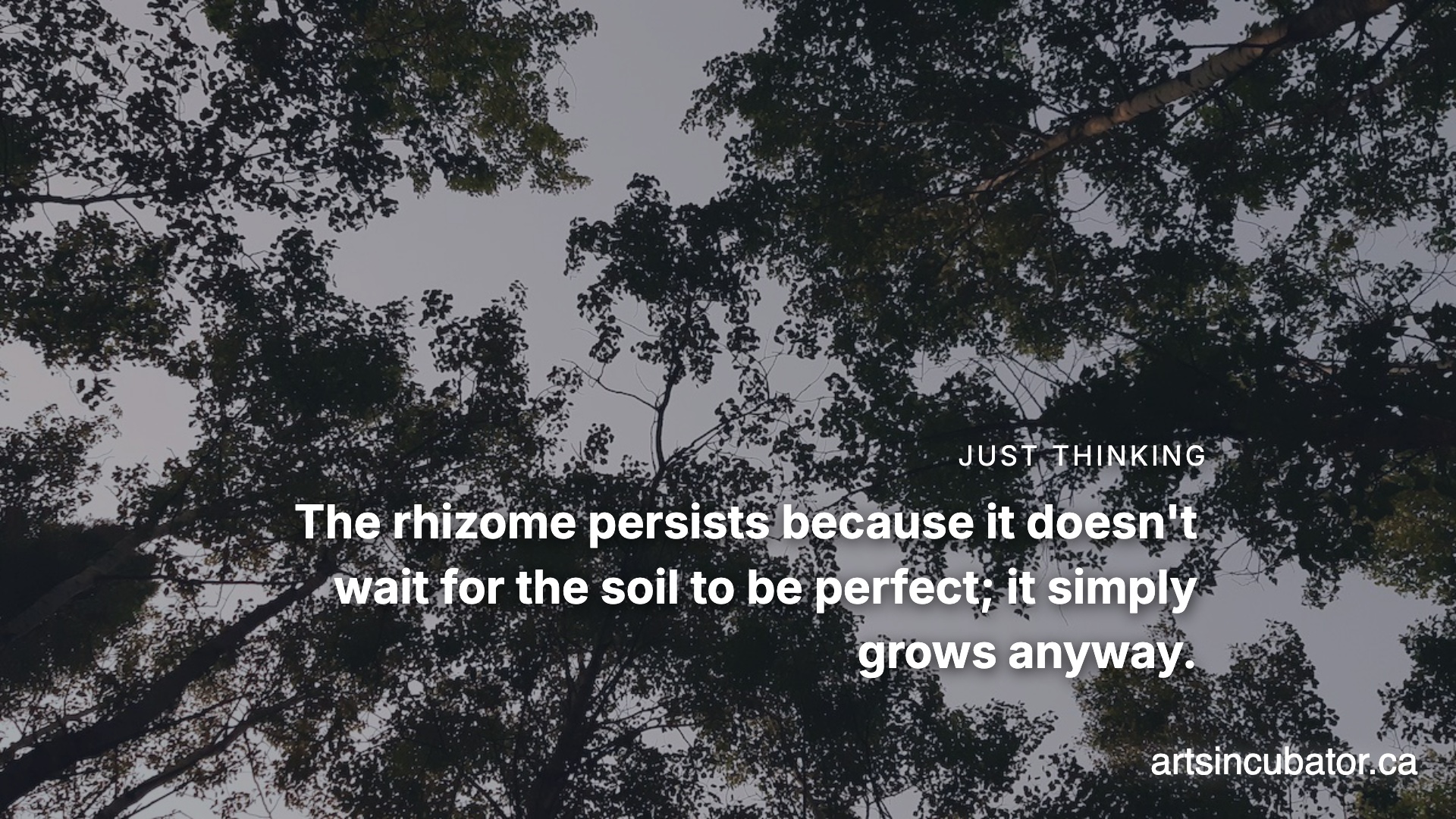
We are currently navigating a landscape where the ground is literally shifting beneath our feet, a tangle of provincial neglect and federal promises. But the rhizome persists because it doesn’t wait for the soil to be perfect; it simply grows anyway. Your practice is a thread in a much larger network of survival that stretches back through every recession and every frozen winter. By refusing to be erased, you are creating a legacy of presence. It is a quiet, stubborn dignity that says we were here, we felt this, and we refused to be silent.
Sustainability is often discussed as a matter of grants and line items, but for those of us on the ground, it is a matter of memory. When a venue closes on Main Street, the music doesn’t just stop; it moves into the walls and into the stories we tell the next generation of kids with guitars. We are building an archive of feeling that cannot be defunded or deleted. You are not just making art; you are participating in a long, nonlinear conversation with everyone who ever tried to make something beautiful in this specific, difficult place.
You are the keeper of the unofficial record in a year that feels increasingly synthetic. Every time you collaborate with a newcomer or share a space with an elder, you are building a bridge that doesn’t show up on a city planning map. The arts are not just an economic engine; they are the only thing that keeps us from becoming a collection of strangers living in the same zip code. Do not let the fear of austerity shrink your vision. Your work is the evidence that we are still human, even when the world around us is trying to turn into a series of optimized data points.
Thoughts on art and the state of the world!
These fragments trace the rhizomatic flow of thought through art, life, and place — scattered impressions from studio corners, fleeting ideas scrawled in notebooks, whispered exchanges at galleries, and observations picked up on quiet northern roads. Some fragments linger on technique, intuition, and doubt; others drift through community, culture, and the subtle poetry of everyday moments. They offer no conclusions, only openings, inviting readers to follow connections wherever they emerge.
Wandering laterally between process, memory, and environment, these pieces map associations across creativity, identity, and belonging. They intersect with humor, failure, resilience, and collaboration, and trace the ways artistic thinking seeps into gardens, small-town rhythms, friendships, and civic life across Manitoba and Northwestern Ontario — and further afield. Each thought functions as a node, part of a living network of reflection, expanding and branching with possibility.
Discover more associative fragments, conceptual wanderings, and artful reflections on our thoughts page.