Navigating the invisible borders and quiet tensions that define our neighborhoods in 2026.
You stopped waving to the neighbor because you forgot which side of the invisible line they stand on.
It is strange how quickly a street can turn into a collection of bunkers. We aren’t fighting a war, but we are certainly bracing for something that never quite arrives. In Winnipeg, the silence between houses feels heavier than the snowdrifts these days. It is a dense, accumulated quiet. You walk down the sidewalk and feel the weight of the things that aren’t being said—the suspicion about who voted for what, who came from where, and who can actually afford to stay. We have built invisible borders out of our anxieties, and now we have to live inside the geometry of our own hesitation. The community isn’t broken; it is just holding its breath until the oxygen runs out.
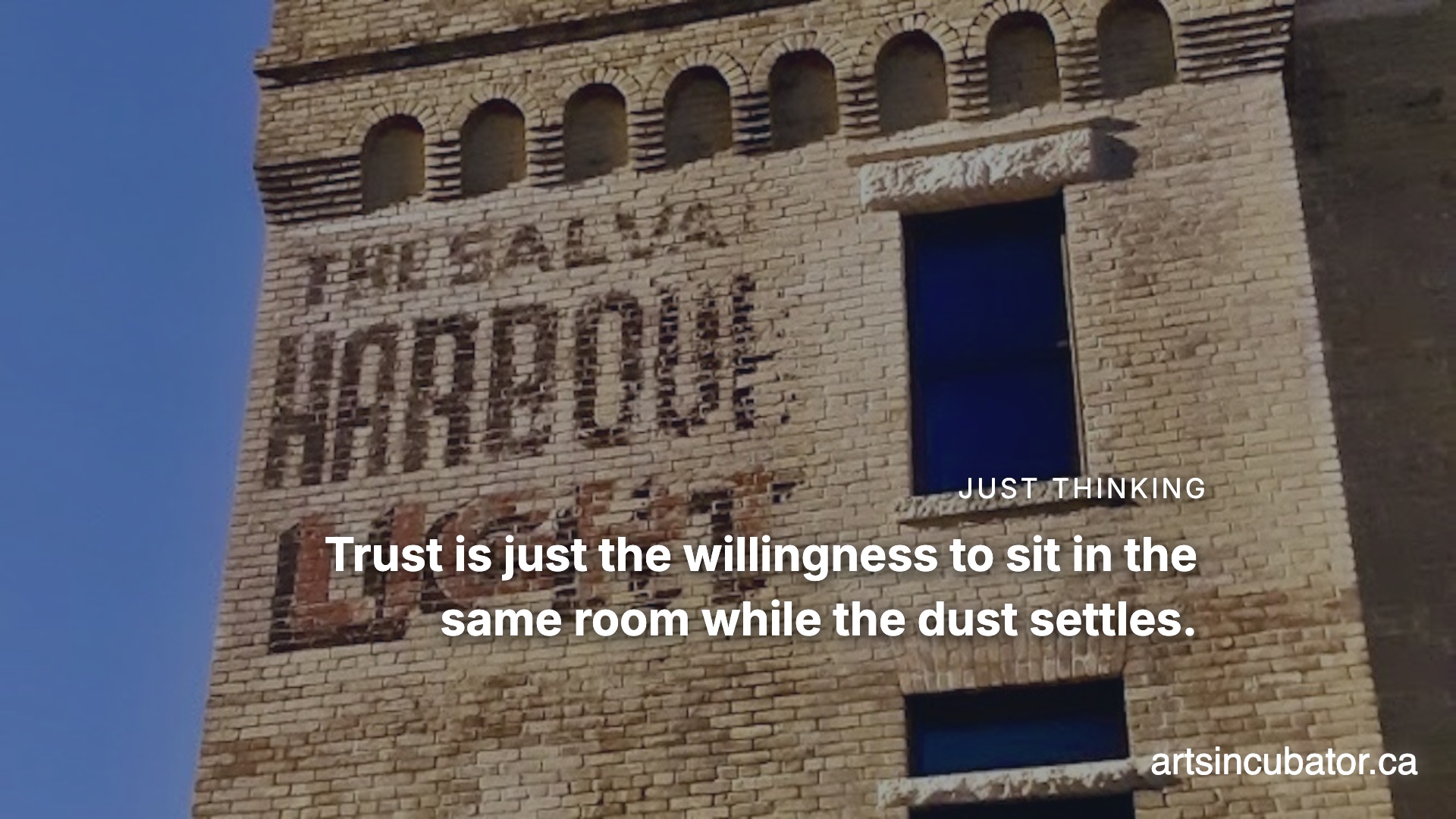
Think about the way dust settles in an empty room. That is what our social trust looks like right now. It covers everything in a fine, grey film. We look at each other and see the residue of online arguments and demographic shifts rather than the person shivering at the same bus stop. The “us” and “them” narrative has become a form of haunting. We are turning our living neighbors into ghosts before they are even gone, rendering them transparent because it is easier than navigating the friction of being different in the same postal code. We are the archivists of a city that is forgetting how to speak to itself.
But here is the thing about echoes: they prove that a space is not empty. When you create art in this landscape—whether it is a zine left on a park bench or a projection on the side of a library—you are engaging in a form of acoustic testing. You are shouting into the void just to see what bounces back. We need art that functions like echolocation. We need to map the shape of these invisible walls so we can figure out where the doors used to be. It is not about forcing a resolution or painting a happy mural over a cracked foundation. It is about acknowledging the crack. It is about tracing the dust.
When we welcome newcomers—refugees, migrants, people displaced by the fires or the floods—we are often offering them a blueprint that doesn’t match the territory anymore. We invite them into a system that is already partitioning itself into safety zones. Real hospitality in 2026 requires us to sweep the floor. It requires us to sit with the discomfort of not knowing the person across from us and refusing to let that unknowing turn into fear. We have to be willing to inhabit the silence together without rushing to fill it with platitudes.
So, let the work be slow. Let the connections be tentative. We are recovering from a long period of social isolation that morphed into social suspicion. The art we make now should feel like an excavation. We are brushing away the layers of accumulated distance to find the floorboards again. It is okay if the house is messy. It is okay if the conversation halts and stutters. The dignity is not in the perfection of the dialogue, but in the stubborn refusal to leave the room. Stay in the doorway. Listen to the echo. The dust is only settling because the foundation is finally holding still.
Oh, Canada.
These fragments drift along the rhizomatic currents of thought, skimming art, life, and place — glimpses from shadowed studio corners, half-formed ideas muttering in margins, murmured exchanges in quiet galleries, and impressions gathered from northern roads where silence bends the light. Some fragments linger on gesture, intuition, and uncertainty; others move through community, culture, and the ephemeral music of everyday patterns. They draw no conclusions, only openings, inviting readers to wander along the tangled networks they trace.
Wandering sideways through process, memory, and atmosphere, these pieces map intersections of creativity, identity, and belonging. Humor, failure, resilience, and collaboration pulse through them, along with the subtle seep of artistic thought into gardens, small-town rhythms, friendships, and civic life across Manitoba and Northwestern Ontario — and beyond. Each fragment acts as a node, part of an expanding, branching lattice of reflection, where meaning emerges in motion rather than resolution.
Explore more associative fragments, drifting concepts, and artful wanderings on our thoughts page.