Reclaiming our humanity from the blur of the algorithmic grind.
How fast do you have to scroll before your own hands look like strangers? You are vibrating at a frequency that feels suspiciously like panic.
The algorithm doesn’t want you to sleep; it wants you to process. You know that specific nausea of the 3 AM doom-scroll where the news about the shrinking boreal forests blends seamlessly with an ad for vitamin supplements. It is a centrifugal force. It pushes everything to the edges until the center—your actual life, your neighbors, the snow piling up on Portage Avenue—feels hollowed out. We are living in the “Great Blur.” Jobs appear and vanish like pop-up windows. You are coding for a startup that won’t exist next Tuesday, or delivering food to a ghost kitchen that is just a QR code on a back door. The labor is invisible because it is moving too fast to be seen.
We are becoming digital ghosts haunting our own timelines. The divide between “us” and “them” isn’t a wall anymore; it’s a bandwidth issue. You can’t empathize with a blur. When interaction is reduced to a swipe, humanity gets compressed into a jpeg that doesn’t load. The anxiety you feel isn’t a disorder; it’s motion sickness. You are trying to stand still on a planet that is spinning faster than your inner ear can handle. The systems of 2026 are designed for velocity, not for people. We are just the fuel for the engine, burnt up to keep the frame rate high.
So, how do we hack the momentum? We induce a lag. A deliberate, jagged stutter in the stream. Art in this city needs to be the dropped frame that forces the viewer to reboot. It’s not about painting a pretty picture of the Red River; it’s about creating a performance so slow, so deliberate, that it physically hurts to watch it with a dopamine-fried brain. We need to reclaim the right to be heavy. To be inefficient. To take up space without generating data.
Think of a drum circle in a park that drowns out the traffic noise. That is acoustic resistance. Think of a zine printed on physical paper that you have to hand to someone, forcing eye contact. That is pure inertia. Every time you make something that cannot be optimized, scaled, or swiped, you are throwing a wrench into the turbine. We are building a culture of the “glitch.” The mistake is the only place where the algorithm can’t follow you.
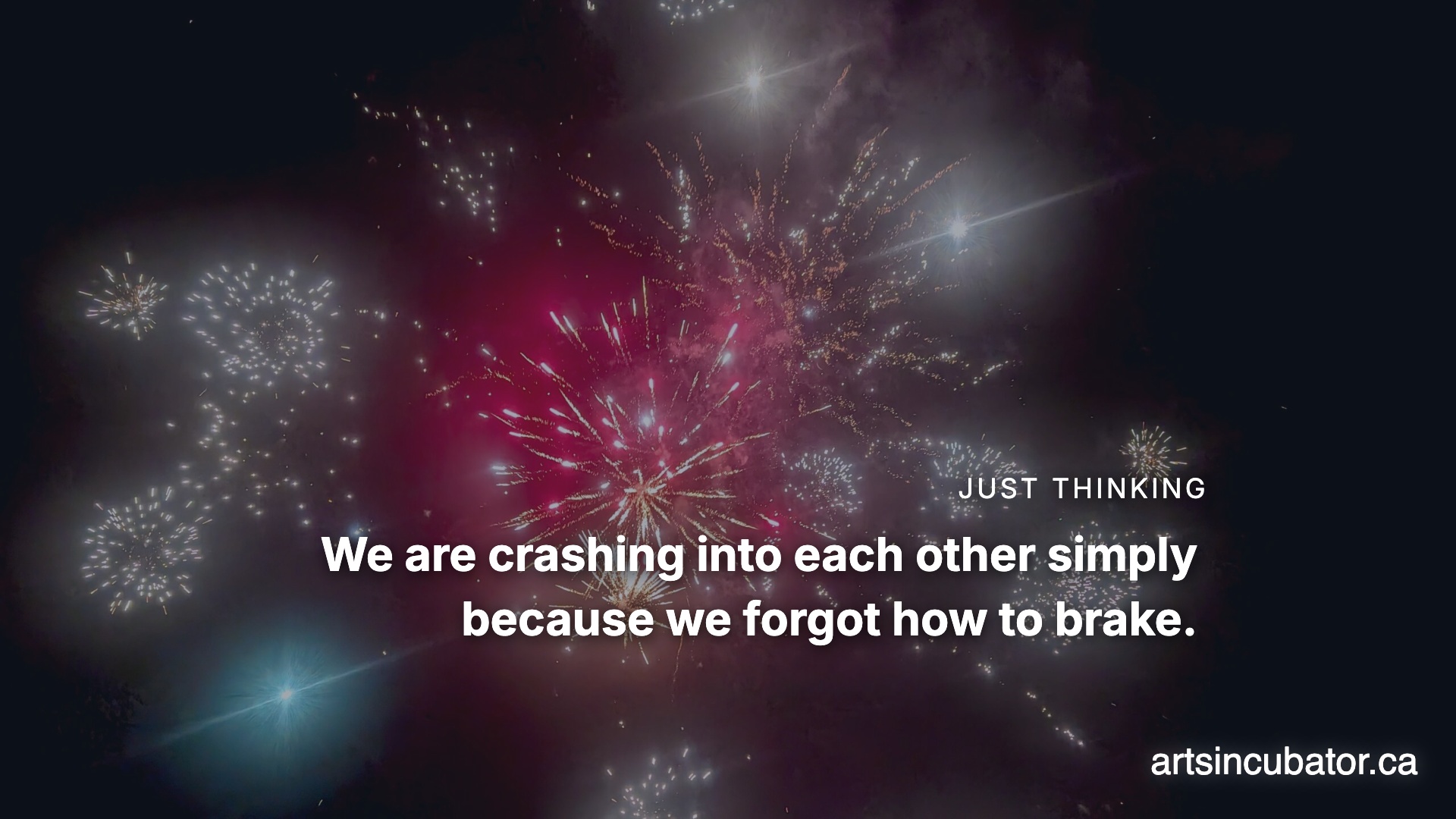
The divides in our community—the vanishing security, the tension on the bus—are symptoms of the acceleration. We are crashing into each other because we forgot how to brake. But there is hope in the collision. When we actually stop—at a gallery opening, a protest, or just a stalled car in a drift—we remember that we have faces. We are not data points. We are the drag coefficient on a runaway world. Don’t try to catch up. Sit down. Let the stream rush past. Be the obstacle.
Oh, Canada.
These fragments drift along the rhizomatic currents of thought, skimming art, life, and place — glimpses from shadowed studio corners, half-formed ideas muttering in margins, murmured exchanges in quiet galleries, and impressions gathered from northern roads where silence bends the light. Some fragments linger on gesture, intuition, and uncertainty; others move through community, culture, and the ephemeral music of everyday patterns. They draw no conclusions, only openings, inviting readers to wander along the tangled networks they trace.
Wandering sideways through process, memory, and atmosphere, these pieces map intersections of creativity, identity, and belonging. Humor, failure, resilience, and collaboration pulse through them, along with the subtle seep of artistic thought into gardens, small-town rhythms, friendships, and civic life across Manitoba and Northwestern Ontario — and beyond. Each fragment acts as a node, part of an expanding, branching lattice of reflection, where meaning emerges in motion rather than resolution.
Explore more associative fragments, drifting concepts, and artful wanderings on our thoughts page.