Broken Glass and Bare Soles
by Jamie F. Bell
The Founders' Lawn
A sweltering, overly opulent garden party at a sprawling estate, where the weight of familial expectation clashes with the messy reality of a humid summer evening.
The tray of champagne flutes hit the limestone pavers with a sound that was less of a crash and more of a melodic, sparkling sigh. It was a shatter that seemed to have been composed by a conductor, perfectly timed to interrupt the crescendo of Arch-Dean Peterson’s speech regarding the 'immutable virtues of legacy.'
Joel did not drop the tray. He wasn’t a waiter. He was the son of the host, standing three feet to the left of the podium, encased in a cream-colored linen suit that cost more than a mid-sized sedan and felt like wearing a damp wool blanket in a sauna. The tray had been held by a server who had tripped over the invisible, suffocating tension that seemed to radiate off Joel in waves.
The crowd—a sea of pastel fascinators, seersucker, and faces pulled tight by years of aggressive dermatology—gasped in unison. It was a theatrical, practiced sound. A collective intake of breath that sucked the oxygen right out of the humid July air.
And in that vacuum, Joel felt it. The snap.
It wasn’t loud. It wasn’t the cracking of a bone or the tearing of a ligament, though he was intimately familiar with both sensations thanks to the 'disciplinary rigor' his father favored. This was quieter. It was the sound of a very heavy tether, worn thin by years of friction, finally parting. The silence that followed the shattered glass was absolute. A hundred pairs of eyes shifted from the glistening shards to Joel, waiting for him to apologize, to signal that the play would continue, that he would resume his role as the obedient prop in the Peterson dynasty’s long-running tragedy.
He looked at the glass. He looked at the server, a terrified boy of maybe nineteen whose face had gone the color of curdled milk. Then, Joel looked at his father.
Reginald Peterson stood frozen, his hand halfway to his lapel, his face a mask of purple indignation struggling to maintain the geometry of a smile. His eyes, however, were screaming. They promised later. They promised the library, the closed door, the hushed, violent lecture about embarrassment and standards and the physical cost of failure.
Joel’s left eye twitched. Just once. A tiny, physiological rebellion.
"I believe," Joel said, his voice terrifyingly steady, projecting with the elocution lessons that had stolen his Saturdays for a decade, "that the entropy of this evening has reached its critical mass."
He stepped off the dais. He didn’t check to see if his father was following. He didn't check the server. He simply stepped down, the sole of his Italian loafer crunching audibly onto a shard of crystal. He didn't flinch.
From the periphery of the manicured lawn, in the shadow of a topiary shaped suspiciously like a weeping angel, Stephan watched. He adjusted the cuff of his own jacket—dark charcoal, entirely too heavy for the weather, armor against the frivolity. He took a sip of lukewarm tonic water and felt a distinct, cold thrill run down his spine. It wasn’t fear. It was the sensation of watching a dam burst in slow motion.
Stephan had been hired to manage the estate’s archives, a job that mostly involved keeping Reginald’s vanity projects in alphabetical order. He was the grounded element in this chaotic equation, the dust to their glitter. He had spent six months watching Joel from across mahogany desks and crowded ballrooms, observing the way the younger man flinched when doors slammed, the way he cataloged exits in every room like a spy in enemy territory.
Stephan set his glass on the stone railing of the terrace. He didn’t run. Running was for prey. He moved with the predatory grace of a man who knows exactly where the target is going because he has been mapping their trajectory for weeks.
Joel was walking toward the woodland border. The manicured lawn, green as envy, gave way to the unruly, tangled messy reality of the actual forest. It was a boundary line. Civilization on one side, wild anarchy on the other. Joel crossed it without breaking stride.
The heat under the canopy was different—wetter, heavier, smelling of rotting logs and sweet honeysuckle. It was a physical weight. Joel walked until the sounds of the string quartet were strangled by the density of the oak trees. He stopped in a small clearing where an old folly, a mock-Roman ruin built by his great-grandfather, crumbled in ironic solidarity.
He leaned against a moss-covered column and began to unbutton his jacket. His fingers were shaking. Not a little. A lot. Like a hummingbird trapped in a ribcage.
"The structure of the event was flawed from the outset," a voice said from the path behind him. Deep, resonant, grave.
Joel didn’t jump. He froze, his hand clutching the lapel of his jacket. He turned his head slowly, the movement stiff, mechanical. "Stephan. You are… out of bounds. The archives are in the west wing."
Stephan stepped into the dappled light. He looked out of place among the ferns, too sharp, too monochrome. "And you are out of uniform," Stephan replied, his gaze dropping to where Joel had torn the top button of his shirt in his haste. "Your father will note the discrepancy."
"My father," Joel said, testing the word like it was a piece of meat that had gone bad, "is currently calculating the cost of the crystal and the social capital lost. He will not notice my absence for another twelve minutes. The toast to the donors takes precedence."
"Nine minutes," Stephan corrected, closing the distance between them. He stopped five feet away. The respectful distance of a subordinate. The intimate distance of a conspirator. "He cut the speech short. He is looking for you."
Joel laughed. It was a jagged, ugly sound that had no place in a comedy of manners. "Let him look. I’ve decided to resign my commission."
"This is a family, Joel, not a regiment."
"Is there a difference?" Joel slumped against the stone, the fight draining out of his posture, leaving only the raw, throbbing exhaustion. "The uniforms are better tailored, perhaps. The casualties are quieter."
Stephan watched him. He saw the bruise on Joel’s wrist, partially hidden by the expensive watch. He saw the way Joel held his breath, as if breathing itself was a privilege that could be revoked. The urge to cross the remaining five feet was a physical ache in Stephan’s chest, a magnetic pull that ignored protocol.
"You’re bleeding," Stephan said softly.
Joel looked down. The shard of glass had pierced the thin leather of his shoe. A small bloom of red was spreading on the cream linen of his trouser cuff. "So I am. How poetic. A stigmata of the bourgeoisie."
"Sit down," Stephan commanded. It wasn't a request.
Joel blinked, surprised by the tone. He sat on the base of the ruined column. Stephan knelt before him. The inversion of status was dizzying. The archivist on his knees before the heir, but Stephan held all the power in the way his large, steady hands reached out.
Stephan didn’t ask permission. He took Joel’s foot, resting it on his thigh. The heat of Stephan’s leg burned through the fabric of his trousers. Joel felt a flush rise up his neck, a physiological betrayal. His heart hammered against his ribs, not from fear, but from the terrifying intimacy of being touched with care.
"This will ruin your suit," Joel whispered, staring at the top of Stephan’s head, the dark hair neatly parted.
"It’s charcoal," Stephan murmured, not looking up. "It absorbs everything. That is its function."
He carefully worked the loafer off. The movement was slow, deliberate. Friction. Heat. The slide of leather against skin. Joel let out a breath he didn’t know he was holding. The air between them thickened, charged with something that tasted like ozone—no, like copper and rain.
Stephan inspected the sole of the foot. A small shard was embedded in the heel. "This will hurt."
"Everything hurts," Joel said, his voice drifting. "The shoes. The conversations. The way he looks at me when I eat. The way he… corrects me."
Stephan paused. His hand tightened around Joel’s ankle. A clamp. An anchor. "He won’t correct you today."
"He will. He always does. He’ll find me, and he’ll smile that shark smile, and he’ll guide me back to the tent by my elbow, gripping just hard enough to bruise the nerve, and I will go. Because I always go."
"No," Stephan said. He pulled the glass out. Fast. Clean.
Joel hissed, his toes curling against Stephan’s thigh.
Stephan tossed the bloody shard into the ferns. He didn’t let go of Joel’s ankle. He ran his thumb over the arch of the foot, a soothing, rhythmic stroke that sent shockwaves up Joel’s leg. "You aren't going back, Joel. You shattered the glass. You broke the set."
"I can’t leave," Joel whispered, the theatrical facade crumbling, revealing the terrified child beneath. "I have no money. I have no skills. I have a degree in Art History and a profound knowledge of which fork to use for escargot. I am useless in the wild."
Stephan looked up then. His eyes were dark, heavy with a seriousness that made Joel’s stomach flip. "You are not useless. You are simply… misallocated."
"And you?" Joel asked, his voice trembling. "Are you here to inventory me? To return the stray asset to the vault?"
"I am here," Stephan said, his voice dropping an octave, rumbling through the contact point at Joel’s ankle, "because I saw you walking toward the woods, and for the first time in six months, you looked like you were actually breathing. And I decided I preferred you that way."
The silence that followed was heavy, filled with the chittering of cicadas and the distant, muffled applause from the lawn. It was a bubble of reality separate from the farce up the hill.
Joel looked at Stephan—really looked at him. He saw the tension in the man’s jaw, the restraint in his shoulders. He realized, with a jolt of vertigo, that Stephan was furious. Not at him. For him.
"I have a car," Stephan said. "It is a hatchback. It has a dent in the rear bumper and the air conditioning is temperamental. It is parked at the service gate."
Joel stared at him. "A hatchback?"
"It is utilitarian. It moves from point A to point B without requiring a speech."
"And where is Point B?"
"Away," Stephan said. "Anywhere that isn't here."
Joel pulled his foot back, but Stephan didn’t let go immediately. He let his hand slide slowly down the calf, lingering for a fraction of a second too long, a silent promise of support. The friction was electric. It made Joel’s skin prickle.
"He will call the police," Joel said, anxiety clawing at his throat. "He will say I’ve been kidnapped."
"You are twenty-three years old," Stephan stated, standing up and brushing dirt from his knees. He loomed over Joel, blocking out the sun, a solid wall of dark fabric and resolve. "You are legally an adult. And if he calls the police, I will show them the archives. specifically the ledger from 1998 regarding the offshore accounts."
Joel’s eyes widened. "You have that?"
"I’m an archivist, Joel. I keep everything." Stephan extended a hand. "Come with me."
It was a tableau straight out of a melodrama, Joel thought hysterically. The dark stranger offering salvation in the woods. But the sweat trickling down his back was real. The throb in his foot was real. And the fear of walking back up that hill, of seeing his father’s face, was so potent it tasted like bile.
He looked at Stephan’s hand. It was broad, calloused from handling old paper and heavy boxes. It was a working hand. A hand that could build things. Or dismantle them.
"I…" Joel started, then stopped. He looked at his ruined shoe. He kicked it off. Then he kicked off the other one.
"Barefoot?" Stephan asked, a dry note of amusement in his voice.
"The shoes were pinching," Joel said, standing up. He wobbled slightly, and Stephan caught him. His hands gripped Joel’s waist—firm, possessive, steadying. The contact burned. Joel could feel the individual fingers through the linen of his shirt.
They stood there for a moment, suspended in the amber light of the late afternoon. Joel could smell Stephan now—soap, old paper, and something uniquely human and warm. He wanted to lean in. He wanted to bury his face in that charcoal jacket and hide. But he didn’t. He stood on his own two feet, the moss cool against his soles.
"I don't have my wallet," Joel said.
"I have money," Stephan replied. "Enough for gas. Enough for a motel."
"A motel," Joel repeated, the word sounding exotic and dangerous. "With the vending machines?"
"And the questionable carpet. Yes."
Joel took a breath. It was the first full breath he had taken all day. It hurt, expanding his ribs against the constraints of his tailor-made prison. "Lead the way, Mr. Archivist."
They moved through the woods, away from the path, away from the folly. Stephan led, pushing aside branches, creating a wake for Joel to follow. They didn’t speak. There was no need for the witty banter or the layered subtext of the drawing room. The sound of their breathing, the snap of twigs, the distant, angry hum of the gala fading behind them was dialogue enough.
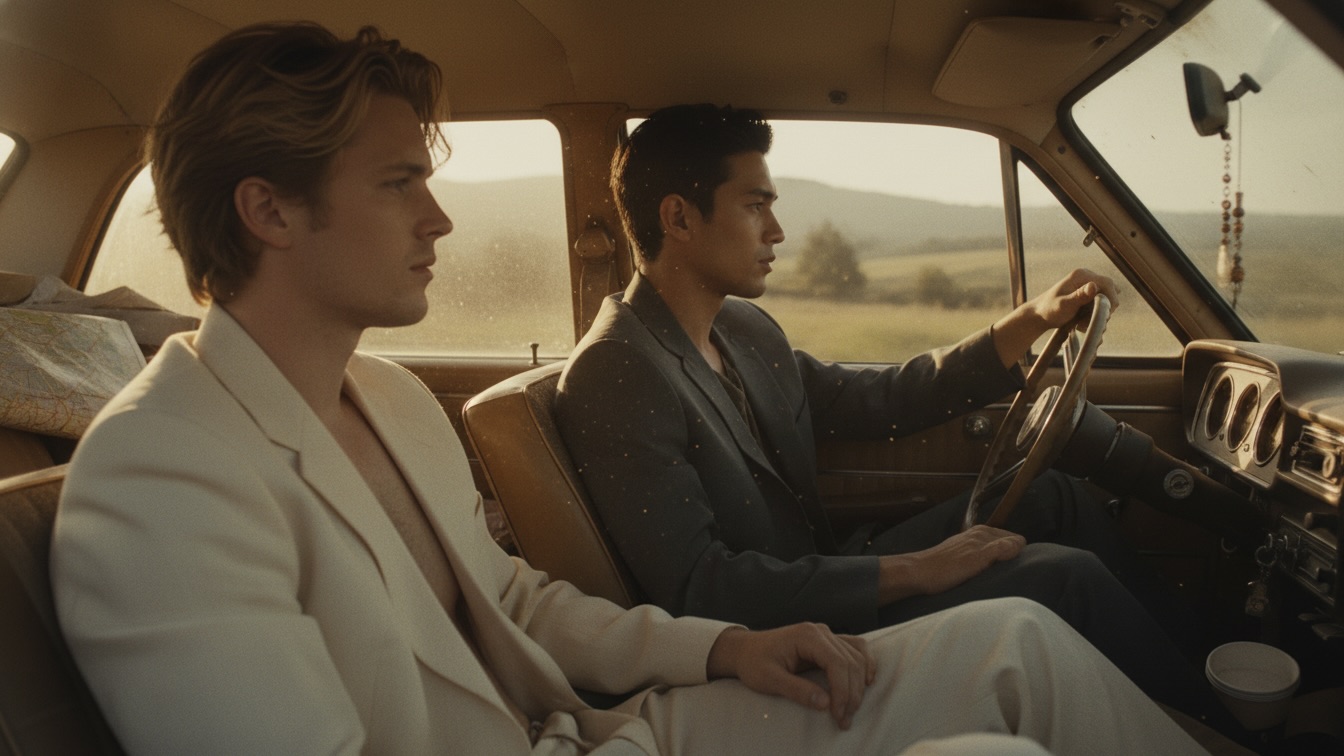
When they reached the service gate, the rusty iron hinges groaned in protest. Stephan’s car was there—a beaten-up grey thing that looked beautiful in its ugliness. Stephan unlocked the passenger door.
Joel paused. He looked back up the hill, towards the manicured perfection he was leaving. He thought of his father. He thought of the bruising grip on his arm. He thought of the endless, suffocating expectations.
Then he looked at Stephan, who was holding the door open, waiting. Not pushing. Just waiting.
Joel got in. The seat was hot. The upholstery was scratchy. It smelled of stale coffee.
It smelled like freedom.
Stephan got in the driver’s side. He cranked the engine. It sputtered, then roared to life with a rattle that shook the frame. He looked at Joel.
"Ready?"
Joel looked at his bare feet on the rubber floor mat. He looked at his hands, empty of crystal, empty of obligation. He looked at Stephan, whose eyes were fixed on him with an intensity that made the air in the car feel thin.
"Drive," Joel said. "Before I remember that I’m supposed to be terrified."
Stephan put the car in gear. As they pulled away, tires kicking up gravel, Joel reached out and turned on the radio. It was static, just white noise. He didn’t change the station. He let it hiss, a chaotic, beautiful counterpoint to the silence of his past life.
Stephan’s hand dropped from the gearshift to the space between the seats. It didn’t retreat to the wheel. It stayed there, palm up. An offer.
Joel stared at it. Then, slowly, tentatively, he reached out and laid his hand in Stephan’s. Their fingers interlaced. Stephan squeezed, hard. A promise. A verdict.
They didn’t look back.
To the Reader
“Breaking the mold of your life feels like destruction, but often, the wreckage is the only place where something real can finally grow. You do not need permission to walk away from what hurts you; the door was unlocked the whole time.”
Share This Story


