Athletic Tape and Truth
by Jamie F. Bell
The Concrete Underbelly of the Stadium
Following a locker room assault, Jude and Tom share a tense, secluded moment in the parking lot and inside a car, surrounded by the sensory details of an autumn evening.
"You make a sound like a dying radiator when you breathe. You know that?"
That was Miller. Miller, who possessed the intellectual depth of a damp towel and the physical density of a vending machine. He was currently pressing his forearm against my throat against the cold, gray lockers. The metal bit into my spine. It was a familiar sensation, like an old, unwanted friend.
"I said," Miller grunted, his breath smelling of grape Gatorade and stale anger, "you make a weird noise."
"It’s… asthma," I wheezed. Not true. It was panic. Pure, unadulterated, biological terror. But asthma sounded medical. Asthma was a weakness they understood. Panic was a weakness they feasted on.
"Freak," Miller muttered. He didn't hit me. Not today. He just let gravity and leverage do the work, grinding my shoulder into the vents of the locker. The rest of the varsity squad—the gods of this suburban pantheon, worshiped by booster clubs and terrified freshmen alike—ignored us. They were busy with the rituals of the post-practice comedown: the snapping of towels, the aggressive application of body spray that smelled like chemical warfare, the loud, performative laughter that signaled they were the kings of the school.
I hated them. I hated the way they moved, all heavy limbs and entitled space. I hated the sound of their cleats on the concrete floor—a cacophony of clicks that sounded like a plague of beetles. I hated that I was the equipment manager, a glorified servant meant to wash their grass-stained polyester armor. And mostly, I hated that I was terrified of them.
Miller got bored. That was the only mercy with guys like him. Their attention spans were short. He shoved me one last time, a dismissive flick of his wrist that sent me stumbling over a duffel bag, and turned away to high-five a linebacker named Trent.
I scrambled to gather the mesh laundry bag. My hands were shaking. I hate that. The shaking gives it away. It tells them they won. I gripped the fabric until my knuckles turned white, trying to force the tremors to stop, trying to make my nervous system behave.
Then, the room went quiet. Not silent—locker rooms are never silent—but the frequency changed. The chaotic, barking energy dropped into a lower, heavier register. The air pressure shifted.
Tom walked in.
He didn't look at anyone. He didn't have to. Tom Moore. The quarterback. The golden calf. The guy whose face was plastered on the banner downtown. He walked with a terrifying economy of motion, stripping off his practice jersey with a fluid, distracted grace. He didn't posture. He didn't yell. He just existed, and the rest of the room bent around him like light curving around a black hole.
He wasn't part of the noise. He was the silence.
He opened his locker—A1, naturally—and sat on the bench. He began to unlace his cleats. The action was precise. Loop. Pull. Knot. He didn't look up.
Miller and Trent quieted down. They drifted toward the showers, their loud jokes dying in their throats. It was pathetic, really. They were apex predators until the real lion showed up. Then they were just jackals.
I should have left. I had the laundry bag. I had an exit vector. But my feet felt like they were nailed to the floor. I watched Tom. I always watched Tom. It was a compulsion, a sickness. I watched the way the muscles in his back shifted as he leaned forward. I watched the sweat dripping from his hair, darker than the fluorescent lights allowed. I watched him, and I felt that familiar, sickening lurch in my stomach—half nausea, half hunger.
He stopped unlacing. He didn't turn his head. He just stopped.
"Miller," Tom said. His voice wasn't loud. It was a low rumble, barely audible over the hum of the ventilation system. But it cut through the room like a scalpel.
Miller froze near the shower entrance, a towel slung over his shoulder. "Yeah, Cap?"
"You missed a block on the slant route. Again."
Miller blinked, confused by the pivot to shop talk. "I slipped. The turf is—"
"If you touch the equipment manager again," Tom said, his tone flat, bored, almost clinical, "I will make sure you never see the ball inside the red zone for the rest of the season. I'll throw it into the dirt before I hand it off to you."
The silence that followed was absolute. It was heavy and thick, tasting of copper.
Miller turned a shade of red that clashed with his jersey. He looked at me, then at Tom, then back at me. He opened his mouth, closed it, and then muttered something unintelligible before disappearing into the steam of the showers.
I stood there, the laundry bag a heavy, damp weight in my arms. My heart was hammering against my ribs like a trapped bird. Tom hadn't defended me because it was right. He hadn't defended me because he cared. He did it because Miller was annoying him. That was the narrative. That was the safe story I told myself.
Tom turned then. He looked right at me. His eyes were dark, unreadable. There was no pity in them. Thank god. I could handle hate. I could handle indifference. Pity would have dissolved me right there on the tiled floor.
"You're bleeding," he said.
I touched my lip. My fingers came away red. I must have bitten it when Miller shoved me. "I'm fine," I said. My voice cracked. Humiliating.
"Wait outside," Tom said. It wasn't a request. It was an instruction. He turned back to his locker, dismissing me as effectively as he had dismissed Miller.
I walked out. I walked past the trophy case with its tarnished silver cups from 1982. I walked out the double doors and into the autumn evening. The air hit me like a slap—cold, crisp, smelling of burning leaves and damp asphalt. I stood by the brick wall of the field house, shivering in my thin hoodie, hugging the laundry bag like a lifeline.
Why was I waiting? I should run. I should get on my bike and pedal until my lungs burned and this town was a speck in the rearview mirror. But I stayed. I leaned against the rough brick, counting the cracks in the pavement, waiting for the one person who terrified me more than the bullies.
Ten minutes. The sky turned a bruised purple, the sun bleeding out over the western bleachers. The parking lot lights flickered on with a buzz—sodium vapor orange, casting long, unnatural shadows.
The door opened. Tom stepped out. He was wearing his varsity jacket now, the leather sleeves creaking softly. He had a duffel bag over one shoulder. He looked at me, scanned me from head to toe, assessing the damage.
"Car," he said. He jerked his chin toward the far end of the lot where his black Jeep was parked in the spot reserved for 'Team Captain'.
"I have to do the laundry," I said, gesturing stupidly to the bag.
"Leave it." He walked past me. He didn't check to see if I was following. He knew I would. That was the power dynamic. He was gravity. I was debris.
I dropped the bag inside the door and followed him. The walk across the lot felt miles long. The wind bit through my clothes. My shoulder throbbed where Miller had ground it into the metal. I felt small. I felt visible in the worst way.
We got into his Jeep. It smelled like leather, mint gum, and something uniquely Tom—clean, sharp, like rain on slate. He started the engine, the heater blasting life into my frozen fingers. He didn't drive away, though. He just let the engine idle.
"Let me see," he said.
"See what?" I feigned ignorance, staring out the windshield at the empty practice field.
"Jude." He said my name. He never said my name. It sounded foreign in his mouth, heavy and deliberate.
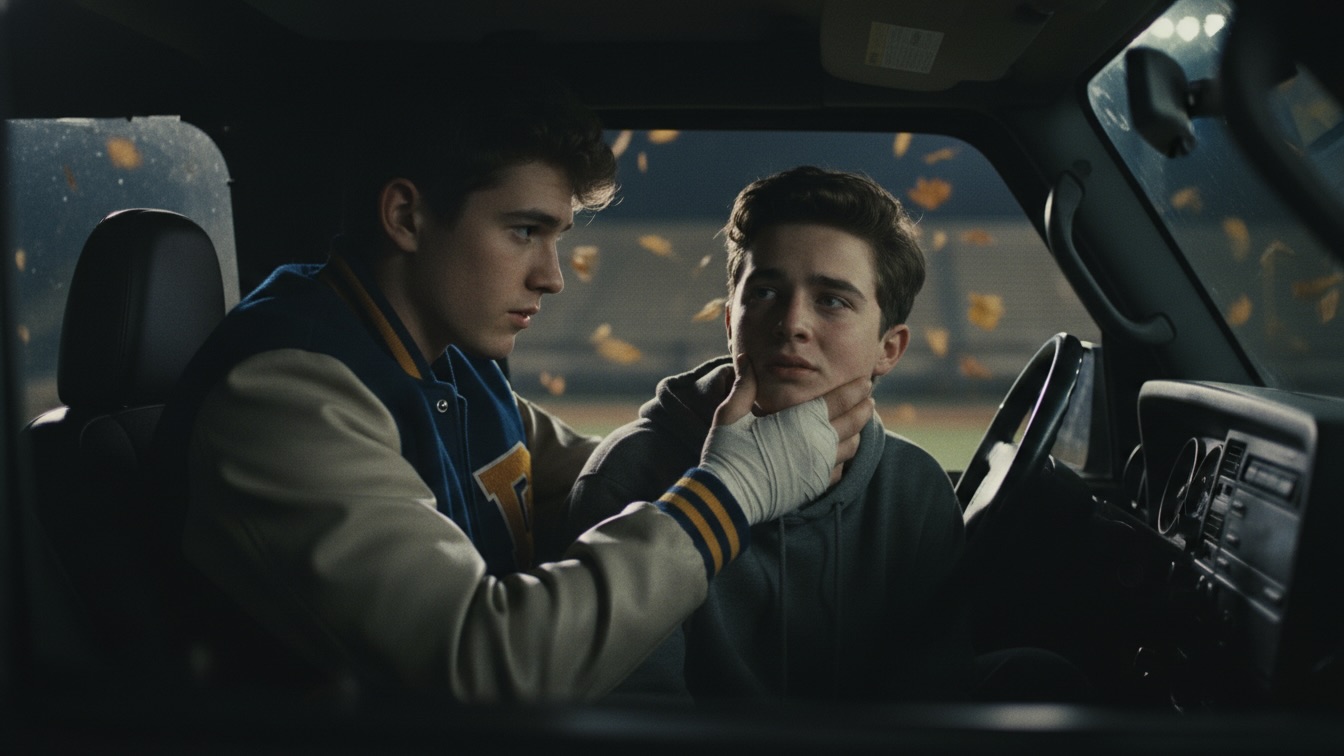
I turned to him. The cab was dark, lit only by the dashboard dials. He reached out. His hand hovered for a split second before touching my chin. His fingers were rough, calloused from the ball, from the weights. But his touch was… careful. Not gentle. Careful. Like he was handling something volatile.
He tilted my head to the side, inspecting the split in my lip. His thumb brushed against the corner of my mouth. The contact sent a jolt through me so violent I almost flinched away. It was electric. It was terrifying. My breath hitched, a jagged sound in the small space.
"It's not deep," he decided. He dropped his hand. The absence of his touch felt like a physical loss, a sudden drop in temperature.
He reached into the center console and pulled out a roll of athletic tape and a small first-aid kit. Of course he had one. He was prepared for everything. He was the Captain.
"Hand," he commanded.
I held out my hand. He took it. His palm was warm, dry, enveloping mine. He saw the scrape on my knuckles from where I'd hit the floor.
"Miller is a waste of genetic material," Tom said, uncapping a tube of antiseptic ointment. "But you... you just take it. Why do you just take it?"
The ointment stung. I hissed through my teeth. "What am I supposed to do, Tom? Fight him? He outweighs me by eighty pounds. He has a scholarship. I have... a laundry bag."
"You don't have to fight him to stop him," Tom said. He was wrapping my knuckles now, the tape winding tight, supportive. He was efficient, focused. He looked at my hand like it was a puzzle he was solving. "You just have to show him he can't break you."
"I am broken," I snapped. The bitterness welled up, spilling over. "That's the point. That's the joke. I'm the punchline of this whole school. I'm the weird kid, the quiet kid, the kid who cleans your jockstraps so he can put 'extracurriculars' on a college application for a school he can't afford."
Tom stopped wrapping. He didn't let go of my hand. He held it there, suspended between us over the gear shift.
"Is that what you think this is?" he asked. His voice was lower now, stripping away the command, leaving something raw underneath.
"I don't know what this is," I whispered. "I don't know why you're doing this. You ignore me for three years, and now you're playing nurse in the parking lot? Is this pity? Because I swear to god, Tom, if this is—"
"It's not pity." The words were sharp, angry.
He looked up. His eyes locked onto mine. In the dashboard light, they were intense, demanding. There was no mockery there. There was hunger. A terrifying, restrained hunger that mirrored the hollow feeling in my own chest.
"Then what?" I challenged him. I was terrified, but I was tired. I was so tired of the game. "Tell me. Why do you care if Miller snaps me in half?"
Tom looked at my mouth. Then my eyes. Then my mouth again. The air in the car grew thin. The static from the radio—which wasn't even on—seemed to buzz in my ears. I could hear his breathing. I could hear my own heart, a frantic drum solo against my ribs.
"Because," Tom said, and his voice cracked. The Golden Boy. The Captain. His voice cracked. "Because I can't focus when you're hurt. I can't throw the ball because I'm looking at the sideline to see if you're okay. I missed that block on purpose, Jude. I watched Miller hit you, and I froze."
My brain short-circuited. "You... what?"
"I watch you," he confessed. The words tumbled out, clumsy, unpolished. "I watch you fold the towels. I watch you reading those weird books on the bus. I watch you trying to be invisible. And it kills me. It drives me insane."
I stared at him. This was a hallucination. A concussion symptom. Tom Moore did not notice me. Tom Moore did not watch me.
"You're... joking," I breathed.
"Do I look like I'm joking?" He tightened his grip on my hand. It hurt, just a little. It was grounding. "I'm scared, Jude. I'm scared all the time. Everyone thinks I'm this... rock. But I'm just waiting for the other shoe to drop. I'm waiting to fail. And the only time I feel... quiet... is when I'm near you."
The confession hung in the air, heavy and undeniable. He was scared. He was like me. Under the armor, under the varsity jacket, he was just a scared kid trying to survive the expectations of a town that ate its young.
I looked at our hands. His, large and capable. Mine, slender and bruised. Wrapped together in white athletic tape.
"I like you," I said. The words fell out of my mouth before I could check them. Stupid. Suicidal. "I've liked you since freshman year. And I hate myself for it because I thought... I thought you were just like them."
Tom let out a breath, a shuddering exhale that seemed to deflate his entire frame. The tension in his shoulders dropped. The mask cracked completely.
"I'm not like them," he said softly. "I'm really trying not to be."
He leaned in. It wasn't a smooth movie move. He bumped his elbow against the steering wheel. He hesitated. He looked for permission.
I didn't pull away. I leaned forward, closing the gap. The space between us collapsed.
When his lips touched mine, it wasn't soft. It was desperate. It tasted of mint gum and adrenaline. It was clumsy and hard and real. His hand came up to cup the back of my neck, his fingers tangling in my hair, pulling me closer, anchoring me. The heat was overwhelming. It wasn't the warm fuzzies of a romance novel; it was the searing heat of a friction burn. It was the feeling of crashing a car and walking away without a scratch.
I grabbed the lapels of his jacket, pulling him in, needing to verify that this was physical matter, that this was happening in the grim reality of a high school parking lot.
He made a sound—a low groan in his throat that vibrated against my lips. It was the most honest thing I'd ever heard him say.
We broke apart, gasping, foreheads resting against each other. My pulse was roaring in my ears. The windows were beginning to fog up, blurring the outside world, erasing the stadium, the field, the locker room.
"Okay," Tom whispered. "Okay."
"Okay," I echoed. I didn't know what it meant. I didn't know what 'okay' looked like tomorrow. I didn't know how we existed in the daylight.
He pulled back, his eyes searching mine again. He ran his thumb over my cheekbone.
"You're staying with me tonight," he said. The command was back, but it was softer now. Protecive. "I'm not letting you go home to an empty house while you're hurt."
"My dad—"
"I'll call him. I'll say we're studying. It's not even a lie. You can teach me... whatever it is you read."
I laughed. A wet, shaky sound. "Philosophy. Satire."
"Great," Tom smirked, a crooked, boyish expression that made him look five years younger. "Teach me how to make fun of everything. I think I need that."
He put the Jeep in gear. As we drove out of the lot, the tires crunching on the gravel, I looked back at the school. It loomed there, a dark fortress of brick and expectation. The banner with Tom's face on it flapped in the cold wind, looking like a ghost.
I felt a hand on my knee. Tom. He wasn't looking at me; he was watching the road, his jaw set, his focus absolute. But he was touching me. He was claiming this space.
For the first time in my life, the cynicism receded, just an inch. The absurdity of it all—the football, the hierarchy, the pain—felt a little less crushing. We were two frauds in a world of make-believe giants.
But as we turned onto the main road, the streetlights cast long, skeletal shadows across the hood of the Jeep. The wind picked up, stripping the last of the dead leaves from the oaks, scattering them like dry bones across the asphalt. The darkness outside the car felt vast and hungry. We had this moment. We had the tape and the heat and the confession. But tomorrow, the locker room would still be there. Miller would still be there. The town would still demand its sacrifice.
Tom squeezed my knee, hard. I covered his hand with mine.
We were driving away from the arena, but I knew, with a sinking, cold certainty, that the game had only just begun. And this time, there were no referees to save us.
To the Reader
“Just as Jude realized that the strongest armor isn't made of polyester and pads but of being truly seen, remember that your own vulnerability is not a defect—it is the only way to let the light in. You are worthy of a love that doesn't ask you to hide.”
Share This Story


