Echoes in an Empty Room

Noah Cardinal refines his spoken-word poetry, a tapestry of family history and modern resilience, while an unexpected encounter at a local gallery brings him face-to-face with Evan, whose quiet observations begin to reshape his world.

The community hall swallowed sound, then returned it, stretched thin and vibrating. Noah Cardinal stood center stage, the worn floorboards beneath his sneakers cool against his arches. He ran a hand over his close-cut hair, a habit when he was trying to nail a rhythm. The air smelled faintly of old wood polish and the lingering ghost of coffee from the morning’s seniors’ bingo. He held his phone, not for notes, but for the timer. Five minutes, thirty seconds. He needed to tighten the transitions, make the breath catch in the right places.

“We build these houses with our hands,” he murmured, the words feeling dry in his mouth. He tried again, a little louder, inflecting the ‘build’ with a sense of generations. “We *build* these houses with our hands, but the current pulls, still, at the foundations.” He paused, letting the silence expand, then contract. The phrase needed to hit harder, like river stone against bedrock. He imagined his Kookum’s hands, gnarled and strong, shaping clay, tending a garden that fed half the reserve. His ancestors hadn't built physical houses, not in the colonial sense, but they had built community, tradition, resilience. That was the foundation. That was what he spoke for.

He paced, a loose-limbed energy humming beneath his skin. His hoodie was a comforting weight, the drawstrings pulled taut then released, a fidget. His next stanza began to roll off his tongue, picking up speed, a cadence that mirrored the drumming he sometimes heard at ceremonies, a deep, persistent pulse. “They ask where we’re from, with eyes that already know. They ask where we’re going, as if the path isn’t paved with their questions.” His voice gained a sharper edge, a controlled anger that felt earned. He thought of the micro-aggressions, the polite inquiries that were never quite polite, the assumptions that built walls higher than any brick and mortar.

He gestured, a slow sweep of his arm that indicated vast plains, then a tightening of his fist when he spoke of being cornered. It wasn’t about anger, not purely. It was about observation, about relaying a truth that often went unspoken, or unacknowledged, by those who didn’t live it. His head tilted, listening to the echoes, gauging if the message resonated even in the empty space. He had to feel it first, truly feel it, for anyone else to. This wasn't just performance; it was testimony.

The timer beeped, shrill and sudden, yanking him back. Five minutes, thirty-five seconds. Still a bit long. He needed to cut three lines from the middle, where the metaphor about the river ran a little too wide, a little too abstract. He scowled at his phone screen, then the scowl softened. A call was coming through. Maya. His sister.

“Hey, trouble,” he said, the shift in his voice immediate, lighter. He slipped off the stage, walking toward the hall’s side door, which opened to a small, enclosed garden, still stubbornly green despite the chill.

“Noah. You busy?” Maya’s voice was warm, tinged with a familiar weariness. She was juggling work, university, and their shared responsibility for their grandmother. He pictured her in their small apartment, probably stirring a pot of something fragrant on the stove, her textbook open beside it.

“Just finished practice,” he told her, rubbing his temples. “Still working out the kinks. How’s Kookum? Did she get her pills today?” He knew he sounded a little too protective, but he couldn't help it. Their Kookum was the anchor, the living memory of their family. Her well-being was paramount.

“Relax, Noah. She’s fine. Took them this morning. She’s actually… asking for you,” Maya chuckled, a soft, dry sound. “Wants to know when you’re coming over for stew. And she wants to see the new piece. The one about the river.”

Noah sighed, a slow release of tension. “Yeah, yeah. I’ll be over. Probably tomorrow. Got to finalize the performance for the gallery next week, and Iris wants me to swing by later today to confirm some logistics.” He pulled a stray leaf from a bush, crumbling it between his fingers. The sharp, green scent was invigorating.

“The gallery gig,” Maya mused. “That’s a big one. You nervous?”

“A little,” Noah admitted. “It’s a different crowd. More… formal. Less community-oriented than the usual spots. But Iris is making sure there’s a good balance. And it's a chance to reach people who wouldn’t normally hear these stories.” He thought about the delicate balance – presenting his heritage and experiences authentically, but in a way that bridged understanding, rather than alienating. It was a tightrope walk he was constantly perfecting.

“Well, you’ll be great,” Maya said, her confidence in him unwavering. “You always are. And seriously, don’t stress about Kookum. I’ve got it. Just focus on your art. We’re all proud of you, you know?”

He hummed, a grateful acknowledgment. They rarely said ‘I love you’ directly. It was in the stew, in the quiet check-ins, in the fierce loyalty. He watched a squirrel dart across the lawn, burying an acorn with frantic, determined movements. Life continued, even amidst the worries, the struggles, the poetry.

After he hung up, a stillness settled, heavy and soft. His mind, usually buzzing with words and rhythms, quieted. And then, a fleeting image surfaced, unbidden. The bus ride. The way light had caught on pale hair, glinting. The sharp line of a jaw, the way a hand had gripped a strap, tendons visible. Evan. The guy from the art class. He’d barely spoken to him, just a few words about a shared brush. But there was something about him, a quiet intensity in his eyes that had stuck. A pull, subtle but persistent, like the river’s current. He shook his head, a small, private smile playing on his lips. Funny how some people just… lodged in your brain.

Later that afternoon, the crisp air biting at his ears, Noah walked towards the 'Art Reach Gallery,' a converted warehouse space downtown. The area was a strange mix of old industrial grit and new, trendy boutiques. The gallery’s glass facade reflected the pale autumn sky, making it seem colder than it was. He pushed open the heavy glass door, a faint bell tinkling overhead. Inside, the space was vast and airy, smelling of fresh paint and something vaguely metallic. The opening for the new exhibit was still an hour away, but a few early birds were already milling about, murmuring quietly, a low hum of anticipation.

He spotted Iris Thompson, the gallery manager, near a large abstract sculpture, her silver hair pulled back in a neat bun, her movements precise as she adjusted a spotlight. Iris was a force – calm, knowledgeable, and a tireless advocate for community artists. He began to make his way towards her, navigating around a woman in a tweed jacket who was peering intently at a mixed-media piece.

As he passed, he saw him. Evan. He was standing near a large, minimalist painting, his head tilted, studying the brushstrokes with an almost scientific intensity. He wore a simple, dark sweater that made his fair skin seem even paler. His hands were tucked into his pockets, one shoulder hunched slightly. He looked… absorbed. Isolated, even, in the way he stood apart from the other early visitors. Noah’s breath hitched, just a fraction. He felt a sudden, inexplicable heat bloom in his chest, a flicker of something he couldn't quite name. The WBL spark. It felt exactly like that. An electric hum under his skin.

Their eyes met across the polished concrete floor. Evan’s gaze, previously lost in the art, snapped to Noah’s. A deer-in-headlights flicker, then a quick, almost imperceptible blush spread across his cheekbones. His lips parted, as if to speak, but no sound came out. He looked startled, as if caught doing something he shouldn't be. Noah felt a strange, pleasant tightening in his stomach. He offered a small, easy smile, a slight tilt of his head.

Evan gave a small, jerky nod in return, his eyes darting away, then back, then away again. He seemed to shrink into himself, his shoulders rising just a fraction. Noah wondered if he should approach, but then Iris’s voice, clear and resonant, cut through the space. “Noah! Perfect timing!”

He gave Evan one last, lingering look – Evan was now staring fixedly at the floor – and then turned towards Iris. As he moved, he was acutely aware of the warmth that still lingered where their gazes had met. It was a strange, charged silence that had passed between them, a language entirely unspoken.

“Iris,” he greeted, taking her offered hand. Her grip was firm, reassuring. “Everything ready?”

“As it can be,” she said, her eyes twinkling. “Just a few last-minute adjustments. Come, let me show you where your piece will be installed. I think you’ll like the spot; it gets excellent natural light.”

They walked together, Iris explaining the flow of the exhibit, the curation choices. Noah listened, offering his own insights. He glanced back once, almost involuntarily. Evan was gone. A pang of something, disappointment perhaps, shot through him. He shook it off. He was here for work.

They reached a quieter corner, where a large, framed canvas leaned against the wall, waiting to be hung. Noah’s name was on a small label beside it, indicating it was his original artwork, the visual component to his spoken-word piece. He ran a hand over the textured surface of the canvas, the paint still smelling faintly of linseed oil. It was a landscape, not literal, but evocative – swirling blues and greens, a faint suggestion of a river, and, at its heart, a stylized, almost abstract, depiction of a longhouse.

A woman in an expensive-looking scarf, the one from before, approached them. Her gaze swept over Noah, then over Iris, then settled on the painting. “Oh, this is lovely,” she said, her voice a little too loud in the quiet space. “Such… authentic lines. You must be the assistant, dear? Could you tell me who the artist is? I don’t see a proper label yet.” She gestured vaguely at Noah’s name, already printed on the small card, with a dismissive wave of her hand.

Noah felt a tightening in his jaw. It wasn't the first time. It wouldn't be the last. The assumption, immediate and ingrained. He was young, Indigenous, and standing next to a gallery manager. Ergo, not the artist. Never the artist. He took a slow breath, grounding himself.

Iris, ever the diplomat, gave a polite, firm smile. “Actually, ma’am, this *is* the artist. This is Noah Cardinal, whose work is featured in our ‘Voices of the Current’ exhibit. The label is right here.” She gestured to the card with Noah’s name, clear and bold. Her tone carried just a hint of steel, a subtle correction that wasn’t aggressive, but wasn’t to be ignored either. She caught Noah’s eye, a flash of shared understanding.

The woman’s smile faltered, replaced by a momentary, awkward flush. “Oh. Oh, I do apologize. I just assumed… well, never mind. It’s truly wonderful, Mr. Cardinal. Such raw talent.” She stumbled over the words, trying to recover, her gaze now fixed on Noah, a new, slightly uncomfortable respect in her eyes. The compliment, intended to smooth things over, felt cheap, an afterthought.

Noah offered a small, tight smile. “Thank you.” His voice was calm, even. He didn't elaborate. Didn't explain. Didn't make it easier for her. His dignity was not something he needed to justify. He just let the silence sit, heavy with the weight of her assumption, and her subsequent retraction. He didn't need to teach her with words; his presence, his quiet, unshakeable composure, did the work.

He caught a fleeting glimpse of movement. Evan. He had returned, now standing near a pillar, partially obscured, but clearly watching the interaction. His eyes were wide, a hint of something fierce in their depths. As Noah met his gaze, Evan flinched, then pressed his lips together, a deep furrow appearing between his brows. His hands, no longer in his pockets, clenched and unclenched at his sides. He hadn’t said a word, but his whole body was screaming a reaction. The effect was visceral, almost painful to witness. He understood. Evan got it.

The woman eventually mumbled another apology and drifted away, leaving Noah and Iris in a quiet understanding. “Some people,” Iris said, a sigh escaping her lips. “Always judging a book by its cover. Or a painter by… their race.” She gave Noah a sympathetic look. “You handled that beautifully, Noah. With grace. But it’s still infuriating, isn’t it?”

“It is what it is,” Noah said, shrugging, though the slight tension in his shoulders betrayed him. “Part of the territory.” He knew she understood. Iris, having worked with countless artists from diverse backgrounds, had seen it all. She saw the nuances, the quiet battles, the strength in resilience.

“Still,” Iris replied, “it’s why your voice, your poetry, is so vital. It carves out space. It reminds people to *see*.” She placed a gentle hand on his arm. “This exhibit means a lot, Noah. To the community. To me. To you, I hope.” Her words were not platitudes; they were solid, grounded. They spoke of a shared burden, a shared hope. It was a connection that transcended words, a quiet pact between two people dedicated to upliftment, to visibility. He felt the weight of that responsibility, but also the strength it gave him. It was a stark contrast to the quiet isolation he’d sensed in Evan earlier, a reminder of the different ways people navigated the world, some building walls, others bridges.

He glanced back at the pillar. Evan was gone again. Vanished. Noah felt a strange mix of frustration and a new, sharper curiosity. He wondered what Evan was thinking, what he felt. What had that look in his eyes meant? A quiet intensity, a sudden, surprising flash of anger on someone else’s behalf. It was unexpected. It was compelling.

Outside, the sky had turned a dull, heavy grey. A chill had set in, damp and penetrating. As Noah stepped onto the pavement, a single, fat snowflake drifted down, landing on his sleeve, dissolving instantly into a cold bead of water. Then another. And another. Soon, a soft, silent flurry began, the first heavy snow of the season. It wasn’t a blizzard, not yet, but a steady, persistent fall that promised to transform the city into something hushed and white by morning. He pulled his hoodie tighter, watching the flakes spin and dance. The city felt different already, quieter, ready for a change. He thought of Maya, of Kookum, of Iris, of the weight of his words, and the challenge of new audiences. He thought of Evan, a fleeting image on a bus, then a startled gaze in a gallery, a silent witness. The snow was coming down harder now, a clean slate, a soft blanket. He wondered what else this new season would bring, what other storms, literal and metaphorical, lay ahead, and what they would reveal about the vulnerabilities and defenses of the hearts caught within them.

As Noah reflects on the subtle interactions and the unfolding season, it prompts us to consider: what unexpected observations might reveal new pathways to connection, even in moments of quiet discomfort?
Echoes in an Empty Room

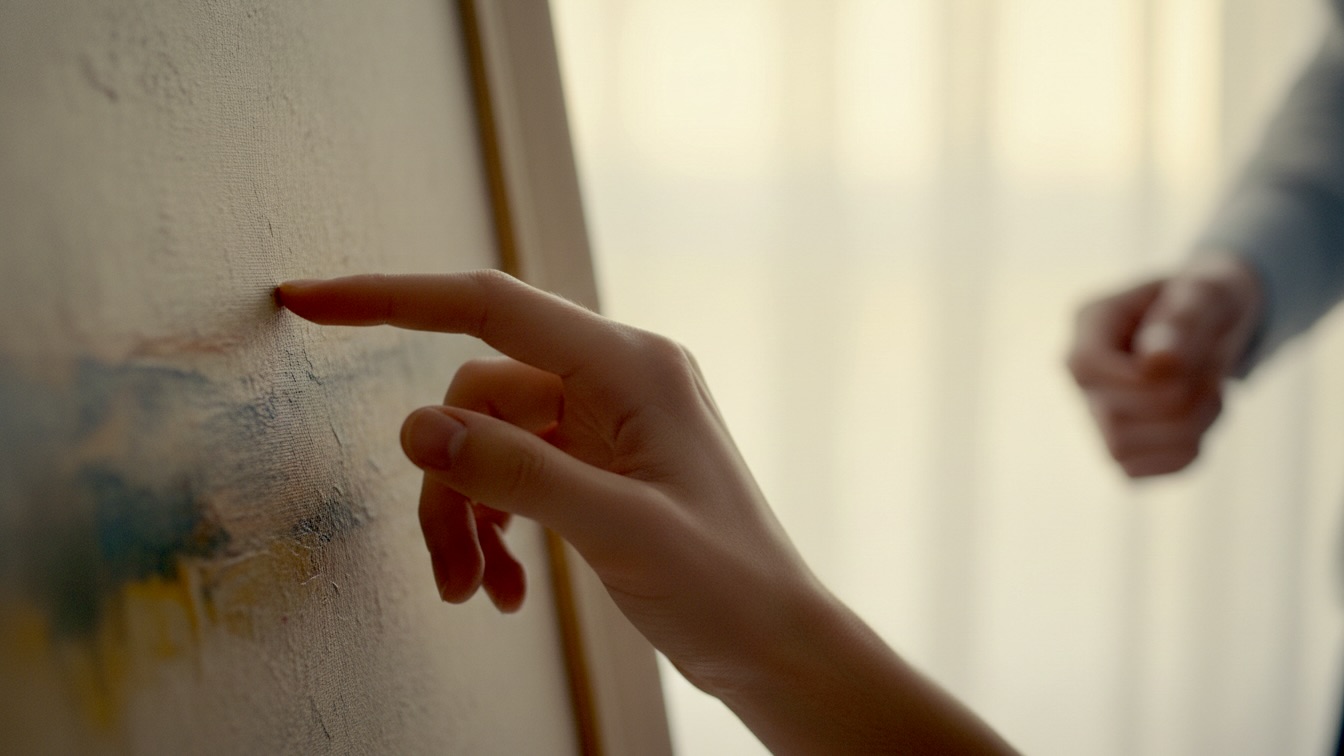
Close-up of Noah Cardinal's hand gently touching a painting in a gallery, with Evan's hand subtly visible and clenched in the soft-focus background. - Slice of Life Boys Love (BL), Romance, Spoken Word Poetry, Indigenous Heritage, Microaggression, Community Ties, Emerging Attraction, Emotional Intelligence, Quiet Dignity, First Snow, Short Stories, Stories to Read, Boys Love (BL), Boys Love, MM Romance, danmei, yaoi, shounen-ai, K-Boys Love (BL)
Noah Cardinal, a young Indigenous man, rehearses his spoken-word poetry in the quiet, echoing expanse of a community hall, his words weaving personal heritage with societal observations. Later, at a local gallery, he encounters Evan amidst an incident of subtle bias, and also connects with community elder Iris Thompson. Slice of Life BL, Romance, Spoken Word Poetry, Indigenous Heritage, Microaggression, Community Ties, Emerging Attraction, Emotional Intelligence, Quiet Dignity, First Snow, Short Stories, Stories to Read, BL, Boys Love, MM Romance, danmei, yaoi, shounen-ai, K-BL
• Slice of Life Boys Love (BL)
Noah Cardinal refines his spoken-word poetry, a tapestry of family history and modern resilience, while an unexpected encounter at a local gallery brings him face-to-face with Evan, whose quiet observations begin to reshape his world.

The community hall swallowed sound, then returned it, stretched thin and vibrating. Noah Cardinal stood center stage, the worn floorboards beneath his sneakers cool against his arches. He ran a hand over his close-cut hair, a habit when he was trying to nail a rhythm. The air smelled faintly of old wood polish and the lingering ghost of coffee from the morning’s seniors’ bingo. He held his phone, not for notes, but for the timer. Five minutes, thirty seconds. He needed to tighten the transitions, make the breath catch in the right places.

“We build these houses with our hands,” he murmured, the words feeling dry in his mouth. He tried again, a little louder, inflecting the ‘build’ with a sense of generations. “We *build* these houses with our hands, but the current pulls, still, at the foundations.” He paused, letting the silence expand, then contract. The phrase needed to hit harder, like river stone against bedrock. He imagined his Kookum’s hands, gnarled and strong, shaping clay, tending a garden that fed half the reserve. His ancestors hadn't built physical houses, not in the colonial sense, but they had built community, tradition, resilience. That was the foundation. That was what he spoke for.

He paced, a loose-limbed energy humming beneath his skin. His hoodie was a comforting weight, the drawstrings pulled taut then released, a fidget. His next stanza began to roll off his tongue, picking up speed, a cadence that mirrored the drumming he sometimes heard at ceremonies, a deep, persistent pulse. “They ask where we’re from, with eyes that already know. They ask where we’re going, as if the path isn’t paved with their questions.” His voice gained a sharper edge, a controlled anger that felt earned. He thought of the micro-aggressions, the polite inquiries that were never quite polite, the assumptions that built walls higher than any brick and mortar.

He gestured, a slow sweep of his arm that indicated vast plains, then a tightening of his fist when he spoke of being cornered. It wasn’t about anger, not purely. It was about observation, about relaying a truth that often went unspoken, or unacknowledged, by those who didn’t live it. His head tilted, listening to the echoes, gauging if the message resonated even in the empty space. He had to feel it first, truly feel it, for anyone else to. This wasn't just performance; it was testimony.

The timer beeped, shrill and sudden, yanking him back. Five minutes, thirty-five seconds. Still a bit long. He needed to cut three lines from the middle, where the metaphor about the river ran a little too wide, a little too abstract. He scowled at his phone screen, then the scowl softened. A call was coming through. Maya. His sister.

“Hey, trouble,” he said, the shift in his voice immediate, lighter. He slipped off the stage, walking toward the hall’s side door, which opened to a small, enclosed garden, still stubbornly green despite the chill.

“Noah. You busy?” Maya’s voice was warm, tinged with a familiar weariness. She was juggling work, university, and their shared responsibility for their grandmother. He pictured her in their small apartment, probably stirring a pot of something fragrant on the stove, her textbook open beside it.

“Just finished practice,” he told her, rubbing his temples. “Still working out the kinks. How’s Kookum? Did she get her pills today?” He knew he sounded a little too protective, but he couldn't help it. Their Kookum was the anchor, the living memory of their family. Her well-being was paramount.

“Relax, Noah. She’s fine. Took them this morning. She’s actually… asking for you,” Maya chuckled, a soft, dry sound. “Wants to know when you’re coming over for stew. And she wants to see the new piece. The one about the river.”

Noah sighed, a slow release of tension. “Yeah, yeah. I’ll be over. Probably tomorrow. Got to finalize the performance for the gallery next week, and Iris wants me to swing by later today to confirm some logistics.” He pulled a stray leaf from a bush, crumbling it between his fingers. The sharp, green scent was invigorating.

“The gallery gig,” Maya mused. “That’s a big one. You nervous?”

“A little,” Noah admitted. “It’s a different crowd. More… formal. Less community-oriented than the usual spots. But Iris is making sure there’s a good balance. And it's a chance to reach people who wouldn’t normally hear these stories.” He thought about the delicate balance – presenting his heritage and experiences authentically, but in a way that bridged understanding, rather than alienating. It was a tightrope walk he was constantly perfecting.

“Well, you’ll be great,” Maya said, her confidence in him unwavering. “You always are. And seriously, don’t stress about Kookum. I’ve got it. Just focus on your art. We’re all proud of you, you know?”

He hummed, a grateful acknowledgment. They rarely said ‘I love you’ directly. It was in the stew, in the quiet check-ins, in the fierce loyalty. He watched a squirrel dart across the lawn, burying an acorn with frantic, determined movements. Life continued, even amidst the worries, the struggles, the poetry.

After he hung up, a stillness settled, heavy and soft. His mind, usually buzzing with words and rhythms, quieted. And then, a fleeting image surfaced, unbidden. The bus ride. The way light had caught on pale hair, glinting. The sharp line of a jaw, the way a hand had gripped a strap, tendons visible. Evan. The guy from the art class. He’d barely spoken to him, just a few words about a shared brush. But there was something about him, a quiet intensity in his eyes that had stuck. A pull, subtle but persistent, like the river’s current. He shook his head, a small, private smile playing on his lips. Funny how some people just… lodged in your brain.

Later that afternoon, the crisp air biting at his ears, Noah walked towards the 'Art Reach Gallery,' a converted warehouse space downtown. The area was a strange mix of old industrial grit and new, trendy boutiques. The gallery’s glass facade reflected the pale autumn sky, making it seem colder than it was. He pushed open the heavy glass door, a faint bell tinkling overhead. Inside, the space was vast and airy, smelling of fresh paint and something vaguely metallic. The opening for the new exhibit was still an hour away, but a few early birds were already milling about, murmuring quietly, a low hum of anticipation.

He spotted Iris Thompson, the gallery manager, near a large abstract sculpture, her silver hair pulled back in a neat bun, her movements precise as she adjusted a spotlight. Iris was a force – calm, knowledgeable, and a tireless advocate for community artists. He began to make his way towards her, navigating around a woman in a tweed jacket who was peering intently at a mixed-media piece.

As he passed, he saw him. Evan. He was standing near a large, minimalist painting, his head tilted, studying the brushstrokes with an almost scientific intensity. He wore a simple, dark sweater that made his fair skin seem even paler. His hands were tucked into his pockets, one shoulder hunched slightly. He looked… absorbed. Isolated, even, in the way he stood apart from the other early visitors. Noah’s breath hitched, just a fraction. He felt a sudden, inexplicable heat bloom in his chest, a flicker of something he couldn't quite name. The WBL spark. It felt exactly like that. An electric hum under his skin.

Their eyes met across the polished concrete floor. Evan’s gaze, previously lost in the art, snapped to Noah’s. A deer-in-headlights flicker, then a quick, almost imperceptible blush spread across his cheekbones. His lips parted, as if to speak, but no sound came out. He looked startled, as if caught doing something he shouldn't be. Noah felt a strange, pleasant tightening in his stomach. He offered a small, easy smile, a slight tilt of his head.

Evan gave a small, jerky nod in return, his eyes darting away, then back, then away again. He seemed to shrink into himself, his shoulders rising just a fraction. Noah wondered if he should approach, but then Iris’s voice, clear and resonant, cut through the space. “Noah! Perfect timing!”

He gave Evan one last, lingering look – Evan was now staring fixedly at the floor – and then turned towards Iris. As he moved, he was acutely aware of the warmth that still lingered where their gazes had met. It was a strange, charged silence that had passed between them, a language entirely unspoken.

“Iris,” he greeted, taking her offered hand. Her grip was firm, reassuring. “Everything ready?”

“As it can be,” she said, her eyes twinkling. “Just a few last-minute adjustments. Come, let me show you where your piece will be installed. I think you’ll like the spot; it gets excellent natural light.”

They walked together, Iris explaining the flow of the exhibit, the curation choices. Noah listened, offering his own insights. He glanced back once, almost involuntarily. Evan was gone. A pang of something, disappointment perhaps, shot through him. He shook it off. He was here for work.

They reached a quieter corner, where a large, framed canvas leaned against the wall, waiting to be hung. Noah’s name was on a small label beside it, indicating it was his original artwork, the visual component to his spoken-word piece. He ran a hand over the textured surface of the canvas, the paint still smelling faintly of linseed oil. It was a landscape, not literal, but evocative – swirling blues and greens, a faint suggestion of a river, and, at its heart, a stylized, almost abstract, depiction of a longhouse.

A woman in an expensive-looking scarf, the one from before, approached them. Her gaze swept over Noah, then over Iris, then settled on the painting. “Oh, this is lovely,” she said, her voice a little too loud in the quiet space. “Such… authentic lines. You must be the assistant, dear? Could you tell me who the artist is? I don’t see a proper label yet.” She gestured vaguely at Noah’s name, already printed on the small card, with a dismissive wave of her hand.

Noah felt a tightening in his jaw. It wasn't the first time. It wouldn't be the last. The assumption, immediate and ingrained. He was young, Indigenous, and standing next to a gallery manager. Ergo, not the artist. Never the artist. He took a slow breath, grounding himself.

Iris, ever the diplomat, gave a polite, firm smile. “Actually, ma’am, this *is* the artist. This is Noah Cardinal, whose work is featured in our ‘Voices of the Current’ exhibit. The label is right here.” She gestured to the card with Noah’s name, clear and bold. Her tone carried just a hint of steel, a subtle correction that wasn’t aggressive, but wasn’t to be ignored either. She caught Noah’s eye, a flash of shared understanding.

The woman’s smile faltered, replaced by a momentary, awkward flush. “Oh. Oh, I do apologize. I just assumed… well, never mind. It’s truly wonderful, Mr. Cardinal. Such raw talent.” She stumbled over the words, trying to recover, her gaze now fixed on Noah, a new, slightly uncomfortable respect in her eyes. The compliment, intended to smooth things over, felt cheap, an afterthought.

Noah offered a small, tight smile. “Thank you.” His voice was calm, even. He didn't elaborate. Didn't explain. Didn't make it easier for her. His dignity was not something he needed to justify. He just let the silence sit, heavy with the weight of her assumption, and her subsequent retraction. He didn't need to teach her with words; his presence, his quiet, unshakeable composure, did the work.

He caught a fleeting glimpse of movement. Evan. He had returned, now standing near a pillar, partially obscured, but clearly watching the interaction. His eyes were wide, a hint of something fierce in their depths. As Noah met his gaze, Evan flinched, then pressed his lips together, a deep furrow appearing between his brows. His hands, no longer in his pockets, clenched and unclenched at his sides. He hadn’t said a word, but his whole body was screaming a reaction. The effect was visceral, almost painful to witness. He understood. Evan got it.

The woman eventually mumbled another apology and drifted away, leaving Noah and Iris in a quiet understanding. “Some people,” Iris said, a sigh escaping her lips. “Always judging a book by its cover. Or a painter by… their race.” She gave Noah a sympathetic look. “You handled that beautifully, Noah. With grace. But it’s still infuriating, isn’t it?”

“It is what it is,” Noah said, shrugging, though the slight tension in his shoulders betrayed him. “Part of the territory.” He knew she understood. Iris, having worked with countless artists from diverse backgrounds, had seen it all. She saw the nuances, the quiet battles, the strength in resilience.

“Still,” Iris replied, “it’s why your voice, your poetry, is so vital. It carves out space. It reminds people to *see*.” She placed a gentle hand on his arm. “This exhibit means a lot, Noah. To the community. To me. To you, I hope.” Her words were not platitudes; they were solid, grounded. They spoke of a shared burden, a shared hope. It was a connection that transcended words, a quiet pact between two people dedicated to upliftment, to visibility. He felt the weight of that responsibility, but also the strength it gave him. It was a stark contrast to the quiet isolation he’d sensed in Evan earlier, a reminder of the different ways people navigated the world, some building walls, others bridges.

He glanced back at the pillar. Evan was gone again. Vanished. Noah felt a strange mix of frustration and a new, sharper curiosity. He wondered what Evan was thinking, what he felt. What had that look in his eyes meant? A quiet intensity, a sudden, surprising flash of anger on someone else’s behalf. It was unexpected. It was compelling.

Outside, the sky had turned a dull, heavy grey. A chill had set in, damp and penetrating. As Noah stepped onto the pavement, a single, fat snowflake drifted down, landing on his sleeve, dissolving instantly into a cold bead of water. Then another. And another. Soon, a soft, silent flurry began, the first heavy snow of the season. It wasn’t a blizzard, not yet, but a steady, persistent fall that promised to transform the city into something hushed and white by morning. He pulled his hoodie tighter, watching the flakes spin and dance. The city felt different already, quieter, ready for a change. He thought of Maya, of Kookum, of Iris, of the weight of his words, and the challenge of new audiences. He thought of Evan, a fleeting image on a bus, then a startled gaze in a gallery, a silent witness. The snow was coming down harder now, a clean slate, a soft blanket. He wondered what else this new season would bring, what other storms, literal and metaphorical, lay ahead, and what they would reveal about the vulnerabilities and defenses of the hearts caught within them.

As Noah reflects on the subtle interactions and the unfolding season, it prompts us to consider: what unexpected observations might reveal new pathways to connection, even in moments of quiet discomfort?