Moving On
by Leaf Richards
The Mud and the March
Ted Rivers wakes disoriented and injured in a forest, the remnants of a political operation scattered around him. His partner, Evan Carter, already alert, forces them to move, knowing their pursuers are closing in. Spring rain turns the forest floor into a treacherous, muddy escape route, intertwining their personal and political survival.
My head felt like a cracked bell, ringing with a dull, insistent throb. Every muscle in my back screamed. I opened my eyes to a blurry tableau of wet, dark green leaves, a relentless spring rain drumming a cold rhythm on something metallic just above me. The smell was damp earth, decaying leaves, and something sharp, almost like burning copper – the aftermath of whatever had hit us.
“Ted. You with me?”
Evan’s voice was a low, steady thrum, cutting through the fog. It was the kind of voice that demanded attention without ever raising in volume. I tried to shift, a mistake. A sharp pain lanced through my ribs, and I gasped, a pathetic sound even to my own ears. I could feel the grit of dirt, small sharp pebbles digging into my cheek. Somewhere, water was trickling, a steady, mocking counterpoint to the rain.
“Yeah,” I managed, the word a rasp. “Just… dandy.” My attempt at sarcasm fell flat, caught in the throaty ache. I could taste blood, metallic and thin, probably from biting my tongue. Or maybe something worse. My hand went to my forehead, coming away slick with mud and something warmer.
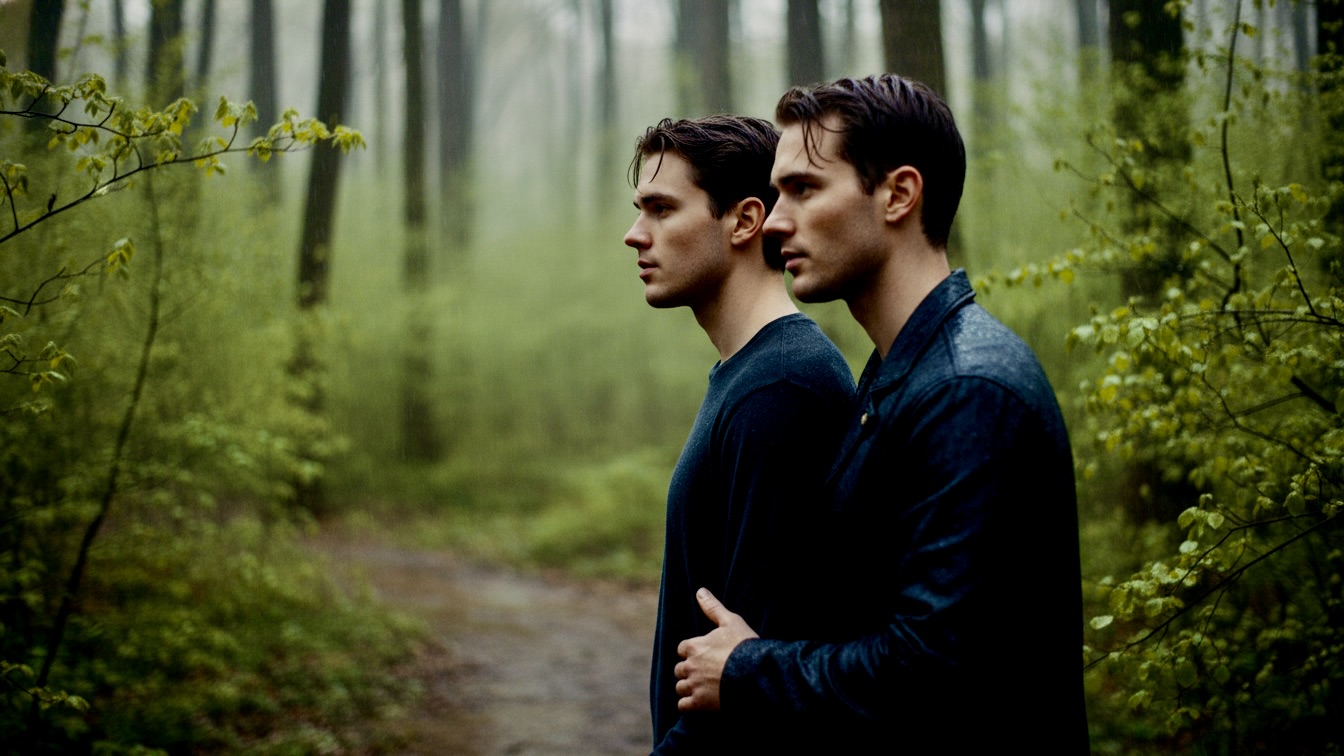
“Stay still for a second,” Evan commanded, his voice closer now. I heard the scrape of his heavy boots on wet soil, then a shadow fell over me, blocking out the drizzly sky. He knelt, his dark hair plastered to his forehead, droplets clinging to his eyelashes. Even covered in mud, with a scrape blossoming on his jawline, he looked… annoyingly put-together. Like he’d simply decided to pose as a survivor.
His fingers, surprisingly gentle, probed the back of my head, then moved to my neck. His touch sent a shiver through me that had nothing to do with the cold. It was a familiar jolt, a current that always seemed to run between us, even when we were actively trying to avoid it. My heart, already hammering from the shock, ratcheted up another notch.
“No obvious fractures,” he murmured, more to himself than to me. “Concussion possible. Ribs… probably bruised, maybe cracked. Can you stand?”
“Can I…?” I scoffed, but the sound was weak. “Did you miss the part where I’m currently impersonating a speed bump?”
Evan ignored the question. He reached for my arm, his grip firm. “We need to move. Now. They’ll be here.”
My eyes finally found his. They were the same intense, unreadable dark brown I remembered, but there was a tightness around them, a strained alertness that spoke volumes. Evan didn’t do panic. He did controlled, surgical urgency. And that urgency, now directed at me, made my stomach clench. He wasn't just worried about us. He was worried about them.
“Who? The… the cleanup crew?” I pushed, trying to make light of it, trying to ignore the way my breath hitched when he pulled, a sudden, almost violent tug. My body screamed in protest, but Evan was already halfway to his feet, pulling me with him. I stumbled, knees weak, vision swimming. My jacket felt heavy, soaked through, clinging to my skin. A branch scraped my face, cold and sharp, as I fought for balance.
He didn’t release my arm. Instead, he pulled me closer, slinging my arm over his shoulder. The sudden proximity was almost a physical blow. I could feel the solid warmth of his body through our wet clothes, the faint, clean smell of his soap underneath the damp earth and static discharge. His breath ghosted over my temple as he leaned down. “The people who don’t like witnesses, Ted. The ones we just betrayed.”
The words were a cold splash, sharper than the rain. Betrayed. It was a funny word for leaving a sinking ship, for trying to salvage what little honor we thought we still had. But to them, to the organization, it was betrayal. And they were notoriously bad at letting betrayers just… walk away.
We shuffled forward, Evan practically carrying me. My boots squelched in the mud, sinking with every step. The forest was thick here, a dense tangle of young maples and old oaks, their budding leaves a sickly yellow-green in the gray light. The rain picked up, a sheeting downpour that plastered my hair to my scalp and ran in cold rivulets down my neck. It felt like the world was actively trying to wash us away.
“Comms?” I asked, my voice still rough, trying to distract from the searing pain in my side. And from the unsettling heat radiating from Evan’s side.
“Dead,” he replied, clipped. “The scrambler hit. Probably fried everything within a five-meter radius of the vehicle. Including, presumably, my chances of ever getting a decent cup of coffee again.” His attempt at humor was so dry it was almost a threat.
I managed a weak cough, more of a choke. “You always were dramatic about your coffee.”
“Some things are sacred, Ted.” He tightened his grip, pulling me around a fallen log slick with moss. I almost went down, my bad leg buckling. His forearm flexed under my hand, hard as stone. The contact was startling, intimate. It made my breath catch.
We pushed on. Every step was a conscious effort, a grinding negotiation between my protesting body and Evan’s relentless forward momentum. He didn’t look back, didn’t falter. His eyes scanned the tree line, the undergrowth, always moving, always alert. I watched him, or tried to, through the curtain of rain. He was a force, unwavering. It was infuriating, and, in a strange, messed-up way, deeply comforting.
“How long?” I finally mumbled, feeling the cold seep into my bones.
“Long enough for them to send in the retrieval teams,” Evan answered, not even bothering to look at me. “Or the exterminators, depending on their mood.”
“Right. Optimistic.” I scraped my knuckles on a low-hanging branch, wincing. My hands were already numb. The mud was everywhere – splattered on my jeans, clinging to my jacket, caked under my nails. It felt like the entire world was dissolving into a watery brown mess.
We kept to the densest parts of the woods, Evan picking a path that seemed impossible, weaving through thorns and thickets. My denim jacket snagged repeatedly, tiny rips appearing in the fabric. I could feel the cold dampness against my skin. The spring air, usually fresh and new, was heavy with the scent of wet soil and something else… distant woodsmoke? Or was it just my imagination, a phantom smell from a past, simpler escape?
Every now and then, he’d stop, abruptly, without warning. I’d nearly stumble into his back, my face inches from his wet collar. He’d tilt his head, listening. I’d strain my ears too, but all I ever heard was the patter of rain, the drip from leaves, and the frantic thump of my own heart. But Evan heard more. He always did. He was tuned to frequencies I couldn’t even register.
During one such stop, he nudged me against a thick oak. Its bark was rough, wet. I leaned heavily, chest heaving. He pulled a small, folded map – miraculously dry – from an inner pocket of his jacket, scanning it quickly. His brow was furrowed, a tiny muscle twitching near his temple.
“There’s an old maintenance tunnel for the hydroelectric plant, maybe two clicks north of here,” he muttered, more to himself. “Abandoned for decades, but the schematics show it still exists.”
“A tunnel?” The word tasted like relief, even if it was a cold, dark one. “Better than… this.” I gestured vaguely at the dripping, miserable forest.
Evan glanced at me then, a quick, intense look that seemed to strip away all my defenses. His gaze lingered on my pale face, the mud smears, the way my shoulders slumped. A flicker, something almost like regret, crossed his eyes, gone before I could name it. Then his expression hardened again, resolute. “It’s our best bet for cover. And for shaking them.”
We moved on, the idea of a tunnel, of shelter, a desperate beacon. The terrain got worse, steeper, the ground slick with runoff. I stumbled again, my bad leg giving out completely. I gasped, tumbling forward. Evan, still holding my arm, didn’t let me fall. He braced, twisting his body, taking the impact of my weight. His grunt was low, guttural, a sound of pure strain. My face ended up pressed against the wet fabric of his jacket, my nose filled with that faint, clean scent again, mixed with the sharpness of damp wool and his own body heat.
“Sorry,” I breathed, mortified. My cheek was pressed against his shoulder, the rough texture of his jacket abrasive against my skin. I could feel the rumble of his chest as he took a deep, steadying breath. His arm tightened around my waist, pulling me upright, holding me against him for a beat longer than strictly necessary. It was a strange, suffocating comfort.
“Don’t apologize,” he said, his voice a low growl near my ear. “Just keep moving, Ted.”
The way he said my name, quiet and firm, sent another jolt through me. It was a command, yes, but also… something else. A promise? A plea? I couldn’t tell, and the ambiguity was both frustrating and deeply affecting. I pushed myself up, my legs trembling, and tried to match his pace. It felt like my lungs were tearing, my chest burning with every ragged breath.
Hours blurred into a miserable, damp eternity. The light began to fade, the sky a bruised purple. The rain, blessedly, eased to a drizzle, but the mud remained, a constant, sucking adversary. My teeth were chattering now, a frantic rhythm that echoed the ache in my bones. I could feel my body beginning to shut down, the cold winning its slow battle.
Evan suddenly stopped, pulling me to a halt beside him. He pointed with his chin. “There.”
Through the gloom, barely visible amidst a tangle of thorny bushes and overgrown weeds, was a dark, rectangular opening, half-buried in the side of a small hill. It looked less like a tunnel entrance and more like a wound in the earth, edged with rusted metal. A trickle of water spilled out from its depths, adding to the general dampness. It was foreboding, but also… salvation.
He pushed aside the thick brush, revealing more of the entrance. It was a concrete culvert, maybe six feet high, reinforced with rebar. The air coming from it was cold, still, and smelled faintly of damp concrete and something metallic, like old coins. He didn’t hesitate. He ducked his head, pulling me in after him.
Inside, it was absolute darkness, broken only by the dim, filtered light from the entrance. The floor was rough, uneven concrete, coated in a fine layer of silt and standing water. The temperature dropped significantly. I shivered violently, my teeth clattering loudly in the sudden quiet. The drip of water was amplified, echoing eerily.
Evan released my arm, and I felt a sudden, irrational pang of loss. He fumbled in his pocket, pulling out a small, tactical flashlight. The beam cut through the black, a sharp, white spear. It revealed the rough, damp walls, the low ceiling, the endless, straight path stretching into the blackness. And it illuminated Evan’s face, etched with grime and fatigue, but still resolute.
He turned the beam to me, briefly, and I flinched, my eyes aching from the sudden light. He studied me, his gaze intense. I felt utterly exposed, shivering and pathetic in the harsh white glow. My lip trembled, a small, involuntary movement.
“We’ll rest here,” he said, his voice softened by the enclosed space. “For a bit.” He didn’t wait for a reply, already scanning the tunnel, looking for any signs of recent passage. He was always scanning, always assessing, always planning. My pursuer, my protector, my… everything I was running from and running towards.
I slid down to the wet concrete floor, my legs giving out completely. The cold seeped through my wet jeans immediately, but I didn’t care. I leaned my head against the cold, damp wall, closing my eyes. The metallic tang in the air mixed with the cloying scent of wet earth, trapping us in a cold, dark bubble. It was supposed to be a separation, a clean break from everything. Instead, we were more entangled than ever, tied together by mud, betrayal, and the unnerving, electric hum of an attraction neither of us ever really acknowledged.
Evan sat down next to me, not touching, but close enough that I could feel the subtle shift in the air, the faint warmth radiating from him. He kept the flashlight beam pointed down the tunnel, a sentinel against the encroaching dark. He was a stone, solid and unyielding, and I was a mess, trembling and on the verge of collapsing. But for now, in this cold, forgotten tunnel, we were together. And for some infuriating, terrifying reason, that felt like the only thing that mattered.
“Are they… close?” I whispered, not wanting to break the fragile quiet.
He took a slow, deep breath, and I felt it in the vibrations through the concrete. “Always. But we bought ourselves some time. Just keep moving, Ted.” His voice was a low hum, a current that ran right through me, echoing the chaotic rhythm of my own heart in the echoing dark. I shivered again, not entirely from the cold.
To the Reader
“It's a strange truth that the paths we choose to abandon sometimes lead us straight back to the most unexpected connections. This chapter reminds us that even when the world is crumbling, courage to face both external threats and internal feelings is a testament to your own enduring strength.”
Share This Story


