You Must Remain.
by Jamie F. Bell
The Wrought Iron Gate
Connor, a young man adrift, arrives at the formidable, decaying Blackwood Manor, having taken on a vague caretaker position. He is greeted by Owen, the manor's intense and mysterious owner, whose very presence shifts the air around them.
The rain, fine and persistent, was a gauze over everything. It clung to the ragged firs that choked the driveway and slicked the moss on the wrought iron gates, rusted to a deep, visceral red. My reflection, if it could be called that through the gloom and the grimy window of the borrowed sedan, was a pale blur. Just another ghost in a place surely teeming with them. This was it, then. Blackwood Manor. A name that sounded less like an address and more like a whispered threat.
My hands, clammy and cold, tightened on the steering wheel. Twenty-one years. And what had I to show for them? A string of abandoned art projects, a university transcript that looked more like a confession of failure, and a pervasive, bone-deep loneliness that hummed beneath my skin like a low-grade fever. Moving through the world felt like wading through treacle, every step an effort against an unseen resistance. My parents, in their well-meaning, exasperated way, had called this ‘an opportunity for perspective.’ I called it running, again.
The advertisement had been cryptic: 'Caretaker required for isolated estate. Minimal duties. Long-term preferred. Discretion essential.' It had spoken to something primal in me, a desperate need for quiet, for shadows, for a place where the clamor of my own inadequacies might finally dim. And the pay… well, the pay was enough to postpone the inevitable reckoning, at least for a while. Enough to make me ignore the unsettling feeling that had curdled in my stomach since the moment I saw the hand-drawn map. A map that ended here, at this impenetrable, rain-soaked fortress of a house.
I cut the engine. The sudden silence was vast, punctuated only by the drip of water from the ancient trees and the distant, mournful cry of some bird I couldn't identify. I leaned my head against the cool glass, inhaling the damp, earthy scent of rotting leaves and wet bark. The air was thick, heavy with the promise of spring rain, but carried no freshness, only the weight of time and neglect. This place was breathing, I thought, but it was the shallow, rattling breath of something very old and very tired.
A flicker of movement by the gates. Not a ghost, not yet. A figure, impossibly tall and slender, emerged from the rain-blurred archway. He was silhouetted against the grey sky, an almost theatrical entrance. His coat, a dark, heavy thing, moved with a fluid grace that seemed to defy the wind, and a cascade of dark hair, longer than I'd expected, fell across his shoulders. He didn't seem to hurry, didn't seem to notice the rain that pasted strands of hair to his forehead. He simply… moved, with a purpose that felt predestined.
My heart did a strange, lurching thing in my chest. Not fear, exactly. More like a sudden, sharp intake of breath, as if a hand had reached in and squeezed. He was closer now, and I could discern the angles of his face – sharp, almost severe, with high cheekbones and a jawline that could carve stone. His eyes, even from this distance, felt like a physical force. Dark, fathomless, they seemed to absorb the muted light rather than reflect it. They settled on me, or perhaps on the car, and I felt utterly, completely seen. It was unnerving, profoundly so.
I pushed open the door, the groan of the hinges loud in the still air. My boots squelched in the muddy gravel of the drive. The man had stopped perhaps ten feet from me, close enough for me to feel the chill emanating from him, or perhaps it was just my own anxiety. He was older than me, perhaps by a few years, but carried himself with an ancient gravity that belied his apparent youth. There was an elegance to his stillness, a poise that made my own fidgeting feel clumsy and raw.
“Connor,” he stated, his voice a low thrum that seemed to vibrate in the very air. It was a voice that belonged in a larger, grander space, a voice that carried the resonance of old stone. There was no question in it, only confirmation. He already knew who I was. Of course, he did. He was the one who placed the ad, after all. But the certainty in his tone, the way my name sounded on his tongue, sent a shiver down my spine that had nothing to do with the damp cold.
“Yes,” I managed, my voice, by contrast, a thin, reedy thing. I swallowed, feeling the sudden dryness in my throat. “You must be… Owen.” The name felt heavy, mythological, a direct contrast to the prosaic reality of my situation. Owen merely inclined his head, a gesture both formal and dismissive, as if my verbal confirmation was entirely superfluous.
His gaze swept over me, a slow, meticulous appraisal that missed nothing. I felt every damp strand of hair, every wrinkle in my worn jacket, the muddy scuff on my boots. I wanted to shrink, to disappear into the heavy rain, to be anything but the exposed, uncertain creature I was. There was no judgment in his eyes, not precisely, but a profound sense of assessment, as if he were cataloging my every flaw, every hesitation. He was the grounded force, a still point in the chaotic swirl of my own self-doubt, and I, the reactive, felt my entire being subtly reorient around him.
“You are late,” he remarked, the words measured, devoid of accusation, yet they landed with the weight of a decree. It was true. The old sedan had sputtered and stalled twice on the winding country roads, and a sudden detour had added another hour to my journey. My face, I was sure, flushed a mortifying crimson under his steady gaze. My heart thumped against my ribs, an insistent, quick rhythm.
“I… I apologize,” I stammered, feeling a fresh wave of heat rise to my ears. “The roads were… difficult.” I felt the need to explain, to justify myself, something I rarely bothered with anymore. His presence commanded it, a silent, unyielding authority. He simply observed my discomfiture, his expression utterly unreadable.
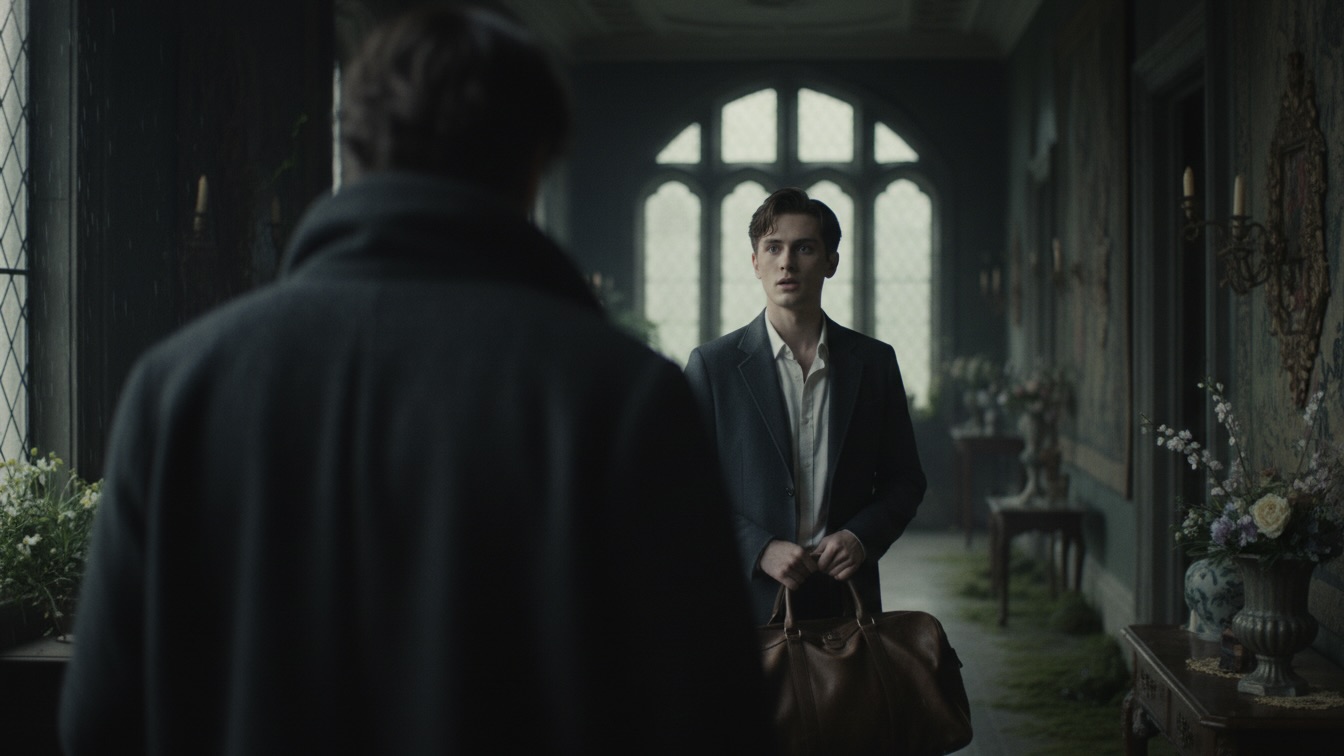
“Indeed,” he said, his eyes now fixed on something just beyond my shoulder, towards the looming darkness of the manor itself. “The roads to Blackwood always are.” He turned, a slow, deliberate movement, his coat swirling around him. “Come. There is much to attend to.” He didn't wait for my assent, already moving towards the house, his long strides effortlessly covering the uneven ground. I found myself scrambling to retrieve my small duffel bag from the back seat, then hurrying to catch up, the gravel crunching loudly under my feet.
The manor was more imposing up close, a gothic behemoth of grey stone and dark timber, its windows like vacant eyes staring out from under heavy, sagging brows of ivy. The air here was cooler, denser, carrying the distinct, metallic scent of damp stone and something else, something undefinable, like forgotten dreams and the static cling of old secrets. Every surface seemed to hum with history, with untold stories. This wasn’t just a house; it was a mausoleum of memory.
Owen pushed open a massive oak door, intricately carved and studded with iron, which groaned in protest. The sound echoed into the cavernous hall within, a space swallowed by gloom. The interior was colder, damp-smelling, and vast. High ceilings disappeared into shadow, and dusty tapestries depicting scenes I couldn’t quite make out hung limply from the walls. Moonlight, or perhaps just the faint, bruised light of the spring afternoon, struggled through the grimy panes of a tall, arched window, casting long, distorted shadows that danced like specters.
“This,” Owen’s voice cut through the heavy silence, “is the main hall. Your quarters are through that archway, the first door on the right.” He pointed with a long, elegant finger towards a dark opening. “You will find them… adequate.” There was a subtle inflection in his tone, a hint of dry amusement, perhaps, at the understatement. The ‘adequate’ room I would find, no doubt, would be a faded grandeur, a ghost of its former self. But even a ghost of grandeur was more than I was used to.
I nodded, trying to appear less overwhelmed than I felt. My gaze darted around, taking in the grand, sweeping staircase that disappeared upwards into absolute darkness, the looming ancestral portraits whose eyes seemed to follow me, the thick layer of dust that coated every surface like a shroud. This place was a testament to a bygone era, a relic, beautiful in its decay, but utterly consuming. It felt as if the very walls watched, judged, absorbed.
“My duties, then,” I ventured, needing a distraction from the suffocating atmosphere, from the way Owen’s silent presence seemed to amplify every sound of my own quick breathing. “The advertisement mentioned… minimal.”
Owen turned to face me fully, his dark eyes like polished obsidian. “Indeed. The upkeep of this estate is… considerable. However, I require assistance with a very specific, rather arcane collection of texts and artifacts. Their categorization, their restoration. And perhaps,” he paused, his gaze intensifying, “a degree of companionship. This house, as you may surmise, is not often visited.” He did not smile, not precisely, but the corners of his lips quirked almost imperceptibly, a fleeting shadow of an expression that vanished before I could truly register it.
My breath hitched. Restoration of arcane texts? Companionship? This was far more, and far less, than I had anticipated. A strange warmth spread through my chest, chasing away some of the chill, quickly followed by a rush of confusion. This wasn't a job for a failed art student; it was a role for an antiquarian, a scholar, or perhaps a recluse equally as strange as the man standing before me. And the ‘companionship’… the word hung in the air, charged with a meaning I couldn’t decipher, but which made my skin prickle with an unfamiliar awareness.
“I… I’m not sure I’m qualified for such work,” I admitted, my voice barely above a whisper. The truth of my unsuitability felt stark in this grand, imposing hall. He merely stepped closer, his movement almost silent on the dusty flagstones. The scent of him—earthy, like old leather and damp moss, with a sharp, clean undertone—reached me, surprisingly intoxicating.
“Qualifications,” he murmured, his voice now a low, intimate tone that seemed meant only for my ears, “are often overrated. What one possesses in earnest desire, in diligence, often far outweighs a mere certification. And,” his dark gaze swept over my face again, lingering on my lips, “you have a certain… capacity. A sensitivity to the unspoken. This place, Connor, requires more than a mere hand. It requires an understanding.” He raised a hand, and for a fleeting, electrifying moment, I thought he might touch my cheek. My body stiffened, a rush of pure, unadulterated sensation flooding my veins. My breath caught.
But his hand only reached past me, to a heavy velvet drape hanging nearby, his fingers brushing the fabric with a tender, almost reverent touch. The proximity, the sheer intensity of his gaze, left me breathless. I felt a flush crawl up my neck, hot and insistent. My entire being was hyper-aware of him, of the slight tilt of his head, the way the light, however dim, seemed to find the silver threads woven into the dark fabric of his coat. This wasn’t companionship in the sense I understood it. This was… something else entirely. A vortex, perhaps, and I, the helpless debris, was being slowly, inexorably drawn in.
“For now,” he continued, withdrawing his hand, the spell broken, though the reverberations still hummed through me, “you may settle in. Dinner will be served in the smaller dining room at seven. I shall expect you there. No need for formality, merely… presence.” He turned, and with another fluid, unhurried movement, disappeared down a shadowed corridor, leaving me utterly alone in the vast, echoing hall, the scent of him lingering in the damp, ancient air. My heart hammered, a frantic drum against my ribs.
I remained standing there for a long moment, my duffel bag still clutched in my hand, the weight of the house, of his presence, pressing in on me. The 'adequate' room. The 'arcane collection.' The 'companionship.' Every word he had uttered seemed to possess layers of hidden meaning, like the deep shadows that clung to every corner of Blackwood Manor. I was no longer just running; I was standing on the precipice of something entirely new, something thrilling and terrifying in equal measure. My usual anxieties were still there, a low thrum, but now they were overshadowed by a bewildering current of electricity, a sense of being caught in a powerful, undeniable tide.
The loneliness I had nursed for so long felt, for the first time, not like an affliction, but like an empty vessel, waiting to be filled. And the man who stood before me, Owen, with his dark eyes and cryptic pronouncements, seemed poised to pour something into it. Something dangerous. Something beautiful. Something that would irrevocably change the shape of my emptiness. I took a shaky breath, the metallic tang of damp stone filling my lungs. The house was a living, breathing entity, and I, it seemed, was its newest offering. I looked toward the shadowed archway, then to the imposing staircase, wondering what secrets lay waiting in the darkness, and what fate, good or ill, Owen held for me within these crumbling walls. This wasn't just a place to hide; it was a labyrinth, and I had just stepped through its mouth.
To the Reader
“Just as Connor felt his loneliness transforming into a vessel waiting to be filled, remember that the quiet spaces within you are not empty, but hold the profound potential for connection, growth, and the most extraordinary kinds of love.”
Share This Story


