You Cannot Stay Hidden.
by Jamie F. Bell
The Glittering Cage
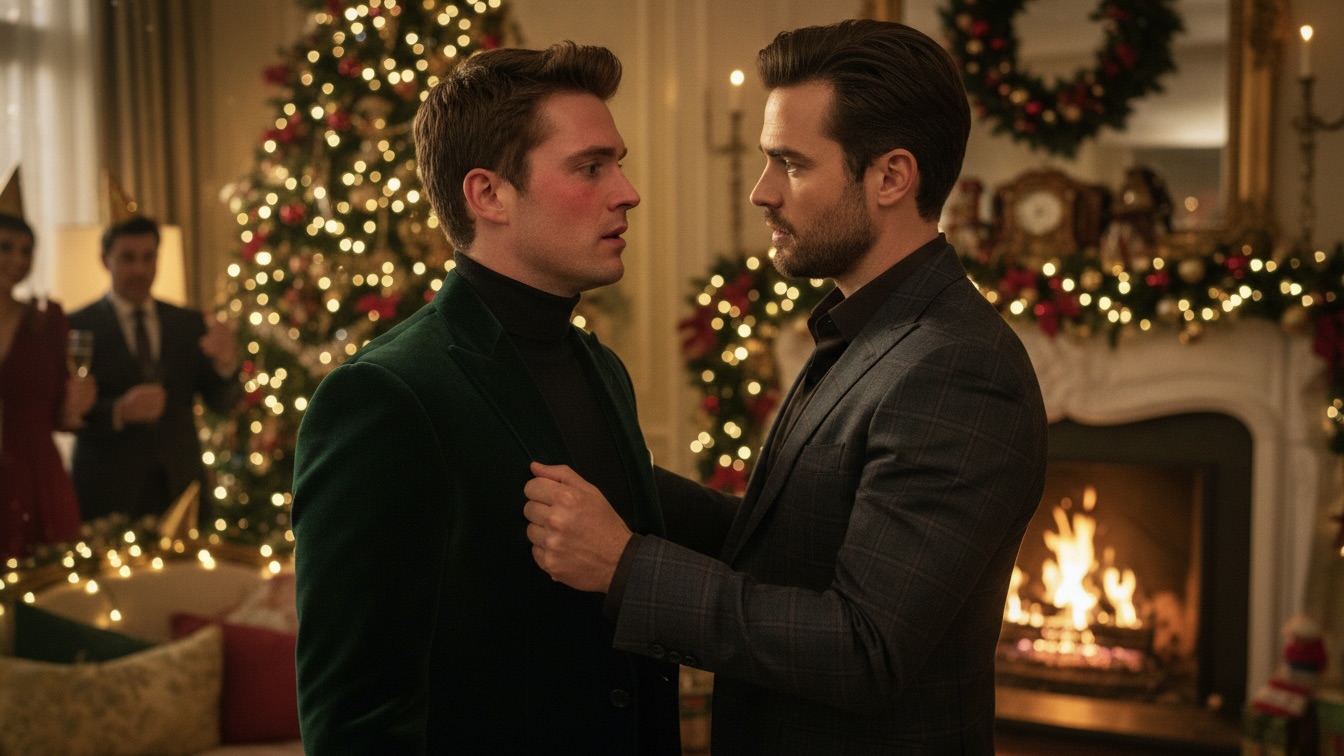
Thomas finds himself trapped at a pre-Christmas holiday party at his aunt's lavish, overly decorated home. Amidst forced cheer and cloying scents, he encounters Philippe, whose observant gaze and direct manner shatter Thomas's fragile composure, forcing a tense, almost theatrical exchange.
“Jesus, Thomas. Are you trying to merge with the ficus?”
The voice cut through the background drone of some soulless, jazzy Christmas cover. It was low, deep, and laced with an infuriating amusement I knew better than my own damn heartbeat. I didn’t have to look. I could feel that voice in my teeth. Philippe. Who the fuck else?
He was holding up the archway to the dining room, one shoulder leaned against the frame like he owned it. He was framed by a ridiculously oversized garland of plastic holly and gold ribbon that looked cheap and tacky next to him. He had one long leg crossed over the other, the picture of casual, infuriating grace. He was wearing a simple charcoal-gray sweater, but it was the kind of soft, dark wool that probably cost more than my entire semester’s worth of textbooks. It fit him in a way that seemed both accidental and meticulously engineered to make his shoulders look broader and his waist narrower. A tiny, knowing smirk played on his lips—lips that were frankly an unfair distribution of genetic wealth.
My aunt’s annual holiday ‘extravaganza’ was, as always, a masterclass in performative joy, and I was its star delinquent, currently trying to achieve photosynthesis to avoid talking to my great-uncle about his latest conspiracy theory. The ficus I was hiding behind smelled sharply of lemon-scented industrial cleaner and quiet despair. I knew the feeling.
My breath didn't just hitch; it snagged, a gear grinding in my chest. It wasn’t the fear of being caught. At six-foot-one, hiding was never really my forte. It was the sudden, high-voltage shock of his attention. Philippe had this… gravitational pull. He didn’t have to be the loudest person in the room; his quiet was louder than anyone else’s noise. He just <i>was</i>, a still point of intensity, and the rest of the world, every nervous thought and flickering glance, just seemed to orbit him. My throat went tight, the air suddenly as thick and cloying as the cinnamon-apple potpourri simmering somewhere in the house, a scent I now associated with low-grade torture.
I made myself turn, slow and deliberate, aiming for a look of boredom I was miles away from feeling. My own blazer, a rental, felt like a cardboard box, tight in the shoulders and already starting to feel damp under the arms. “And you’re… what? Auditioning for a role as a mysterious P.I. in a noir film? You’ve got the dramatic lurking down. All you need is a trench coat and a thunderclap.”
He pushed off the archway. It wasn’t a sudden move, but it was packed with a coiled energy, a deliberate unfolding that felt less like a person crossing a room and more like a predator closing a carefully measured distance. Every step was silent on the thick Persian rug, but I felt them like tiny tremors up the soles of my shoes. My heart, that absolute traitor, started hammering against my ribs, a frantic, stupid drumbeat that was way too fast for the situation. <i>It’s just a fight-or-flight response,</i> I told myself, the thought a flimsy, academic shield. <i>He’s a large dude invading my personal space. It’s primal. Nothing more.</i> But my logic was completely drowned out by the thumping in my ears.
He stopped a few feet away. Still too close. Close enough that his scent cut through the party’s olfactory assault of gingerbread, pine-scented candles, and my aunt’s cloying perfume. It wasn’t cologne. It was something cleaner, sharper. Cedar, maybe, and the undeniable smell of cold night air clinging to his sweater, and the faint, clean scent of ironed cotton. It was a brutal, grounding contrast, and it was so uniquely <i>him</i> that my stomach did a slow, nauseating flip.
“My dramatic entrance is a direct result of your dramatic exit,” Philippe countered, and his eyes—shit, his eyes—pinned me in place. They were the color of dark roast coffee, nearly black, and they held the thousand twinkling fairy lights of the room in their depths without reflecting any of their cheap cheer. They just absorbed the light, leaving only the unnerving intelligence behind. “A pretty public exit, I might add. Hiding behind the saddest-looking plant in the tristate area. You might as well have worn a sign that said, ‘Please, somebody find me.’”
A scoff tore out of my throat, louder and sharper than I intended. The sound was brittle, fragile. “Oh, fuck off. Or maybe the sign just says, ‘A man would like five goddamn minutes of quiet in a room full of people screaming with joy over cheese cubes.’ And you are making that unnecessarily difficult.”
He took another step. Then another. Until he was entirely inside my bubble, well within the circle of air I considered my own. My peripheral vision hazed over, my focus narrowing to the sharp line of his jaw, the way a single lock of dark, almost-black hair fell across his brow, perfect and unmovable. He had the kind of casual, boyish good looks that felt both natural and deeply unfair—clear skin, strong features, but with a softness around the eyes that could trick you into thinking he wasn't constantly analyzing everything around him. The space between us felt like it was humming, charged with a low-grade static that made the hairs on my arms prickle. My fingers twitched in the pockets of my blazer. I had a sudden, stupid urge to reach out, to brace myself against his chest, just to feel something solid. Instead, I balled my hands into fists, my nails digging crescent moons into my palms.
“Ah, but the difficulty, Thomas,” he murmured, his voice dropping, becoming intimate and conspiratorial in a way that was pure performance. I knew it was. “That’s often where the most interesting things happen, don’t you think?”
It was a tactic, a flourish designed to get under my skin. And god, it worked. The heat started in my chest, a prickling, shameful wave that crawled up my neck and flooded my cheeks. I could feel the blush, a visible, burning betrayal of the cool indifference I tried so hard to project. I fucking hated it. I hated that my body was in a constant conspiracy against my brain, reacting to him with a will of its own.
I ripped my gaze away, feigning a sudden fascination with a ceramic Santa on the mantelpiece. The thing had a perpetually startled expression, its painted eyes wide with what I could only describe as existential dread. I felt a deep kinship with that Santa. “And what’s so ‘interesting’ about watching me try to keep it together in this… tinsel-choked nightmare? Is this for, like, a psych paper? ‘A Study in the Deleterious Effects of Forced Merriment’?”
Philippe chuckled. It wasn’t a loud sound, but it was deep and resonant, a vibration I felt through the soles of my shoes, right up my spine. “Not a bad title. And you’re not entirely wrong. I confess, your particular brand of holiday misery is morbidly fascinating. Most people just give in, get drunk on cheap wine, and accept the spectacle. You, however… you fight it like you’re defending a doomed fortress.”
My head snapped back to face him, a surge of raw indignation overriding the humiliating blush. “A fortress? Against what? The suffocating pressure to be ‘merry and bright’ on command? The sheer, unadulterated absurdity of it all? Is that a crime now, Philippe? To not want to participate in the collective delusion?”
He straightened slightly, and for a second, the mocking glint in his eyes softened into something else. Something deeper, more serious. “No crime, Thomas. Merely a lonely one. You rarely win a war you fight by yourself.”
The words, spoken so casually, landed like stones in my gut. An accusation. A diagnosis. <i>Lonely.</i> He saw it. He always fucking saw it. It was the same way he’d seen through my feigned boredom at that disastrous open mic night last spring, or the carefully blank expression I’d worn when that prick from my political science seminar won the scholarship I’d been quietly killing myself over. Philippe had x-ray vision for the cracks in my armor, for the tender, bruised spots I kept hidden from everyone else.
Just then, a catering assistant, a kid who looked about nineteen and perpetually on the verge of tears, bumped into my elbow with a tray of miniature quiches. The tray wobbled violently. Reflexively, Philippe’s hand shot out, not touching me, but perfectly steadying the edge of the silver tray with long, elegant fingers. “Easy there,” he murmured to the kid, his voice calm and reassuring.
The assistant stammered an apology, his face crimson, before scurrying away into the crowd. The brief, clumsy interaction was a welcome distraction, a splash of cold water. The quiche smelled of burnt cheese and desperation. My stomach churned, a familiar, acidic anxiety gnawing at its edges. It was a feeling as much a part of Christmas as the twinkling lights and my aunt’s passive-aggressive comments about my art history major.
“You alright?” Philippe asked, his attention fully back on me. The theatricality was gone, replaced by a flicker of what looked unnervingly like genuine concern. “You look like you’ve just seen a ghost. Or, I don’t know, a really aggressive fruitcake.” He started to reach out, his hand hovering in the air between us for a half-second before he seemed to think better of it and let it drop. The absence of the touch was a strange, hollow ache. It was ridiculous. He hadn't even touched me.
“I’m fine,” I bit back, the words sharper than I intended. “My constitution can withstand the horrors of seasonal pastry, I assure you.” I needed to get control of this. This conversation, this whole interaction, was veering into a territory I kept fenced off with barbed wire, especially during the holidays. Christmas was a minefield, and Philippe, with his goddamn perception, felt like he was dancing on the detonators.
He just watched me, his expression unreadable again. Not judging, not mocking. Just… observing. Soaking in the rigid set of my shoulders, the way I kept clenching and unclenching my fists in my pockets. It was unnerving, that absolute focus. Most people looked <i>at</i> you; Philippe looked <i>into</i> you. It made me want to crawl out of my own skin.
“Maybe,” he said finally, his voice soft again, pulling me back into the strange, pressurized bubble of our conversation. “Or maybe the horror isn’t in the pastry. Maybe it’s in the memories it brings up. This season… for some people, it’s less a party and more of a… reckoning.”
The unexpected empathy was a punch to the diaphragm. It winded me. He couldn’t know. He <i>couldn't</i>. There was no way he could possibly know about the smell of hospital antiseptic that always seemed to cling to the scent of pine needles in my memory, or the crushing weight of the first Christmas without my dad. He couldn’t know about the silence in the car on the way home, or the way my mom stared at his empty chair at the table for a full minute before she started crying. And yet, the way he said it, the slight, knowing tilt of his head, the unwavering steadiness of his gaze—it was like he was looking right at the raw, gaping hole in my chest.
My eyes dropped to the floor, to the intricate crimson and gold pattern of the Persian rug. The threads blurred, a mess of color that mirrored the chaos in my head. <i>Reckoning.</i> Jesus. That was the word. Every year, Christmas was a reckoning with the ghost of a past that refused to stay buried. The empty chair. The relatives who looked at me with that unbearable pity in their eyes. The heavy, screaming silence that settled over everything once the carols stopped.
A burst of shrill, boisterous laughter erupted from a group of my aunt’s friends by the fireplace. The sound grated on my frayed nerves like nails on a chalkboard. I flinched, a tiny, involuntary jerk of my shoulders.
Philippe noticed. Of course, he noticed.
And this time, his hand didn’t hesitate. It landed on my elbow, a firm, warm, grounding pressure. It wasn’t a question. It wasn’t a request. It was a statement. <i>I’m here.</i> An anchor in the turbulent, glittering sea of noise.
The warmth of his palm soaked through the cheap, thin fabric of my blazer instantly. It wasn't just warmth; it was a current, a low-voltage shock that spread up my arm, making the fine hairs stand on end. My skin tingled. The muscles in my shoulder, which I hadn’t even realized were knotted tight enough to bounce a quarter off of, began to release. It was just a physical sensation, I told myself again, my internal mantra wearing thin. Just a physiological response to an external stimulus. But it felt profoundly, terrifyingly personal. An invasion. I wanted to yank my arm away, to re-establish the perimeter, but my feet felt like they were nailed to the floor.
“It’s a lot, isn’t it?” he whispered, his voice so low it was almost lost in the din, meant only for me. His thumb, almost imperceptibly, moved, brushing against the thin, sensitive skin of my inner elbow.
A full-body jolt went through me. It was a shiver that had nothing to do with the cold. It was pure, distilled awareness. Of him. Of his hand. Of his thumb making that slow, circular motion that was probably accidental but felt devastatingly deliberate. My entire nervous system lit up, every thought scattering like startled birds.
I dared to look up, my eyes meeting his. The intensity was still there, but it was different now. It wasn't observational. It felt… shared. Like he wasn’t just looking at my pain, but acknowledging it. My throat tightened, the urge to say something real, something raw and vulnerable, pulsed behind my teeth. A dangerous, stupid impulse.
“Sometimes,” I started, my voice a strained, hoarse thing that didn’t sound like my own. “Sometimes it’s not the noise. It’s the silence. The one that gets… louder. When all this is going on.” I made a vague, helpless gesture at the room, at the glittering prison of forced cheer.
Philippe’s grip on my elbow tightened, just a fraction. A squeeze of reassurance. His thumb continued its slow, hypnotic motion. "I know," he said.
Just two words. Simple. Quiet. But they landed with the force of a tidal wave, knocking down every defense I had. In those two words, there was a universe of understanding that I hadn't asked for and didn't know how to handle. It wasn’t pity. It was acknowledgement.
His ‘I know’ wasn’t a question. It was a statement of fact, delivered with the quiet authority of someone who had mapped out these internal landscapes before. And in that moment, standing in the middle of this party, drowning in memory, Philippe’s presence felt less like an intrusion and more like a precarious, desperately needed refuge. My mind, usually a maelstrom of sarcastic deflections and self-preservation, went quiet. A fragile, terrifying calm settled over me.
I looked into his eyes again, really looked, past the clever comebacks and the infuriating smirks. I saw past the facade he wore, the effortless, handsome confidence. And what I saw in his eyes was not judgment, but a stark, undeniable reflection of my own turmoil, met with a quiet, unwavering strength that I suddenly, desperately wanted to lean against. The lights from the giant Christmas tree in the corner seemed to intensify, casting the two of us in a small, illuminated bubble, the rest of the party fading into a blurry, noisy backdrop. The smell of pine and gingerbread, once cloying, now felt almost comforting, laced with the sharp, electric tang of his proximity.
The moment stretched, taut and fragile. The heat from his hand on my arm was a constant, overwhelming reality, melting the boundary between us. My breathing was shallow, caught somewhere in my chest. A part of me, a deep, buried, lonely part, wanted to lean into that touch. To give in. But the habits of a lifetime—the walls I had built brick by painful brick around myself—were high and strong. The urge to bolt, to retreat back into my safe, numb isolation, was at war with a desperate, terrifying longing to just… stay.
Then, a high-pitched shriek, followed by the sound of something shattering. A little girl, no older than five, had run headlong into a small side table, sending a glass ornament crashing to the floor. The spell was broken.
Slowly, reluctantly, Philippe’s hand withdrew from my arm. The loss of contact was immediate and jarring, a physical chill that raised goosebumps on my skin. The place where his hand had been felt both hot and cold at once, a lingering imprint of pressure and warmth. He took a small step back, restoring a polite, yet still charged, distance between us. The noise of the party came rushing back in, a tidal wave of chatter and music, washing away the quiet intimacy. His expression, once so open and soft, shuttered again, the mask of cool, thoughtful observation sliding back into place. It wasn't perfect, though. I could see the seams.
“Seems our reprieve is over,” he said, his voice regaining its lighter, satirical edge, but it was strained. I could hear the echo of what had just passed between us. He glanced toward the living room, where my aunt was now trying to rally people for charades. A visceral, full-body shudder went through me at the thought. His eyes, however, came back to mine for one last beat. A silent question. A lingering promise.
I could only nod, my throat too tight to speak. The raw vulnerability of the last few minutes was still thrumming under my skin like an exposed nerve. He had seen too much. He knew too much. And the most terrifying thing was, a part of me—the part I kept locked in the deepest, darkest part of my chest—didn’t want him to forget it. The thought was terrifying, but it was there: a fragile, green shoot of longing pushing its way up through the wreckage of another painful Christmas.
Philippe offered a faint, almost imperceptible smile. It wasn't his usual smirk; it was something else, something small and genuine, and it hit me harder than any of his mockery ever had. Then he turned, melting back into the glittering throng, leaving me alone again. But it was a different kind of alone now. I was irrevocably changed, still feeling the phantom heat of his touch on my arm.
I watched him go, a slash of dark, quiet elegance in a sea of garish Christmas sweaters. He stopped to exchange a few words with one of my uncles, his posture relaxed, his expression polite and interested. He was a master of his own performance, I realized, just as I was of mine. Only his seemed to come as easily as breathing, while mine was a constant, exhausting battle. The thought brought a strange, bitter pang. We were both hiding. But tonight, he had seen my real face, and he hadn’t flinched. The weight of this holiday, of all the past holidays, still pressed down on me. But now, underneath it all, there was a faint tremor of something new. Something that might have been warmth. Something that felt, terrifyingly, like an anchor. And I was left to navigate the rest of this glittering, painful night, carrying not just my own old wounds, but the unsettling, undeniable imprint of Philippe.
To the Reader
“Just as Thomas discovered that true solace can be found in the most unexpected and uncomfortable of connections, remember that your own vulnerabilities are not weaknesses, but profound invitations for genuine connection, making you worthy of being truly seen.”
Share This Story


