Unwanted Casseroles
by Jamie Bell
A Different Kind of Offering
Picking up after Sunny has found a temporary solace in his darkened home, this chapter sees Lin gently forcing his way back into Sunny's life through mundane acts of service, stirring a complex mix of resentment and relief. The arrival of Mrs. Lillo, bearing a casserole, escalates the emotional tension, leading to a raw argument between Sunny and Lin about charity, love, and what it truly means to care. The chapter ends with a quiet dinner and a poignant discovery.
The darkness, thick and insulating, had been Sunny's only steady companion for weeks. It swallowed the dust dancing in the light from the drawn blinds, absorbed the silence, and held him in a fragile, suffocating embrace. Then Lin showed up. Not with a grand gesture, not with pitying words, but with a toolkit and an unwavering intention.
Sunny watched him from the kitchen doorway, a ghost in his own home. Lin was at the sink, forearms bared, a threadbare dishcloth draped over his shoulder. The faucet had been dripping a slow, maddening rhythm for over a month, a relentless percussion of neglect that Sunny had long since learned to tune out. Now, the quiet clink of a wrench, the scrape of metal on metal, was a jarring intrusion. Lin didn’t ask, he simply fixed. His presence, solid and competent, filled the space in a way the silence never could. Sunny’s jaw ached, a knot of irritation and something else he couldn’t name.
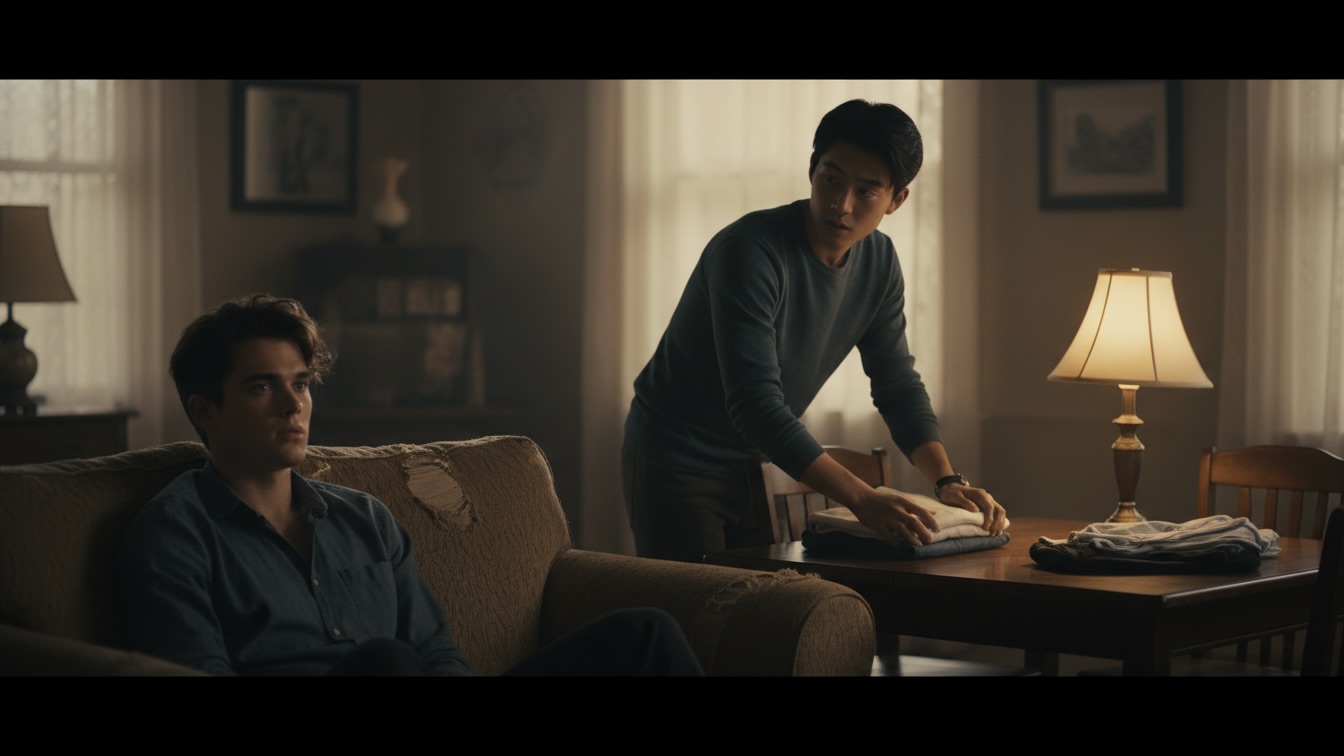
Later, it was the laundry. The overflowing hamper, a testament to Sunny’s inertia, sat slumped in the corner of his bedroom. Lin found it, not with a sigh or a question, but with a quiet hum. He disappeared into the laundry room, and the soft thrum of the washing machine soon vibrated through the floorboards. Sunny, curled on the living room couch, pulled a moth-eaten blanket tighter around himself. He tried to focus on the static hum of the refrigerator, on the way the late afternoon light barely pierced the heavy curtains. He tried to conjure the safety of utter stillness, but the domestic sounds — the slosh, the spin, the distant clatter of Lin’s shoes — broke through. It was a low-level thrum of life, and it grated on his raw nerves, even as a strange, almost imperceptible warmth began to spread beneath his skin.
He watched Lin fold clothes on the dining table, a methodical, almost meditative rhythm. Lin didn’t comment on the wrinkles, the mismatched socks, or the faint smell of stale air that clung to everything. He just folded, each movement precise, efficient. A faint scent of fresh laundry, clean cotton and a hint of something earthy, began to displace the stagnant air in the house. Sunny hated it. Hated the way it smelled like care, like someone cared enough to do something he couldn't bring himself to do. Hated the way it almost, almost, made him feel lighter. The irritation was a shield, thick and heavy, but beneath it, a sliver of relief, sharp and unexpected, pierced through.
He stayed put, a fixture on the couch, pretending to be absorbed by the peeling paint on the ceiling. Lin caught his eye once, a brief, calm glance that held no judgment, no expectation. Just… seeing. It was more unsettling than any sermon. Sunny quickly looked away, his heart knocking a frantic rhythm against his ribs. He felt like a specimen under a microscope, his apathy exposed, his carefully constructed shell cracking under the gentle, persistent pressure of Lin’s presence.
Then came the sound of the doorbell, a shrill, unwelcome chime that sent a jolt through Sunny. He stiffened, every muscle tensing. He hadn’t had a visitor in… he couldn’t remember. Lin, already by the door, opened it before Sunny could even fully process the intrusion. Mrs. Lillo stood on the porch, a small woman with hair the color of dandelion fluff and eyes that seemed to have seen too much winter. In her hands, she clutched a casserole dish, steam still wisping from the foil cover. Her knuckles were white where she gripped the handles, her smile a wavering line.
“Lin, dear,” she began, her voice a reedy whisper, “I just… I brought a little something. For Sunny.” She glanced past Lin, her gaze finding Sunny on the couch, and her smile faltered into a trembling concern. It was a look Sunny knew too well, a look that seeped into his bones and made his skin crawl. Pity. Thick, cloying, unbearable pity.
Lin took the dish, his movements smooth, shielding Sunny from her gaze. “Thank you, Mrs. Lillo. That’s very kind of you.” He had that quiet, calm tone, the one that meant he was handling things, making everything okay. Sunny hated it. Hated being 'handled'.
Mrs. Lillo wrung her hands. “Well, I just… I know things have been… difficult. So, I thought a little comfort food might… you know.” Her gaze drifted back to Sunny, full of a well-meaning sadness that felt like a weight pressing down on his chest. He wanted to shout, to tell her to leave, to tell her he didn’t need her sympathy, didn’t need her food. Didn’t need anyone.
“We appreciate it,” Lin said, firm but gentle, already beginning to close the door. Mrs. Lillo nodded, a slight, almost imperceptible tremor running through her shoulders, and then she was gone, leaving behind the ghost of her concern and the tangible warmth of the casserole dish. The smell of roasted vegetables and cheese filled the air, a scent that, under different circumstances, might have been comforting. To Sunny, it smelled like obligation, like being seen as broken, like a monument to his failing.
Lin carried the casserole to the kitchen, setting it gently on the counter. The foil crinkled. The silence that followed Mrs. Lillo’s departure was thick, strained. It felt heavier than before, charged with unspoken emotions. Sunny pushed himself off the couch, his limbs stiff, a tremor running through his hands. He walked into the kitchen, his bare feet slapping against the cold linoleum. He stood there, shoulders hunched, staring at the dish as if it were an enemy.
“I don’t want it,” he said, his voice a low growl, rough from disuse. He hated how weak it sounded. “I don’t want charity, Lin.”
Lin turned from where he was putting away the now-folded laundry. His expression was unreadable, calm, but his eyes, when they met Sunny’s, were sharp, piercing. “It’s not charity, Sunny.” His voice was low, steady, a counterpoint to the rising tremor in Sunny’s own. “It’s Mrs. Lillo. She cares about you.”
“She pities me,” Sunny snapped, the words hot and bitter in his mouth. He felt the anger coil in his gut, a familiar, comforting presence. It was easier than anything else. “Everyone pities me. I don’t need it. I don’t need you to bring people’s pity into my house.”
He waited for Lin to react, for the usual defensiveness, the argument, the frustrated sigh. But Lin just stood there, his gaze unwavering, taking in Sunny’s slumped posture, the wildness in his eyes, the clenched fists at his sides. He didn’t raise his voice, didn’t even flinch. He just held Sunny’s gaze, a quiet intensity burning behind his calm facade.
“It’s not pity,” Lin repeated, his voice softer this time, but no less firm. The words, though quiet, felt like physical blows. “It’s love, Sunny. It’s just… love. Trying to find a way in. And maybe,” he added, his voice dropping to a near whisper, “it’s fumbling for a way in, because you’re making it impossible.”
The words hung in the air between them, heavy and suffocating. Love. The word felt like a brand, searing hot, on Sunny’s skin. It was worse than pity, worse than anger. It stripped him bare, exposed him. He couldn’t handle love. He couldn’t accept it. He didn’t know how. He felt a sudden, desperate urge to flee, to retreat back into the comfortable, insulating darkness of his room. But Lin’s steady gaze held him captive, a silent, unyielding force.
He wanted to retort, to argue, to deny, but the words caught in his throat, a lump of painful emotions he couldn’t articulate. He just stood there, breathing heavily, the smell of casserole mingling with the faint, unsettling scent of clean laundry. The argument had drained him, leaving him hollowed out, but Lin’s words, 'It’s love, trying to find a way in,' lingered, echoing in the cavern of his chest, unsettling him more than any fight ever could. He felt exposed, vulnerable in a way he hadn't in a long time. The irritation was still there, but now it was tinged with a bewildering, uncomfortable warmth.
Later, they sat at the dining table. The same table where Lin had folded his clothes, now set with two plates. The casserole, surprisingly, was delicious. Sunny ate slowly, each bite a deliberate, almost defiant act. He hadn’t eaten a proper meal in… he didn’t want to think about it. The warmth of the food spread through him, a physical comfort he hadn’t realized he craved.
Lin didn’t press. He didn’t try to engage Sunny in a deep conversation about his feelings. Instead, he talked. About the broken faucet, the surprising complexity of the washers. About a new, incredibly bad movie he’d watched last night, complete with terrible special effects and even worse dialogue. About the local bookstore he used to frequent as a kid, how they were selling off old stock at a ridiculously low price. Mundane stories, simple observations, anchoring the evening in a fragile normalcy. It wasn’t a forced cheerfulness, just a steady, quiet stream of words filling the space, an antidote to the suffocating silence Sunny had grown accustomed to.
Sunny listened, not actively participating, but not entirely tuning out either. He watched Lin’s hands as he gestured, the way a small smile played on his lips when he recounted a particularly absurd plot point from the movie. He felt the electric hum of Lin’s presence, close but not invasive. It was a strange comfort, this shared silence punctuated by Lin’s low, steady voice. He felt the tension in his shoulders ease, just a fraction. He felt the warmth of the food, the subtle shift in the air, the sense of another living, breathing person in the room with him, not judging, just… being.
He finished his plate, a small, almost imperceptible achievement. The last bite of casserole, rich and savory, lingered on his tongue. He looked at the empty dish, a faint surprise stirring within him. He had eaten. All of it. He pushed the plate away, a tremor still in his hands, but this time it felt less like fear and more like a lingering echo of something profound, something he couldn’t yet grasp.
When Lin finally stood up, clearing the table, Sunny didn’t protest. He just watched him move, an efficient, familiar rhythm. Lin stacked the plates, rinsed the casserole dish, and placed them in the sink, not making a sound. He didn’t ask Sunny to help. Didn’t even suggest it. He just did. And then, with a quiet, almost imperceptible nod, he said, “I’ll be back tomorrow morning. Maybe the porch light needs a new bulb.”
Sunny didn’t respond. He just watched Lin walk out, the soft click of the door closing behind him. The house, suddenly, was silent again. But it wasn’t the same silence. It felt… altered. The scent of clean laundry still hung in the air, a faint, lingering promise. The memory of Lin’s voice, calm and steady, still echoed in the corners of the room. The casserole dish, now clean, sat on the drying rack, a testament to a shared meal.
He wandered into the living room, drawn by some unseen force. His eyes scanned the familiar, messy space. And then he saw it. Tucked beneath an old magazine on the coffee table, a thick, leather-bound photo album. It wasn’t his. It was old, worn at the edges, the cover faded. Lin must have brought it in, maybe when he was putting away the laundry, maybe just to look at himself. Sunny hesitated, his fingers hovering over the worn leather, a strange dread and an equally strange curiosity warring within him.
His breath hitched. He shouldn’t. He really shouldn’t. But his hand, as if with a will of its own, reached out, gripping the album. The leather felt cool beneath his fingertips, the scent of old paper and dust rising from it. He flipped it open, the brittle pages creaking softly. The first few pages were blurry landscapes, then older relatives he vaguely remembered. He turned another page, and then his breath caught again, sharply, in his throat.
There they were. Two boys, impossibly young, smeared with mud from head to toe, their faces split in wide, unrestrained grins. Sunny, a gap-toothed, wild-haired version of himself, was clinging to Lin, who was slightly taller even then, his face smudged with dirt but his eyes shining with an almost identical joy. They were standing by the creek behind his old house, a place he hadn’t thought about in years, a place where they’d built endless, crumbling dams and launched stick boats. The sun, bright and unfiltered, caught the water behind them, making it sparkle. It was a photo from a time when laughter came easy, when mud was just mud, and when Lin was just… Lin, his best friend, his shadow, his constant.
A painful warmth bloomed in Sunny’s chest, sharp and unexpected, like a hidden bruise suddenly pressed. It was a warmth that twisted with longing, with regret, with a profound sense of loss for that unburdened boy. He looked at his own face, so open, so joyful, and then at Lin’s, full of an uncomplicated happiness he hadn’t seen in years. The memory, bright and vivid, was a shock to his system. He slammed the album shut, the sound echoing unnaturally loud in the quiet room. He dropped it back on the table, as if it had burned him. But the image, the muddy, laughing boys, was seared into his mind. Something had shifted, a tectonic plate beneath the frozen surface of his heart, and he knew, with a certainty that both terrified and thrilled him, that nothing would ever be quite the same again.
To the Reader
“Just as Sunny feels the profound, unsettling warmth of a forgotten connection, remember that the most beautiful truths about ourselves are often found in the places we’ve tried hardest to bury, and you are absolutely worthy of unearthing them.”
Share This Story


