The Shape of Silence
by Jamie Bell
A Season of Stillness
Early December has transformed Sunny's house into a quiet, frozen world reflecting his internal state. He exists in a fog of grief, marked by stillness and an avoidance of the outside world, while Lin makes small, persistent attempts to reach him.
The frost on Sunny's windowpane didn’t just glitter; it fractured the already weak morning light into a thousand jagged pieces. It had been two months since his mother died. Two months since the world, as he knew it, had not merely stopped, but crumbled into a fine, colorless dust that clung to everything, especially him. Time, once a steady river, now pooled in stagnant, grey puddles around his feet.
He sat on the worn couch, his mother's old afghan – a patchwork of every sweater she’d ever tried to knit, uneven stitches and all – draped over his knees. The television murmured, a low, indistinct hum, images flashing by in muted tones. He didn’t care what was on. He just needed the sound, a faint buffer against the heavy, absolute quiet that otherwise consumed the house, a quiet that tasted of dust and cold. His phone, a dark, heavy rectangle on the coffee table, hadn't been picked up in days. Weeks, really. The battery had died, then he’d charged it, then ignored it again. Each notification, a tiny, insistent ping from the world he’d actively disconnected from, felt like a miniature explosion.
College, deferred. Messages, unread. Meals, forgotten until a gnawing ache in his stomach forced him to rummage for whatever was easiest. Ramen, stale crackers, occasionally a forgotten tin of peaches. The outside world, he knew, was already spinning itself into a frenzy of red and green, tinsel and carols. He could hear it sometimes, faint echoes of festive cheer leaking through the insulation, through the double-paned glass. It sounded loud. Too loud. A harsh, bright noise against the numb ache in his chest, a cruel reminder of seasons past. He preferred the frost, the quiet, the careful stillness he’d cultivated. It was safe.
A soft thump against the front door, barely audible over the TV’s drone, made him flinch. He froze, the remote still in his hand, his knuckles white. It wasn’t a heavy knock, not demanding. Just… a presence. A gentle pressure. Lin. It was always Lin. He hadn't seen Lin's face in weeks, not really. Not up close. But he knew the precise cadence of his footsteps on the porch, the way the old oak floorboards creaked under his weight. He knew the quiet click of the screen door. He knew the almost apologetic scrape of a bag being set down.
He waited, breath held tight in his throat, for the sound of retreating footsteps. They came, after a beat, slow and measured, moving back down the icy path. He pictured Lin, tall and bundled in his dark blue jacket, his breath misting in the cold December air. Lin, who somehow knew when Sunny was low on milk, or when the trash can outside was overflowing. Lin, who shoveled his walk without being asked, leaving perfect, clean lines in the fresh snow.
Once, about a week ago, Sunny had been in the kitchen, making instant coffee. He’d seen Lin through the window, bent over the sidewalk, his dark hair dusted with flakes of snow. Lin hadn’t looked up, hadn’t tried to catch his eye. Just worked, steadily, silently, until the job was done. Sunny remembered a strange heat blooming in his chest then, sharp and unfamiliar, almost like embarrassment, but heavier, more complex. He’d ducked away from the window, pulling the curtain shut with a jerk that rattled the flimsy rod. He’d felt like a ghost, haunting his own life, a life Lin still tried to touch.
A text message chimed. Sunny looked at his phone, still inert on the table. He knew what it would say. Probably a picture of a random street dog Lin had found, or a question about an old assignment. Something innocuous, easy to ignore. Something that wasn't about his mother, wasn't about the gaping hole in his life. He left it. The silence felt safer. The distance, a shield.
Days blurred. Mornings were just less dark than nights. The frost thickened, sometimes melted, then returned. The sky remained a consistent grey, sometimes spitting fine, sharp pellets of ice. Lin's disruptions continued, a steady, unwavering rhythm against the chaos inside Sunny’s head. A bag of groceries — fresh bread, some apples, a carton of milk — would appear on the porch. A new text: 'Saw this, thought of you.' A blurry photo of a particularly odd-looking cloud. Or sometimes just, 'Hey. Hope you’re okay.' Always simple. Always gentle. Never an accusation, never a demand.
One afternoon, the light was particularly weak, a thin wash of pale yellow trying to break through the overcast sky. Sunny found himself in the living room, drawn by some invisible thread to the old mantelpiece. His gaze landed on the small, unassuming calendar, still hanging on its nail. It was an old-fashioned kind, with a new page for each month. December. And there, circled in his mother’s familiar, looping handwriting, was the 25th. Christmas.
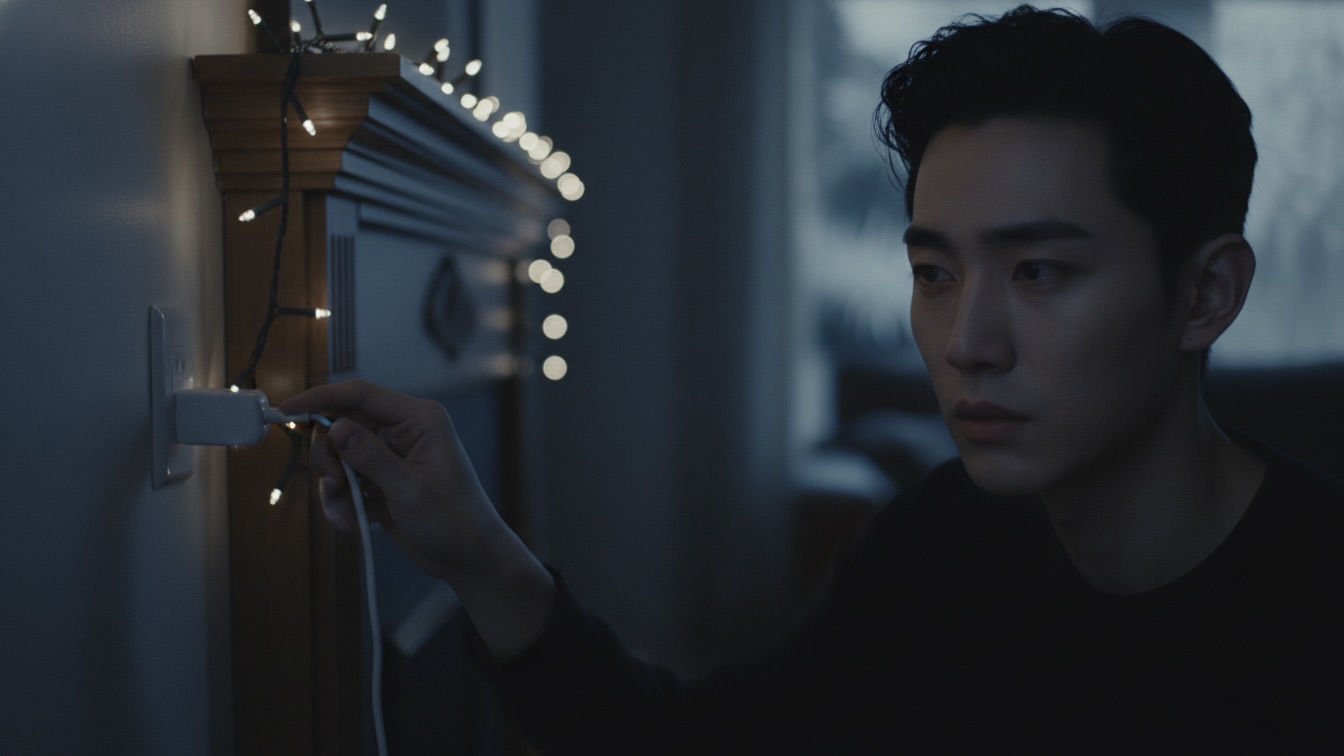
A cold dread, sharp and sudden, pierced through the numbness he had meticulously maintained. Christmas. His mother had loved Christmas. The lights, the carols, the smell of pine and gingerbread. Last year, she had spent hours stringing small, warm white lights around the mantel, each tiny bulb a beacon against the winter dark. She’d hummed off-key to holiday songs, a bright, cheerful sound that now felt like a relic from another lifetime.
He reached out, his fingers brushing against the cold, smooth plastic of the light strand. The familiar texture, the tiny, almost imperceptible warmth of the unused bulbs, brought a wave of nausea. He saw her face, laughing, her eyes crinkling at the corners. He heard her voice, light and full of life, telling him to help her untangle the wires. The memories, once comforting, now felt like razors, tearing at the delicate fabric of his composure.
His breath caught. He couldn’t. He couldn’t face it. Not this year. The thought of those lights glowing, a cheerful, defiant spark in the suffocating quiet of the house, was unbearable. It would be a lie. A cruel, mocking reminder of what was gone. His hand trembled as he found the small, white plug. With a decisive, almost desperate tug, he pulled it from the outlet.
The small, dark, unlit bulbs, still wrapped around the mantel, looked even colder now, lifeless. The room plunged deeper into shadow. No warm glow, no hint of festive cheer. Just the grey, muted light from the window and the oppressive weight of silence. It was better this way. Safer. The darkness matched the numb ache in his chest, a perfect, comforting void. The silence, he told himself, was a sanctuary, even as it tightened around him like a cage, cold and inescapable.
To the Reader
“Just as Sunny finds a temporary safety in the isolating darkness, remember that even in your deepest quiet, there are hands reaching out, waiting to offer a warmth you absolutely deserve.”
Share This Story


