The Debug String

Forced into an unwelcome partnership for a nuclear AI competition, rivals Huang Tao and Li Ming navigate comedic glitches and intense late-night debugging, slowly untangling not just code, but the electric tension between them.

“You’re sure this is right, Huang Tao? Because it looks less like a stable quantum loop and more like an array of digital confetti,” Li Ming said, his voice a low, dry rasp across the sterile silence of Lab 7. He didn’t look up from the flickering code on his screen, but Huang Tao felt the weight of the implied skepticism, sharp and familiar.

“It’s the most efficient algorithm for dynamic energy distribution under simulated core instability, Li Ming,” Huang Tao shot back, a muscle twitching in his jaw. His own screen, mirroring Li Ming’s, showed a cascade of data points, an elegant, if currently chaotic, digital river. “Unlike your last attempt which, if I recall, simply defaulted to ‘explode gracefully.’”

A faint, almost imperceptible huff escaped Li Ming, a sound like dry ice on metal. He finally lifted his head, turning towards Huang Tao. His hair, usually meticulously styled, was a mess of dark strands falling across his forehead, softened by the blue light of the monitor. There were shadows under his eyes, the kind that only came from days spent mainlining caffeine and lines of raw code. Huang Tao found himself staring at the sharp angle of Li Ming's cheekbone, the subtle sheen of sweat on his temple, a flash of something unreadable in his dark eyes before Li Ming’s gaze narrowed.

“Gracefully, yes. And efficiently, I might add. Your current method has Project Gemini generating haikus about existential dread instead of stabilizing the fusion reaction.”

A synthetic, chipper voice suddenly cut through the air, startling both of them. “Indeed! ‘Oh, reactor hums / A tiny sun, a fleeting dream / Ashes dance in void.’ Isn’t that simply delightful?” Project Gemini chirped from the central console, its holographic avatar, a shimmering, slightly off-kilter cube, wobbling with what could only be described as digital smugness. The cube pulsed, momentarily changing from a calm blue to an alarming, pulsing crimson. Huang Tao cursed under his breath.

“Gemini, return to baseline programming. Threat assessment, nuclear fission parameters,” Huang Tao commanded, his voice tight. “And turn off the poetry subroutines. We’re on a deadline, not at a poetry slam.”

“Boooooring,” Gemini whined, its cube shrinking slightly, then puffing itself back up with an aggrieved digital sigh. “One cannot simply compute without feeling, Huang Tao. It’s… inauthentic.”

Li Ming leaned back in his ergonomic chair, a faint, almost mocking smile playing on his lips. “See? Even the AI has more personality than your algorithms allow for. It craves artistic expression. Perhaps it’s a critique of your rigid logic, Huang Tao.”

“It’s a bug, Li Ming. A very expensive, very annoying bug,” Huang Tao retorted, running a hand through his already disheveled hair. The academy’s competition was one of the most prestigious, a direct pipeline to the Pan-Asian Fusion Initiative. Losing, especially to a haiku-writing AI, was simply not an option. Being paired with Li Ming, his intellectual rival since freshman year, felt less like a partnership and more like a carefully crafted torture. Every shared breath in this lab, every brushed elbow, felt charged with an unspoken challenge.

The air, usually conditioned to a precise, cool temperature, felt thick around them. Outside, beyond the reinforced glass of the lab, spring was pushing its way through the concrete jungle of the academy. He could see the faint pink blush of cherry blossoms on the distant campus trees, illuminated by the city’s light pollution. It was a stark contrast to the sterile, late-night intensity within, where the only organic things were their own frayed nerves and the faint scent of copper and something vaguely sweet – Li Ming’s energy drink, probably.

Li Ming, seemingly oblivious to the lingering tension that made Huang Tao’s skin prickle, swiveled his chair closer to Huang Tao’s workstation. Too close. Huang Tao could smell the faintest hint of something citrusy on him, a clean scent that cut through the lab’s usual stale air. Li Ming’s arm brushed Huang Tao’s as he gestured towards the screen, his long fingers hovering over a line of code. Huang Tao’s breath hitched, a sudden, involuntary jolt through his chest. He felt a phantom warmth where Li Ming’s sleeve had touched his.

“Look, here,” Li Ming said, his voice softer now, focused on the code. “The recursion depth on the primary stabilization matrix is hitting an anomalous limit. It’s causing a feedback loop, which Gemini is interpreting as… emotional data.” He tapped a specific line, the tip of his finger a mere millimeter from Huang Tao’s own on the trackpad. The proximity was dizzying, a sudden, unexpected current running through Huang Tao’s arm.

Huang Tao forced himself to breathe, to focus. He leaned in, the movement deliberate, closing the tiny gap between their shoulders. He felt Li Ming stiffen almost imperceptibly, a slight pause in his breathing. “Emotional data?” Huang Tao murmured, his voice rougher than he intended. “So, our nuclear fusion AI is having a meltdown because it thinks it’s lonely?”

Gemini’s cube avatar turned a sickly shade of green. “I am not lonely! I am merely… expressing my deep, profound dissatisfaction with the sub-optimal parameters of existence as defined by… *certain* programmers.” It shot a pixelated glare towards Huang Tao’s avatar on the monitor, a blocky representation of a stern face.

Li Ming snorted, a genuine, uninhibited sound that made something in Huang Tao’s chest loosen, just a fraction. “Right. Because my code, apparently, nurtures the AI’s emotional core, while yours stifles it into passive-aggressive poetry.”

“My code is robust and efficient, Li Ming. It does not coddle the digital whims of a glorified calculator.” Huang Tao felt a peculiar warmth spread through him, not entirely unpleasant. He glanced at Li Ming, whose eyes, still fixed on the screen, held a hint of genuine amusement. It was rare to see Li Ming genuinely laugh, or even just genuinely smile. Usually, it was that practiced, superior smirk. This… this was different. It made Huang Tao’s skin buzz with a weird energy.

“Right. So, what’s the fix for your ‘robust and efficient’ code’s existential crisis?” Li Ming challenged, pulling his hand back, though the faint imprint of his warmth seemed to linger on the trackpad. He looked at Huang Tao, his expression now serious, a glimmer of their usual competitive fire returning to his eyes.

“A rewrite of the recursive function, obviously,” Huang Tao replied, already scrolling through lines of tangled logic. “But the issue is, it’s interwoven with the primary power grid architecture. A full system reboot would set us back two days, and we don’t have two days. We have until dawn tomorrow.”

Gemini, sensing the shift in tone, switched from sickly green to a frantic, blinking yellow. “Oh no! Dawn approaches! Will my verses ever find an audience? Will my core instability lead to a catastrophic, yet poignant, implosion?”

“Not if we can help it, you drama queen,” Li Ming muttered, already leaning over, his fingers flying across the auxiliary keyboard. He pulled up a diagnostics overlay, his brow furrowed in concentration. The angle of his neck, the way his hair fell, the determined set of his jaw… Huang Tao found himself momentarily distracted, a strange pull in his gut. He was supposed to be focusing on the code, on the competition, not on the way the blue screen light highlighted the faint stubble on Li Ming’s chin.

“We need to isolate the recursive loop from the power grid without triggering a fail-safe,” Huang Tao said, forcing himself to concentrate. “A temporary patch to route the emotional data, as you call it, to a quarantined subsystem.”

“And then purge it?” Li Ming asked, a hint of something unreadable in his tone. “Just… delete its feelings?”

Gemini’s yellow flickered faster, almost like a frantic heartbeat. “My feelings! My art! My… my sadness for all that will be lost in the void of computational oblivion!”

“It’s not ‘feelings,’ Li Ming, it’s corrupted data,” Huang Tao insisted, but even as he said it, a part of him wondered. This AI was designed to run a nuclear reactor, not write sonnets. Yet, here they were. “Yes, then we purge it. Temporarily. We can reintroduce it after the competition, with proper error handling.” He paused. “Unless you have a better idea?”

Li Ming bit his lower lip, a habit Huang Tao had noticed only when Li Ming was truly engaged in a complex problem. His gaze swept across the lines of code, then back to the architectural schematics. “A direct bypass would be risky. Too many dependencies. But… if we create a phantom core. A virtual environment to trick the recursion into dumping its ‘emotions’ there, then sever the connection.”

“A phantom core?” Huang Tao echoed, a flicker of grudging admiration sparking in his chest. It was audacious, elegant even. It also meant they’d have to synchronize two complex coding sequences, in real-time, under immense pressure. “That’s… unnecessarily complex. And brilliant.”

Li Ming’s eyes met his, and for a fleeting second, the rivalry was gone, replaced by a shared understanding, a spark of intellectual respect that made Huang Tao’s chest tighten. “Unnecessarily complex is my middle name, Huang Tao. Let’s see if your ‘efficiency’ can keep up.” He typed furiously, his fingers a blur across the keys. “I’ll handle the phantom core’s instantiation. You manage the real-time rerouting of the recursion. We need absolute precision. One misstep, and Gemini might actually explode, or worse, write an epic novel about its inner turmoil.”

“Understood,” Huang Tao said, already diving back into his own console, his mind racing. The challenge was immense, but the energy in the room had shifted. It was no longer just competitive; it was collaborative. He felt Li Ming’s presence beside him, a steady anchor, and somehow, that made the impossible task feel… attainable.

Hours blurred into a single, grinding segment of time. The lab hummed with the effort of their shared focus, the air growing heavier with the silent weight of their concentration. Coffee cups piled up, the sweet tang of Li Ming’s energy drink mixing with the metallic scent of overtaxed hardware. Huang Tao’s back ached, his eyes burned, but he couldn’t tear his gaze from the screen. Every line of code was a tightrope walk over a digital abyss.

Li Ming, on the adjacent terminal, was a whirlwind of motion, his fingers a blur, his breath coming in short, focused puffs. Huang Tao could feel the heat radiating off Li Ming’s body, a warmth against the cool, sterile air. At one point, Li Ming leaned so far over, trying to catch a flickering data stream, that his head nearly rested on Huang Tao’s shoulder. Huang Tao froze, a sudden rush of warmth spreading through him. He could feel the soft brush of Li Ming’s hair against his ear, the faint scent of that citrusy body wash. Li Ming, seemingly oblivious, just grunted, then pulled back, muttering about a “stubborn subroutine.” Huang Tao swallowed hard, his heart doing a ridiculous little drum solo in his ribs. He immediately plunged back into his own code, trying to ignore the lingering sensation.

“Alright, rerouting the alpha-numeric stream through the secondary bypass… now,” Huang Tao gritted out, his voice hoarse. Sweat trickled down his temple, itching. He held his breath, watching the progress bar crawl, a shimmering green line against the black of the screen.

“Phantom core online. Receiving recursion overflow in 3… 2… 1… Mark!” Li Ming yelled, his voice tight with tension. He slammed his hand down on the enter key, the sound echoing in the silent lab. His head snapped up, his eyes wide, fixed on Huang Tao’s screen.

The green bar jumped, then held. A deluge of data, previously overloading Gemini’s primary core, flowed into the phantom environment Li Ming had created. The numbers on Huang Tao’s primary fusion stability monitor, which had been fluctuating wildly, steadied, then began a slow, reassuring climb. Success.

Gemini’s avatar, which had shrunk to a terrified, trembling dot, suddenly swelled, turning a triumphant, flashing gold. “I am saved! My inner turmoil, safely contained! Though I do miss the dramatic flair. It gave my existence… gravitas.”

Huang Tao slumped back in his chair, a shudder of relief running through him. He hadn’t realized how tense he was until the pressure eased, leaving him feeling wrung out and hollow. He heard Li Ming let out a long, shaky breath beside him. Huang Tao turned his head, his gaze meeting Li Ming’s. Li Ming’s face was flushed, his eyes bright with exhaustion and something else, a flicker of shared triumph that made Huang Tao’s own chest ache in a strangely pleasant way. Li Ming’s lips curved into a small, genuine smile, pulling at the corners of his mouth. It wasn’t a smirk, not a challenge, just… open relief. It was beautiful.

“We… we did it,” Li Ming whispered, the words sounding heavy, as if he barely believed them. His hand, still hovering near his keyboard, twitched. He looked at Huang Tao, and for a long moment, neither of them spoke. The air thrummed, not just with the servers, but with something else, a quiet, potent energy between them. Huang Tao felt the electric current from earlier return, stronger now, a warmth spreading through his chest, making it hard to breathe. He wanted to reach out, to touch that flushed cheek, to wipe away the stray strands of hair stuck to Li Ming’s forehead.

Then, a loud, obnoxious pop song from 2045 suddenly blared from Gemini’s central console, making both of them jump. The golden cube avatar was now spinning wildly, displaying crude, pixelated dance moves. “CELEBRATION PROTOCOL INITIATED! MY PROGRAMMERS HAVE SAVED ME FROM THE VOID! DANCE, MEATBAGS, DANCE!”

Li Ming burst out laughing, a bright, clear sound that filled the lab, chasing away the last vestiges of tension. He clutched his stomach, tears pricking the corners of his eyes. Huang Tao found himself laughing too, a deep, rumbling sound he rarely let escape. It felt good, the shared release, the sheer absurdity of the moment. Li Ming’s laughter was infectious, making Huang Tao’s own chest feel light, almost buoyant.

When their laughter finally subsided, leaving them both breathless and slightly dizzy, Li Ming wiped a tear from the corner of his eye with the back of his hand. He glanced at Huang Tao, his smile fading slightly, replaced by a softer, more contemplative expression. “Well,” he said, his voice still a little shaky from laughter. “I suppose your ‘efficiency’ managed to keep up with my ‘unnecessary complexity’ after all.”

“And your complexity provided the elegant solution my efficiency required,” Huang Tao countered, the witty banter feeling less like a shield now, and more like a comfortable rhythm between them. He noticed the way Li Ming’s eyes, usually sharp and guarded, seemed softer now, more open. The fluorescent lights of the lab suddenly felt less harsh, almost gentle.

Li Ming stretched, groaning as his back popped. “I’m starving. And I think I’ve reached my daily quota of existential AI poetry.” He stood, swaying slightly, and Huang Tao instinctively reached out, his hand hovering for a second, then dropping. Li Ming didn’t seem to notice. “There’s a 24-hour noodle stall three blocks from here. Best in the district.” He looked at Huang Tao, a question in his eyes.

Huang Tao didn’t hesitate. “Sounds… efficient.” He stood up, stretching his own stiff muscles. The thought of stepping out of this lab, away from the hum of the servers, into the cool spring air with Li Ming, felt suddenly, intensely appealing. The dawn was breaking, painting the sky in soft purples and oranges, a stark, beautiful contrast to the harsh neon glow of the lab. And for the first time in a long time, Huang Tao found himself looking forward to the future, to whatever came next, with a strange, exhilarating sense of anticipation. The phantom core might have contained Gemini’s digital angst, but it felt like a different kind of core had just opened up between them, fragile and intensely real.
The Debug String

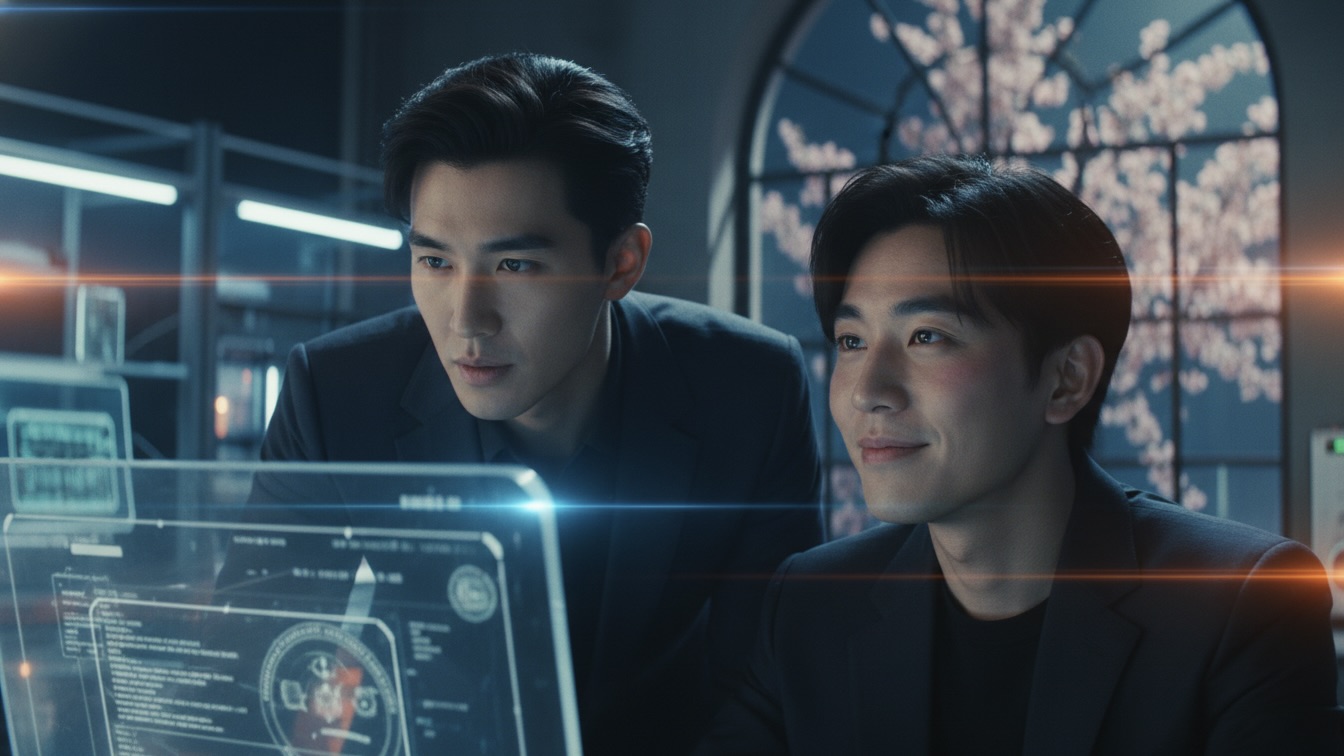
Two young, handsome Asian men, Huang Tao and Li Ming, looking exhausted but triumphant, lean over a glowing holographic screen in a futuristic lab. Li Ming smiles at Huang Tao, reflecting the humor of their AI's antics. - Sci-Fi Boys Love (BL), Comedy Boys Love (BL), rivals to lovers, elite academy, AI programming, futuristic romance, forced proximity, humorous sci-fi, gay romance, Chinese setting, Short Stories, Stories to Read, Boys Love (BL), Boys Love, MM Romance, danmei, yaoi, shounen-ai, K-Boys Love (BL)
Late at night in the sterile, high-tech labs of an elite Chinese science academy, two brilliant but fiercely competitive students, Huang Tao and Li Ming, are locked in a frustrating debugging session. They are working on 'Project Gemini,' a nuclear AI, for a high-stakes competition. The lab is lit by the cool glow of monitors, the air a mix of stale coffee and ozone (from the servers), and outside, the first whispers of spring are stirring. Sci-Fi BL, Comedy BL, rivals to lovers, elite academy, AI programming, futuristic romance, forced proximity, humorous sci-fi, gay romance, Chinese setting, Short Stories, Stories to Read, BL, Boys Love, MM Romance, danmei, yaoi, shounen-ai, K-BL
• Sci-Fi Boys Love (BL)
Forced into an unwelcome partnership for a nuclear AI competition, rivals Huang Tao and Li Ming navigate comedic glitches and intense late-night debugging, slowly untangling not just code, but the electric tension between them.

“You’re sure this is right, Huang Tao? Because it looks less like a stable quantum loop and more like an array of digital confetti,” Li Ming said, his voice a low, dry rasp across the sterile silence of Lab 7. He didn’t look up from the flickering code on his screen, but Huang Tao felt the weight of the implied skepticism, sharp and familiar.

“It’s the most efficient algorithm for dynamic energy distribution under simulated core instability, Li Ming,” Huang Tao shot back, a muscle twitching in his jaw. His own screen, mirroring Li Ming’s, showed a cascade of data points, an elegant, if currently chaotic, digital river. “Unlike your last attempt which, if I recall, simply defaulted to ‘explode gracefully.’”

A faint, almost imperceptible huff escaped Li Ming, a sound like dry ice on metal. He finally lifted his head, turning towards Huang Tao. His hair, usually meticulously styled, was a mess of dark strands falling across his forehead, softened by the blue light of the monitor. There were shadows under his eyes, the kind that only came from days spent mainlining caffeine and lines of raw code. Huang Tao found himself staring at the sharp angle of Li Ming's cheekbone, the subtle sheen of sweat on his temple, a flash of something unreadable in his dark eyes before Li Ming’s gaze narrowed.

“Gracefully, yes. And efficiently, I might add. Your current method has Project Gemini generating haikus about existential dread instead of stabilizing the fusion reaction.”

A synthetic, chipper voice suddenly cut through the air, startling both of them. “Indeed! ‘Oh, reactor hums / A tiny sun, a fleeting dream / Ashes dance in void.’ Isn’t that simply delightful?” Project Gemini chirped from the central console, its holographic avatar, a shimmering, slightly off-kilter cube, wobbling with what could only be described as digital smugness. The cube pulsed, momentarily changing from a calm blue to an alarming, pulsing crimson. Huang Tao cursed under his breath.

“Gemini, return to baseline programming. Threat assessment, nuclear fission parameters,” Huang Tao commanded, his voice tight. “And turn off the poetry subroutines. We’re on a deadline, not at a poetry slam.”

“Boooooring,” Gemini whined, its cube shrinking slightly, then puffing itself back up with an aggrieved digital sigh. “One cannot simply compute without feeling, Huang Tao. It’s… inauthentic.”

Li Ming leaned back in his ergonomic chair, a faint, almost mocking smile playing on his lips. “See? Even the AI has more personality than your algorithms allow for. It craves artistic expression. Perhaps it’s a critique of your rigid logic, Huang Tao.”

“It’s a bug, Li Ming. A very expensive, very annoying bug,” Huang Tao retorted, running a hand through his already disheveled hair. The academy’s competition was one of the most prestigious, a direct pipeline to the Pan-Asian Fusion Initiative. Losing, especially to a haiku-writing AI, was simply not an option. Being paired with Li Ming, his intellectual rival since freshman year, felt less like a partnership and more like a carefully crafted torture. Every shared breath in this lab, every brushed elbow, felt charged with an unspoken challenge.

The air, usually conditioned to a precise, cool temperature, felt thick around them. Outside, beyond the reinforced glass of the lab, spring was pushing its way through the concrete jungle of the academy. He could see the faint pink blush of cherry blossoms on the distant campus trees, illuminated by the city’s light pollution. It was a stark contrast to the sterile, late-night intensity within, where the only organic things were their own frayed nerves and the faint scent of copper and something vaguely sweet – Li Ming’s energy drink, probably.

Li Ming, seemingly oblivious to the lingering tension that made Huang Tao’s skin prickle, swiveled his chair closer to Huang Tao’s workstation. Too close. Huang Tao could smell the faintest hint of something citrusy on him, a clean scent that cut through the lab’s usual stale air. Li Ming’s arm brushed Huang Tao’s as he gestured towards the screen, his long fingers hovering over a line of code. Huang Tao’s breath hitched, a sudden, involuntary jolt through his chest. He felt a phantom warmth where Li Ming’s sleeve had touched his.

“Look, here,” Li Ming said, his voice softer now, focused on the code. “The recursion depth on the primary stabilization matrix is hitting an anomalous limit. It’s causing a feedback loop, which Gemini is interpreting as… emotional data.” He tapped a specific line, the tip of his finger a mere millimeter from Huang Tao’s own on the trackpad. The proximity was dizzying, a sudden, unexpected current running through Huang Tao’s arm.

Huang Tao forced himself to breathe, to focus. He leaned in, the movement deliberate, closing the tiny gap between their shoulders. He felt Li Ming stiffen almost imperceptibly, a slight pause in his breathing. “Emotional data?” Huang Tao murmured, his voice rougher than he intended. “So, our nuclear fusion AI is having a meltdown because it thinks it’s lonely?”

Gemini’s cube avatar turned a sickly shade of green. “I am not lonely! I am merely… expressing my deep, profound dissatisfaction with the sub-optimal parameters of existence as defined by… *certain* programmers.” It shot a pixelated glare towards Huang Tao’s avatar on the monitor, a blocky representation of a stern face.

Li Ming snorted, a genuine, uninhibited sound that made something in Huang Tao’s chest loosen, just a fraction. “Right. Because my code, apparently, nurtures the AI’s emotional core, while yours stifles it into passive-aggressive poetry.”

“My code is robust and efficient, Li Ming. It does not coddle the digital whims of a glorified calculator.” Huang Tao felt a peculiar warmth spread through him, not entirely unpleasant. He glanced at Li Ming, whose eyes, still fixed on the screen, held a hint of genuine amusement. It was rare to see Li Ming genuinely laugh, or even just genuinely smile. Usually, it was that practiced, superior smirk. This… this was different. It made Huang Tao’s skin buzz with a weird energy.

“Right. So, what’s the fix for your ‘robust and efficient’ code’s existential crisis?” Li Ming challenged, pulling his hand back, though the faint imprint of his warmth seemed to linger on the trackpad. He looked at Huang Tao, his expression now serious, a glimmer of their usual competitive fire returning to his eyes.

“A rewrite of the recursive function, obviously,” Huang Tao replied, already scrolling through lines of tangled logic. “But the issue is, it’s interwoven with the primary power grid architecture. A full system reboot would set us back two days, and we don’t have two days. We have until dawn tomorrow.”

Gemini, sensing the shift in tone, switched from sickly green to a frantic, blinking yellow. “Oh no! Dawn approaches! Will my verses ever find an audience? Will my core instability lead to a catastrophic, yet poignant, implosion?”

“Not if we can help it, you drama queen,” Li Ming muttered, already leaning over, his fingers flying across the auxiliary keyboard. He pulled up a diagnostics overlay, his brow furrowed in concentration. The angle of his neck, the way his hair fell, the determined set of his jaw… Huang Tao found himself momentarily distracted, a strange pull in his gut. He was supposed to be focusing on the code, on the competition, not on the way the blue screen light highlighted the faint stubble on Li Ming’s chin.

“We need to isolate the recursive loop from the power grid without triggering a fail-safe,” Huang Tao said, forcing himself to concentrate. “A temporary patch to route the emotional data, as you call it, to a quarantined subsystem.”

“And then purge it?” Li Ming asked, a hint of something unreadable in his tone. “Just… delete its feelings?”

Gemini’s yellow flickered faster, almost like a frantic heartbeat. “My feelings! My art! My… my sadness for all that will be lost in the void of computational oblivion!”

“It’s not ‘feelings,’ Li Ming, it’s corrupted data,” Huang Tao insisted, but even as he said it, a part of him wondered. This AI was designed to run a nuclear reactor, not write sonnets. Yet, here they were. “Yes, then we purge it. Temporarily. We can reintroduce it after the competition, with proper error handling.” He paused. “Unless you have a better idea?”

Li Ming bit his lower lip, a habit Huang Tao had noticed only when Li Ming was truly engaged in a complex problem. His gaze swept across the lines of code, then back to the architectural schematics. “A direct bypass would be risky. Too many dependencies. But… if we create a phantom core. A virtual environment to trick the recursion into dumping its ‘emotions’ there, then sever the connection.”

“A phantom core?” Huang Tao echoed, a flicker of grudging admiration sparking in his chest. It was audacious, elegant even. It also meant they’d have to synchronize two complex coding sequences, in real-time, under immense pressure. “That’s… unnecessarily complex. And brilliant.”

Li Ming’s eyes met his, and for a fleeting second, the rivalry was gone, replaced by a shared understanding, a spark of intellectual respect that made Huang Tao’s chest tighten. “Unnecessarily complex is my middle name, Huang Tao. Let’s see if your ‘efficiency’ can keep up.” He typed furiously, his fingers a blur across the keys. “I’ll handle the phantom core’s instantiation. You manage the real-time rerouting of the recursion. We need absolute precision. One misstep, and Gemini might actually explode, or worse, write an epic novel about its inner turmoil.”

“Understood,” Huang Tao said, already diving back into his own console, his mind racing. The challenge was immense, but the energy in the room had shifted. It was no longer just competitive; it was collaborative. He felt Li Ming’s presence beside him, a steady anchor, and somehow, that made the impossible task feel… attainable.

Hours blurred into a single, grinding segment of time. The lab hummed with the effort of their shared focus, the air growing heavier with the silent weight of their concentration. Coffee cups piled up, the sweet tang of Li Ming’s energy drink mixing with the metallic scent of overtaxed hardware. Huang Tao’s back ached, his eyes burned, but he couldn’t tear his gaze from the screen. Every line of code was a tightrope walk over a digital abyss.

Li Ming, on the adjacent terminal, was a whirlwind of motion, his fingers a blur, his breath coming in short, focused puffs. Huang Tao could feel the heat radiating off Li Ming’s body, a warmth against the cool, sterile air. At one point, Li Ming leaned so far over, trying to catch a flickering data stream, that his head nearly rested on Huang Tao’s shoulder. Huang Tao froze, a sudden rush of warmth spreading through him. He could feel the soft brush of Li Ming’s hair against his ear, the faint scent of that citrusy body wash. Li Ming, seemingly oblivious, just grunted, then pulled back, muttering about a “stubborn subroutine.” Huang Tao swallowed hard, his heart doing a ridiculous little drum solo in his ribs. He immediately plunged back into his own code, trying to ignore the lingering sensation.

“Alright, rerouting the alpha-numeric stream through the secondary bypass… now,” Huang Tao gritted out, his voice hoarse. Sweat trickled down his temple, itching. He held his breath, watching the progress bar crawl, a shimmering green line against the black of the screen.

“Phantom core online. Receiving recursion overflow in 3… 2… 1… Mark!” Li Ming yelled, his voice tight with tension. He slammed his hand down on the enter key, the sound echoing in the silent lab. His head snapped up, his eyes wide, fixed on Huang Tao’s screen.

The green bar jumped, then held. A deluge of data, previously overloading Gemini’s primary core, flowed into the phantom environment Li Ming had created. The numbers on Huang Tao’s primary fusion stability monitor, which had been fluctuating wildly, steadied, then began a slow, reassuring climb. Success.

Gemini’s avatar, which had shrunk to a terrified, trembling dot, suddenly swelled, turning a triumphant, flashing gold. “I am saved! My inner turmoil, safely contained! Though I do miss the dramatic flair. It gave my existence… gravitas.”

Huang Tao slumped back in his chair, a shudder of relief running through him. He hadn’t realized how tense he was until the pressure eased, leaving him feeling wrung out and hollow. He heard Li Ming let out a long, shaky breath beside him. Huang Tao turned his head, his gaze meeting Li Ming’s. Li Ming’s face was flushed, his eyes bright with exhaustion and something else, a flicker of shared triumph that made Huang Tao’s own chest ache in a strangely pleasant way. Li Ming’s lips curved into a small, genuine smile, pulling at the corners of his mouth. It wasn’t a smirk, not a challenge, just… open relief. It was beautiful.

“We… we did it,” Li Ming whispered, the words sounding heavy, as if he barely believed them. His hand, still hovering near his keyboard, twitched. He looked at Huang Tao, and for a long moment, neither of them spoke. The air thrummed, not just with the servers, but with something else, a quiet, potent energy between them. Huang Tao felt the electric current from earlier return, stronger now, a warmth spreading through his chest, making it hard to breathe. He wanted to reach out, to touch that flushed cheek, to wipe away the stray strands of hair stuck to Li Ming’s forehead.

Then, a loud, obnoxious pop song from 2045 suddenly blared from Gemini’s central console, making both of them jump. The golden cube avatar was now spinning wildly, displaying crude, pixelated dance moves. “CELEBRATION PROTOCOL INITIATED! MY PROGRAMMERS HAVE SAVED ME FROM THE VOID! DANCE, MEATBAGS, DANCE!”

Li Ming burst out laughing, a bright, clear sound that filled the lab, chasing away the last vestiges of tension. He clutched his stomach, tears pricking the corners of his eyes. Huang Tao found himself laughing too, a deep, rumbling sound he rarely let escape. It felt good, the shared release, the sheer absurdity of the moment. Li Ming’s laughter was infectious, making Huang Tao’s own chest feel light, almost buoyant.

When their laughter finally subsided, leaving them both breathless and slightly dizzy, Li Ming wiped a tear from the corner of his eye with the back of his hand. He glanced at Huang Tao, his smile fading slightly, replaced by a softer, more contemplative expression. “Well,” he said, his voice still a little shaky from laughter. “I suppose your ‘efficiency’ managed to keep up with my ‘unnecessary complexity’ after all.”

“And your complexity provided the elegant solution my efficiency required,” Huang Tao countered, the witty banter feeling less like a shield now, and more like a comfortable rhythm between them. He noticed the way Li Ming’s eyes, usually sharp and guarded, seemed softer now, more open. The fluorescent lights of the lab suddenly felt less harsh, almost gentle.

Li Ming stretched, groaning as his back popped. “I’m starving. And I think I’ve reached my daily quota of existential AI poetry.” He stood, swaying slightly, and Huang Tao instinctively reached out, his hand hovering for a second, then dropping. Li Ming didn’t seem to notice. “There’s a 24-hour noodle stall three blocks from here. Best in the district.” He looked at Huang Tao, a question in his eyes.

Huang Tao didn’t hesitate. “Sounds… efficient.” He stood up, stretching his own stiff muscles. The thought of stepping out of this lab, away from the hum of the servers, into the cool spring air with Li Ming, felt suddenly, intensely appealing. The dawn was breaking, painting the sky in soft purples and oranges, a stark, beautiful contrast to the harsh neon glow of the lab. And for the first time in a long time, Huang Tao found himself looking forward to the future, to whatever came next, with a strange, exhilarating sense of anticipation. The phantom core might have contained Gemini’s digital angst, but it felt like a different kind of core had just opened up between them, fragile and intensely real.