The Community Centre's Fading Paint
The oppressive summer heat hung thick and heavy, a blanket woven from humidity and the persistent hum of distant insects. Inside the community centre, the air was still, stagnant, despite the single, rattling floor fan in the corner. Paint peeled in languid curls from the window sills, and the scent of old wood and something vaguely metallic—the static charge of a dying fridge, perhaps—clung to everything. It was a place where time felt less like a river and more like a sluggish pond, mirroring the slow, quiet struggle of the community it served.
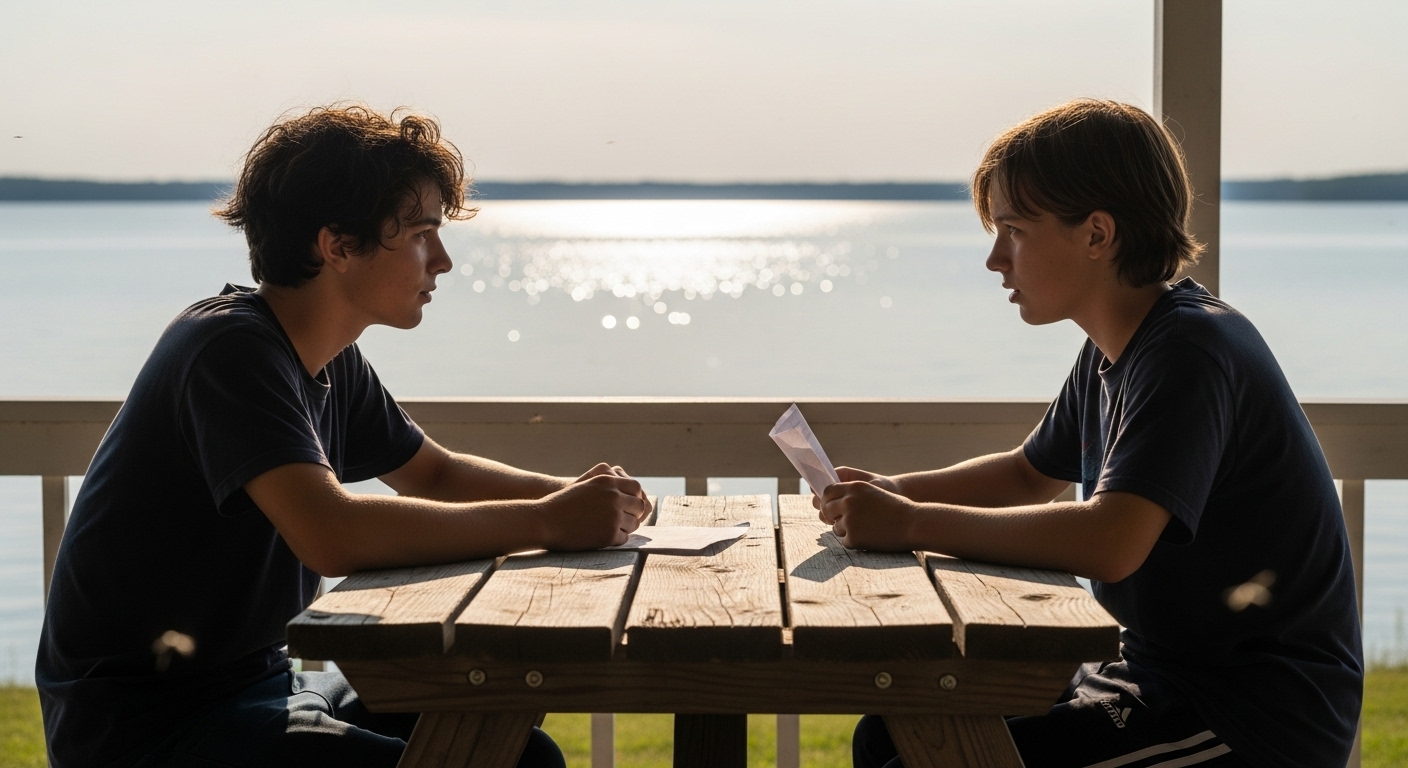
"So," John started, his voice a low rumble, barely cutting through the drone of the single, overworked fan, "what exactly is 'SDG 4' supposed to do for us? Here. In this particular, very small, very remote 'here'?"
I looked up from the crumpled grant application form, the words blurring under my gaze. The heat was a living thing, pressing against my skin, making the old wooden table stick to my forearms. "It's about 'quality education,' John," I said, trying to infuse some authority into my tone, even though my insides felt like a tangled mess of fishing line. "Ensuring 'inclusive and equitable quality education and promoting lifelong learning opportunities for all.'"
John snorted, a dry, dismissive sound. He ran a hand through his short, straw-coloured hair, leaving it standing up in tufts. "Right. And how does that translate into, what was it, 'a robust summer arts and recreation program' for the ten kids left in this entire… settlement?" He gestured vaguely towards the window, where the sun beat down on the dusty road that led to the lake, shimmering like a mirage.
"It's more than just the ten kids," I countered, my voice tight. "It's about capacity building. About making sure that when, or if, those kids decide to stay, or when new families come, there's something here for them. Something beyond… beyond just a fish and a net." The words felt clumsy, inadequate.
"And 'SDG 4' is the magic word for that, is it?" His eyes, usually full of a restless energy, were now shadowed with a weariness that was too old for his seventeen years. "Because last year, when we tried for the 'Youth Development Fund,' they said we were too small, too 'niche.' Too much administrative overhead for too little impact."
The memory stung. That grant had been a disaster, and John had carried the brunt of the rejection, while I'd retreated into my books. But this time, Ms. Taylor had been insistent. "This is different," I said, more to convince myself than him. "She said the UN goals give us… a framework. A way to show that what we do here, even if it's small scale, contributes to a global effort."
"Global effort," John repeated, his gaze drifting to the faded photographs on the wall, pictures of hockey teams from decades past, their smiles wide and confident. "Sounds like a fancy way to say 'fill out a pile of paperwork nobody will read.'"
I pushed the form across the table, the fine print a dizzying blur. "Look, it explicitly mentions 'promoting a culture of peace and non-violence, global citizenship and appreciation of cultural diversity and of culture’s contribution to sustainable development.' That's where the arts and recreation come in. It's about culture, community well-being."
He leaned forward, propping his chin on his hands, a slight scowl on his face. "Cultural diversity. We're diverse, all right. We've got… us. And the folks on the other side of the lake. And that one family from down south who moved up last spring and left after six weeks, complaining about the bugs." He sighed, a dramatic exhalation that stirred the few loose papers on the table.
"It's not just about ethnicity, John," I explained, trying to sound patient. "It's about different ways of life. Different perspectives. Providing a space for expression, for learning new skills. Maybe someone wants to learn traditional drumming, someone else wants to learn coding, and someone else wants to paint the lake in a way no one's ever seen before."
He picked at a loose thread on his worn denim shorts. "Drumming and coding, eh? In the same breath. Pretty ambitious for a place with intermittent internet and a community hall that leaks when it rains hard."
I knew he was right. The limitations of our isolated community, nestled deep within Northwestern Ontario's vast, untamed wilderness, were a constant, undeniable presence. The nearest proper town was a three-hour drive, the road a ribbon of gravel and potholes that swallowed tires whole. Supplies were expensive, skilled labour scarce, and the youth, year after year, dwindled. They left for cities, for schools, for opportunities that simply didn't exist here. It was a slow bleed, a quiet emptying out.
"That's exactly why this grant is so important," I insisted, my voice rising a little in my earnestness. "It’s not just about filling summer days. It's about planting seeds. Giving reasons to stay. Giving reasons to come back."
John looked at me then, a flicker of something unreadable in his eyes. "You really believe that, don't you? That a few art classes and some kayak rentals are going to stop the tide?"
I didn't answer immediately. The fan whirred, sounding more like a complaint than an effort to cool the air. I believed it because I had to believe it. This place, this community, it was in my blood. My ancestors had lived here for generations, their stories woven into the very fabric of the land. But the stories were fading, the threads fraying.
"We need more than belief," I finally said, pulling the form closer again. "We need a plan. A proper, official plan that sounds impressive to people who don't know the difference between a whitefish and a walleye, or how long winter truly lasts up here."
John chuckled, a genuine, if brief, sound. "True enough. So, SDG 4. We're teaching kids to, what, embrace their inner global citizen through finger painting?"
"It's not finger painting!" I protested, though I couldn't help a small smile. "It's about critical thinking. About creative expression. About digital literacy. About connecting with heritage without being… stuck in the past. It’s about, as Grandma Maggie says, making sure our stories aren’t just remembered, but lived."
---
Grandma Maggie's Porch
The air on Grandma Maggie's porch was cooler, or perhaps it just felt that way because of the massive, ancient cedar that shaded her small, impeccably kept cabin. The cedar smelled like deep earth and a touch of something sweet, almost resinous. She sat on her favourite rocking chair, mending a fishing net with nimble, practiced fingers, her silver braids glinting in the dappled sunlight.
"Grandma Maggie," I began, carefully, as John settled onto the steps, propping his elbows on his knees. "We're working on this grant, for the summer programmes. Ms. Taylor thinks we need to connect it to, you know, these big global goals."
She hummed, her eyes focused on the intricate knot she was tying. "Global goals, eh? Sounds like something folks in cities dream up when they run out of local problems."
John stifled a laugh. I shot him a look. "It's called 'Sustainable Development Goal 4,'" I elaborated, trying to explain it simply. "About education, access, promoting culture."
She nodded slowly, a thoughtful expression now on her face. "Culture. That's always been important. Our stories, our songs. Our way of being. They teach us how to live on this land, how to respect it. How to respect each other."
"Exactly," I said, feeling a surge of hope. "So, arts programmes, recreation – they help with that, right? They keep the culture alive, teach skills, build community."
"They can," she conceded, her gaze distant, looking out at the shimmering lake. "But a piece of paper from afar, with big words, doesn't build a community. People do. Hands. Hearts. And sometimes… sometimes a little bit of stubbornness, too."
"What kind of stubbornness?" John asked, his voice softer now, sensing the shift in her tone.
"The kind that says 'we will stay,' even when the easy path is to leave," Grandma Maggie replied, her voice low. "The kind that says 'we will teach our children,' even when they are more interested in what's on a screen than what's in the forest. The kind that says 'we will remember,' even when the new ways try to make us forget."
Her words hung in the humid air, heavier than the summer heat. It wasn't just about grants or programmes. It was about something deeper, something that gnawed at the edges of every conversation about the community's future. The youth leaving. The traditions fraying. The quiet despair that sometimes settled over the older generation.
"Ms. Taylor is really counting on this grant," I told her, my voice barely a whisper. "She thinks it's the only way to get some proper funding for the youth centre, for a new dock for swimming lessons, for art supplies."
"Ms. Taylor is a good woman," Grandma Maggie affirmed, her eyes meeting mine. "She sees the spark. She tries to fan it into a flame. But a flame needs fuel, child. And sometimes, the wood is wet."
I thought about the conversation with John, his cynicism, born not of malice but of observation. The declining numbers, the crumbling infrastructure, the sense of being forgotten. Was the wood truly wet, or were we just not knowing how to start the fire anymore?
"How do we… make the wood dry, Grandma?" I asked, the question feeling foolish even as it left my lips.
She smiled, a small, knowing curve of her lips. "You tell the stories, Ted. You live them. You show the children what they are missing, what they could have. And sometimes… sometimes you just keep putting one foot in front of the other, even when the path is overgrown."
John shifted on the steps, his gaze also fixed on the lake. "Sounds a lot like what we're trying to put into this grant, though. All the 'capacity building' and 'cultural appreciation.'"
"The words can be the same," she said, her voice gentle, "but the heart behind them, that's what makes the difference. Is it just a checklist, or is it a true wanting?"
The question lingered, a challenge thrown into the still summer air. Was our wanting true enough? Or were we just trying to fill out forms to please Ms. Taylor, to stave off the inevitable decline for another year?
---
The Evening's Chill
Later that evening, the lake had cooled slightly, sending up faint wisps of mist that danced over the surface. The mosquitos, however, had not cooled. They were out in full force, a buzzing cloud around my head as John and I sat on the porch of our cabin, staring at the stars. The sky was an impossibly deep indigo, speckled with a million pinpricks of light that felt both comforting and overwhelmingly vast.
"She's right, you know," John said, breaking a long silence. He swatted a mosquito on his arm. "About the heart. It can't just be words."
"I know," I replied, feeling a familiar ache in my chest. "But how do we put 'heart' into a section about 'monitoring and evaluation criteria'?"
He sighed, a deep, frustrated sound. "I don't know, Ted. I really don't know. It feels like… like we're trying to build a new bridge with old, rotting timber. And the river below is getting wider every year."
My mind raced, jumping from Grandma Maggie's quiet wisdom to Ms. Taylor's urgent deadline, to John's pragmatic doubts. The grant was due in two weeks. Two weeks to convince a panel of strangers, sitting in an office hundreds of kilometres away, that our small, struggling community was worth investing in, not just for a summer program, but for its very future.
"We need a hook," I mused aloud, mostly to myself. "Something that makes them see beyond the numbers. Beyond the distance."
"A hook," John repeated, sounding unconvinced. "Like what? A picture of a bear playing the flute?"
"Something real," I clarified, ignoring his sarcasm. "Something that shows them the value isn't just in the 'education' or 'culture' itself, but in what it means for us. The connection. The legacy."
But the truth was, the legacy felt precarious. Every year, another family moved away. Every year, the community felt a little quieter, a little emptier. The older generation held on, fiercely, to their ways, their land, their memories. But the younger ones, like John and me, we stood at a precipice. The world beyond called, glittering with promises of internet speeds that didn't crawl, job opportunities that didn't depend on seasonal tourism or resource extraction, and communities that didn't feel like they were constantly fighting against oblivion.
Ms. Taylor had caught me after school, her eyes, usually so bright with educational zeal, now clouded with a quiet desperation. "This is it, Ted," she'd said, her voice hushed. "If we don't get this, the youth centre might… well, we might have to re-evaluate what we can even offer. The provincial funding is drying up. We need to show them we're self-sustaining, that we're innovative."
Innovative. The word felt like a heavy stone in my gut. How innovative could we be with a leaky roof and a library full of books from the 1980s? Yet, the thought of the youth centre closing, of the children having even fewer reasons to stay, felt like a physical blow. The silence of the night, broken only by the chirping crickets and the occasional splash of a fish jumping in the lake, began to feel less peaceful and more like the quiet before a storm.
"What if we don't get it?" John's question cut through the stillness, echoing my own unspoken fear. He didn't look at me, his gaze fixed on the darkest part of the lake.
I shivered, despite the lingering warmth of the day. The summer had seemed endless just weeks ago, a lazy stretch of sun and water. Now, it felt like a countdown. A deadline. Not just for a grant, but for something far more profound. The pressure was immense, pressing down on us like the heavy, humid air of the day. This small piece of paper, this grant proposal, held the weight of an entire community's hope. And I knew, with a certainty that chilled me to the bone, that the challenges we faced went far beyond the correct phrasing of an SDG. They were rooted in the very ground beneath our feet, in the dwindling numbers of our people, and in the unseen forces that seemed determined to pull us apart.
But the true chill, the one that lingered long after the sun dipped below the horizon, was the unspoken truth that securing the funds might only be the beginning, and perhaps not even the hardest part, of a battle for a future that seemed to be slipping through our fingers like fine, dry sand.
Share This Story


