A Scrape of Winter's Teeth
The city's winter bites hard, transforming familiar paths into treacherous sheets of ice and slush. Amidst the grey, churning landscape of a university campus, Siobhán confronts the harsh realities of urban life, far from the quiet, predictable snows of her northern home, seeking a fragile foothold in a world that feels increasingly alien.
Siobhán’s worn winter boot skidded, a sudden, violent lurch on the black ice that stretched unseen beneath the thin dust of city snow. Her knee twisted, a sharp, searing protest up her leg. A choked sound, half curse, half gasp, snagged in her throat, lost immediately to the wind that ripped off Lake Ontario, carrying with it the metallic tang of frozen salt and damp concrete. Her gloved hand slammed against the nearest lamppost, the metal a raw, shocking current of cold through the thin wool, making her teeth ache. She didn't fall, not quite, but the near-miss left her heart hammering against her ribs, a frantic bird trapped in a cage.
This wasn’t the snow she knew. Not the deep, clean, silencing drifts of home, where every flake held its own perfect geometry. This was city snow: gritty, trodden into a greyish-brown slush, perpetually fighting a losing battle against the endless churn of traffic and hurried footsteps. It hid its treacherous sheen of ice with a deceptive, almost malevolent casualness.
A shape solidified in the swirling, low light, shoulders hunched, head down, a figure battling the same invisible adversary. Carl. He was nearly on her before he registered her presence, pulling up short with a clumsy, heavy-footed shuffle that nearly sent him sprawling. “Whoa. Siobhán? You alright?” His breath plumed out, a dense, fleeting cloud in the frigid air, almost reaching her face.
“Just… nearly made acquaintance with the pavement.” She rubbed her knee through the thick fabric of her jeans, a dull throb already settling in. The ache was familiar, a constant companion since arriving in the city, like a low-grade hum of perpetual dis-ease. “This city. Honestly, it’s got a vendetta against me.”
He let out a short, dry laugh, the sound quickly snatched by the wind. “Tell me about it. Saw a delivery van almost take out a bike courier on Yonge street this morning. Horn blared, the driver yelled something. No one else even blinked. Just kept walking.” He paused, shifting his weight from one foot to the other, a restless energy even when standing still. “It’s different here, eh? The way people just… endure it.”
“Endure is the word.” She pushed off the lamppost, the phantom chill lingering on her palm. They began to walk, a slow, careful shuffle, their boots crunching on the grimy snow, avoiding the slick, gleaming patches. Her gaze drifted over the campus buildings, the Gothic revival stone darkened by decades of city soot, now dusted with a thin, unconvincing layer of white. It looked less like winter, more like neglect.
Carl pulled his scarf tighter, the wool scratching against his stubbled chin. “How’s that essay on urban sociology coming along? Found any profound truths about our concrete jungle yet?”
Siobhán snorted, a small puff of white. “Profound truths mostly involve wishing I was back on the ice road, just watching the stars. Or listening to… nothing. Just the wind, maybe. Not perpetual sirens and the roar of a streetcar every seven minutes.”
“Yeah, the silence, that’s what I miss most. The kind that presses in, you know? Makes your ears ring.” Carl kicked at a loose chunk of ice, sending it skittering. “Here, it’s just… noise. All the time. Even in your head, it feels like there’s traffic.”
The Unseen Currents
They walked past the old physics building, its limestone façade chipped and pitted like an ancient face. Siobhán glanced up, her eyes catching on a window on the third floor. It was a large, arched window, distinct from the others, and a single, intricate frost pattern bloomed across its lower pane. Not the usual haphazard tracery of ice, but something too delicate, too deliberate. Almost like a fern, but with sharper, more angular fronds, unfurling in precise, almost unnatural symmetry. She paused, a flicker of unease tightening her throat.
“What is it?” Carl asked, noticing her halt, following her gaze. “Pretty cold for a window display.”
“Just… that frost. It’s weird, isn’t it?” Siobhán pointed with her chin, not wanting to take her hands from her pockets. “It’s like someone drew it. Or grew it.”
He squinted. “Yeah, I guess. Probably some weird condensation thing with the old glass. This building’s ancient, Siobhán. It probably breathes funny.” He shrugged, dismissing it, his attention already drifting to the steam rising from a nearby manhole cover. “Still, better than my window. Just a sheet of ice, opaque as a glacier. Can’t even tell if it’s day or night sometimes.”
Siobhán didn’t reply immediately. The frost pattern on the physics building window felt different, a cold prickle on her skin despite the distance. It wasn’t just the cold; it was the precision, the almost unsettling artistry of it. She shook her head, trying to dislodge the thought. Just old glass, Carl’s right. Weird condensation. But the image persisted, a fractal of unnerving beauty.
They turned a corner, the wind suddenly dying down to a murmur. The air grew still, heavy with the scent of wet soil and distant exhaust. A cluster of students hurried past, their laughter bright and ephemeral in the muted light. Siobhán felt the familiar pang of being an outsider, an observer. They seemed so effortlessly woven into the fabric of this place, while she still felt like a loose thread, easily unravelled.
“Found a good spot for quiet study yet?” Carl asked, breaking the silence, his voice a little softer now. “Away from the common room chaos?”
“The library’s always a war zone for outlets,” Siobhán murmured. “I found a corner in the basement of the humanities building. Smells a bit like old books and despair, but it’s mostly empty. Got a window, though it looks directly onto a brick wall.” She didn’t mention the way the silence there sometimes felt too heavy, too much like the absence of something important, rather than merely a lack of noise.
---
“You really going to that thing tonight?” Carl asked, kicking a stone with the toe of his boot. “The ‘Northern Voices’ mixer? I heard they’re gonna have bannock.”
Siobhán considered. “I was thinking about it. Felt a bit… obligatory, though. Like they expect us to all sit around and talk about how much we miss home.” Her voice took on a slightly defensive edge. “I mean, I do miss it, but I’m here to… do something. Not just pine.”
“Yeah, I get that.” Carl’s gaze was distant, fixed on the grey horizon where the city skyline dissolved into the bruised winter sky. “Still, could be good to see some familiar faces. Or just… faces that get it. Sometimes I feel like I’m speaking a different language to everyone here.”
“It’s not just the words,” Siobhán agreed, a sudden clarity in her voice. “It’s the rhythm. The pauses. Here, everyone’s in such a rush to fill the air. Back home, you can just… be, sometimes. No one’s expecting you to perform constant witty banter.” She thought of the long stretches of quiet with her grandfather, just watching the river, the comfortable companionable silence that felt like its own kind of communication.
Carl nodded slowly. “Exactly. And like, people here, they talk about ‘community,’ but it feels… different. Like, a series of transactions. You join a club, you get a contact. You help someone, they owe you one. Up north, it just… is. You help because you’re there. You know?” He gestured vaguely, his hand sweeping across the urban landscape, taking in the hurried figures, the indifferent buildings.
Siobhán shivered, though not from the cold. “I guess I’m still figuring out what ‘community’ even means here. It feels like a constant negotiation, rather than a given.” She thought of the frost again, the perfect, alien symmetry on the window. It had felt like an assertion, a deliberate mark against the random chaos of the city. A strange thought, she knew, but it clung.
They reached the main quad, a vast, open space that, even blanketed in snow, felt exposed and vulnerable. A few students were attempting a snowball fight, their shouts echoing faintly. Siobhán felt a sudden, profound fatigue. The constant effort of interpreting, of adapting, of trying to understand the unspoken rules of this new world. It was draining, a slow siphon on her spirit.
“Well,” Carl said, adjusting the strap of his backpack, “I’ve got a calculus lab. Good luck with the existential dread. Maybe I’ll see you at the bannock gathering.” He offered a small, hesitant smile, a momentary warmth in the chill.
“Maybe.” Siobhán returned the smile, a little more convincingly than she felt. She watched him go, his figure shrinking against the grey backdrop, before turning towards her own lecture hall. The thought of a warm room, a strong coffee, was a distant, almost mythical comfort. The ache in her knee had settled into a dull throb, a quiet reminder of the city’s indifferent hazards.
She passed the physics building once more, unable to resist a quick glance upwards. The sun, a weak, diluted circle in the overcast sky, had shifted. The frost pattern on the arched window was still there, perhaps even more defined, catching the pale light. But this time, she saw something else, just for a fleeting moment. A small, dark shape within the intricate fronds, like a tiny, frozen insect caught in amber. Or a symbol, half-hidden, deep within the ice. It was gone as quickly as it appeared, a trick of light, a flicker of tired vision. Yet the image remained, a pinprick of cold unease expanding slowly in her chest. The city had its own deep, ancient patterns, she realised. And sometimes, they seemed to be watching back.
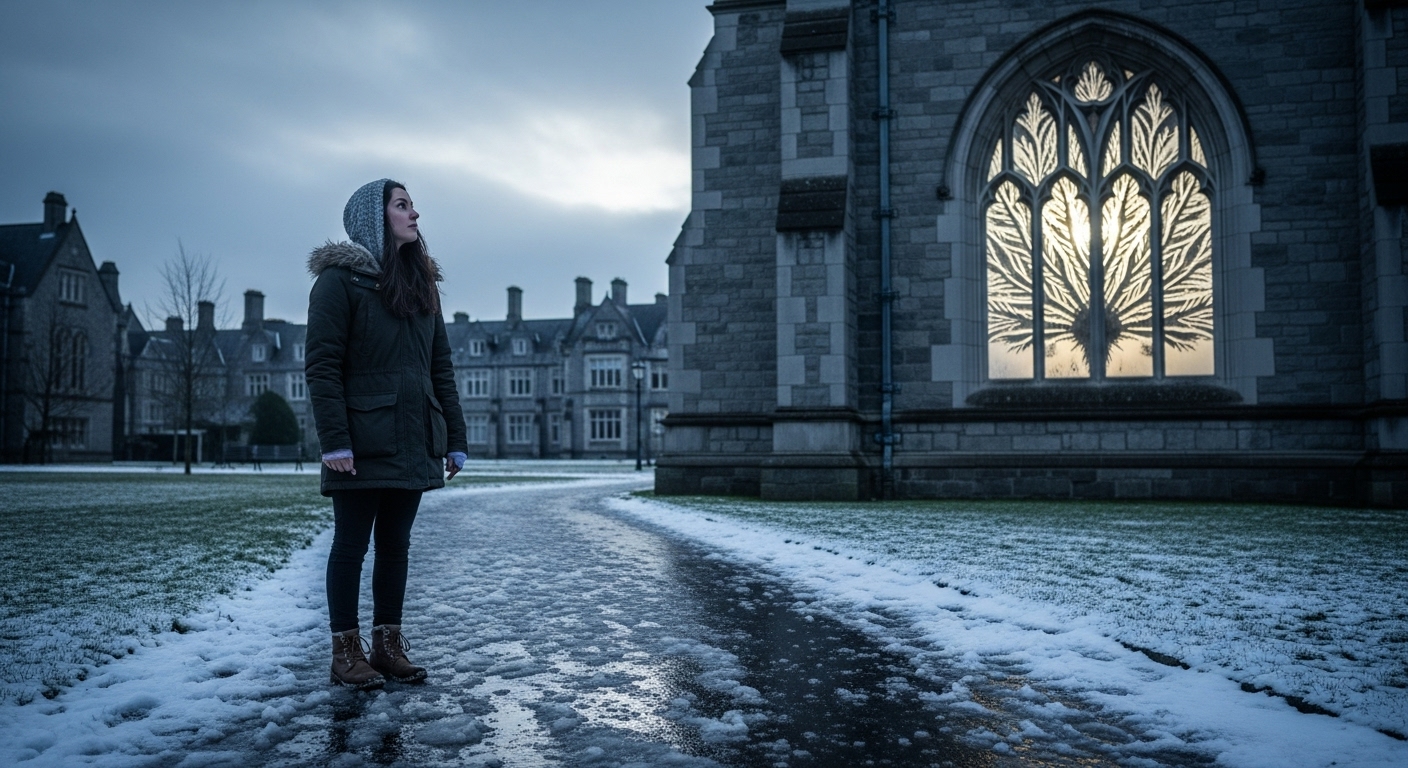
The city had its own deep, ancient patterns, she realised. And sometimes, she couldn't shake the feeling that they seemed to be watching back, their intentions as cold and inscrutable as the deepest winter.
Share This Story


