The Slow Creak of Forgotten Timbers
A biting autumn chill had long settled into the bones of the old municipal building, turning every dust motes dance into a sluggish waltz through shafts of weak, late afternoon sunlight. The air, heavy with the scent of mildewed paper and decaying wood, pressed in on them, making every whispered conversation feel amplified, every floorboard groan a potential betrayal. Spiderwebs, thick as old lace, clung to the corners where the walls met a ceiling stained by decades of forgotten leaks, painting a picture of deliberate neglect, a place the town had chosen to forget.
The light was draining out of the windows, taking the last of the building's faded colour with it. Arnold shifted his weight from one foot to the other, the grit on the warped floorboards grinding under his sneakers. He hated this part. The creeping dread, the way the silence felt like it was holding its breath, waiting for them to make a sound.
“Anything?” Ajax’s voice was a low murmur, barely cutting through the building's ancient hum. He was hunched over a stack of yellowed ledgers, his hoodie pulled tight around his head, the beam of his phone torch cutting a harsh line across the dust-caked shelves. Dust, always dust. It coated everything here, a thick, fine layer that seemed to absorb all light, all sound.
Christine, ever meticulous, meticulously wiped her hands on her jeans before reaching for another stack of records, her movements precise even in the gloom. “Just inventory from ‘53. The library’s still got the good stuff, I’m telling you. This is… refuse.” She flicked a page, a faint cloud of particles rising into the air.
Patricia, meanwhile, was less about methodology and more about brute force. She was systematically tapping the walls, a rhythmic, hollow thud, working her way around what used to be the main office. Arnold watched her, admiring her persistence, even as his stomach did a slow roll. He kept glancing at the door, the flimsy latch, the way the autumn wind whistled through the broken pane in the window. Every gust sounded like a footstep.
“Ajax, come on,” Arnold finally said, his voice a little too loud, a little too strained. “It’s getting dark. If someone sees the light—”
“No one’s seen anything, Benny.” Ajax didn’t even look up. “We’ve been through this. Old man Henderson across the street doesn’t even leave his porch light on anymore. And the neighbourhood watch dissolved three summers ago.”
“Yeah, but,” Arnold started, but Patricia’s sharp intake of breath cut him off. Her tapping had stopped. She was pressing her ear to the wall near a defunct fire extinguisher box, her face suddenly still.
“This isn’t right,” she murmured, more to herself than them. She pushed against a section of plaster, then again, harder. It gave way with a soft, grating sound, revealing a loose brick, barely visible behind a crumbling sheet of paint.
Ajax was there in an instant, his phone light focusing. He worked his fingers into the gap, pulling the brick free. It came away with a shower of plaster dust and the smell of old, trapped air. Behind it, nestled in the small, dark cavity, was not what Arnold expected. No cache of money, no old pistol. Just a slender, leather-bound book, darker with age than the wall itself.
Christine took it, her fingers tracing the worn cover. It had no title. The leather was smooth and cold beneath her touch, surprisingly intact despite the decades of damp and dust. She opened it carefully, pages rustling like dry leaves. Arnold leaned closer, peering over her shoulder. The script inside was neat, precise, almost elegant, but the content was baffling.
“It’s a ledger,” Christine finally announced, her brow furrowing. “But… not like any I’ve seen. Dates, yes. Names, too. But the entries…” She pointed to a line. “’17 Oct 1973 – ‘The shipment arrived.’ Followed by a list of numbers. Then, ‘Expenses for disposal at the Quarry site.’ What in the—?”
Ajax snatched the phone from Arnold, shining its beam onto the page. “Quarry? The old one, out past the creek?”
Patricia peered closer. “’Names on ledger: Fisher, Miller, Davies. Payment received.’ Those are all old families. Fisher, like Mayor Fisher? His grandad?”
Arnold’s skin prickled. This wasn’t some dusty town archive. This was… different. He felt a cold knot tighten in his stomach. “Guys, maybe we should just… give this to someone. The police, or…”
“And say what, Benny?” Ajax scoffed, though his eyes were glued to the page. “’We broke into an abandoned building and found a book that might implicate your grandpa in something shady fifty years ago’? No thanks. We found it. We figure it out.”
Christine tapped a finger on the page. “These dates… they’re all around a similar period. Mid-seventies. And these aren't just payment records. There are notes about 'unforeseen complications' and 're-routing'. This isn’t about some minor town council corruption. This feels… heavier.”
---
The Unblinking Eye of the Quarry
The air outside was sharper, colder. Arnold shoved his hands deep into his pockets, walking a little faster to keep up with Ajax and Patricia, who were practically jogging towards the old quarry road. Christine walked beside him, her face thoughtful, the ledger tucked securely into her rucksack.
“So, ‘disposal at the Quarry site’,” Arnold muttered, more to himself. “That could be anything. Old construction waste. Like, illegal dumping.”
Christine shook her head, her breath misting in the twilight. “Why would they record illegal dumping in a hidden ledger with cryptic notes about ‘complications’ and specific names? And why hide it in the old municipal building? This was a public ledger, or at least, something kept on town property. Someone wanted this buried, properly buried.”
The road narrowed, turning into a gravel track, then just a worn path winding through skeletal trees. The last leaves of autumn clung to branches, rustling like dry whispers. The ground was uneven, a thick carpet of pine needles and damp earth. The silence out here was different from the building’s, less oppressive, but more vast, more empty. Arnold kept scanning the woods around them, the long, distorted shadows of the trees reaching like skeletal fingers.
They reached the quarry just as the last sliver of sun dipped below the horizon, painting the sky in bruised purples and oranges. The sheer cliff face dropped away dramatically, the bottom a dark, still pool, reflecting the dying light like a cracked mirror. It was a stark, lonely place, wind whipping across the exposed rock.
“Okay,” Ajax said, pulling out his phone again, its torch a weak beam against the overwhelming darkness. “So, ‘disposal.’ Where would you ‘dispose’ something?”
Patricia was already scrambling down a loose scree slope, a small shower of pebbles bouncing ahead of her. “Let’s check the bottom. Maybe they dumped it in the water. Or there’s an old cabin, a shed.”
“Careful, Patricia!” Christine called out, but Patricia was already halfway down, her enthusiasm overriding any sense of caution. Arnold followed slowly, each step tentative, the shale crumbling under his boots, sending tiny shards scratching his ankles. A gust of wind smelled faintly of wet dust and cold sweat.
They fanned out, their phone lights cutting shaky paths through the gloom. The air grew colder near the water, a damp chill that seeped into their clothes. Arnold found himself looking at the murky surface of the pool, half-expecting some dark secret to bubble up. His mind was doing its usual scattered thing – the quarry, then the ledger, then the way his dad had squinted at Mayor Fisher on TV last week, then the feeling of the rough stone under his fingers.
“Guys! Over here!” Patricia’s voice was hushed, but excited, echoing faintly against the rock face. She was near a smaller, less sheer section of the quarry wall, where an old rockslide had created a sort of natural alcove. Her light was focused on a dark, rectangular shape half-buried under a pile of loose stones and mud.
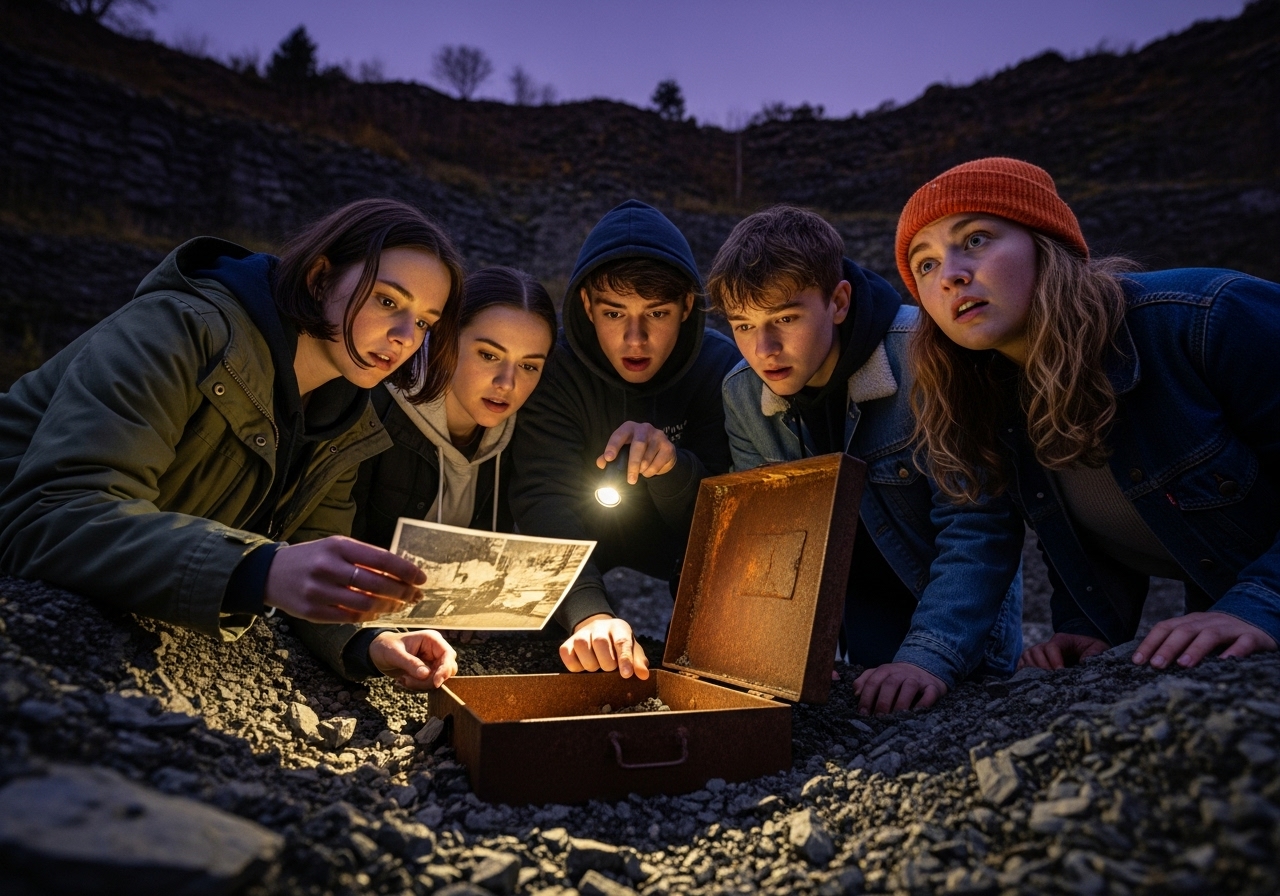
Ajax and Christine clambered over, Arnold trailing behind. It was a metal box, rusted and pitted, perhaps a foot long, half-eaten by the earth. Its surface was the colour of dried blood and old iron. Ajax knelt, trying to pry it open, but it was sealed tight, its hinges seized with corrosion.
“We need to get it open,” Ajax grunted, struggling. “This is it. I can feel it.”
“Or,” Arnold started, “we leave it. This is probably where it gets actually dangerous, don’t you think?” He hugged himself, the cold seeping into his bones, but it wasn't just the temperature. It was the weight of this place, the secret it held.
Christine pulled a small, multi-tool from her rucksack. “Give me that, Ajax. It looks like it might have a latch, if I can just clear the rust.” She worked with surprising strength, the small blade of the tool scraping against the stubborn metal. Patricia hovered, practically bouncing on the balls of her feet.
After a few tense minutes, a sharp CRACK pierced the air. The rusted latch gave way. Christine carefully, slowly, lifted the lid. Inside, nestled on a bed of dry, brittle leaves, were a handful of old, faded photographs, curled at the edges, and a single, tarnished silver pocket watch. Its face was cracked, the hands frozen at a quarter past midnight.
Christine picked up the top photograph, her fingers gingerly avoiding the decaying edges. Ajax and Patricia leaned in close, their phone lights converging. Arnold held his breath. It was a black and white photo, blurred with age, showing a group of men. They were posed stiffly, awkwardly, some in work clothes, some in slightly better attire, standing in a clearing. The trees around them looked sparse, wintery.
“Look closely,” Christine said, her voice barely a whisper. “This one… that’s old man Davies. And this, I swear… that’s Mayor Fisher’s grandfather, Thomas Fisher. The one they named the town square after.”
She was right. The resemblance was uncanny, even in the grainy photo. But it wasn't just the men. What they were standing beside, in the foreground of the picture, pulled Arnold’s gaze like a magnet. A mound of freshly turned earth, crudely piled, unmistakably the shape of a grave. No headstone. Just a raw, anonymous heap. His breath hitched. It was two solitudes, briefly, tentatively, overlapping. He didn’t know if this was supposed to feel… anything. Warm? Comforting? He just… didn’t feel alone, not for a second. His thoughts were a scramble, flashing from the solemn faces in the photo to the names in the ledger, to the word 'disposal'.
“They… they buried someone,” Patricia breathed, her impulsiveness momentarily replaced by sheer, horrified awe. The realization hit them all with the force of a physical blow. This wasn't illegal dumping. This was murder. And the ledger… it was a record of a cover-up. The autumn wind picked up, swirling through the quarry, carrying a new, unsettling sound. A distinct snap of a twig, not the wind, from the path leading back up the slope. Someone else was here. In the dying light, their shadows stretched long and thin, like ghosts reaching out for them.
A cold, undeniable certainty settled in Arnold’s gut: they had dug too deep, and whatever unspeakable thing had been buried here, someone was still watching over it. The snap of the twig confirmed it; they were no longer alone in the dark.
Share This Story


