The Tailgate
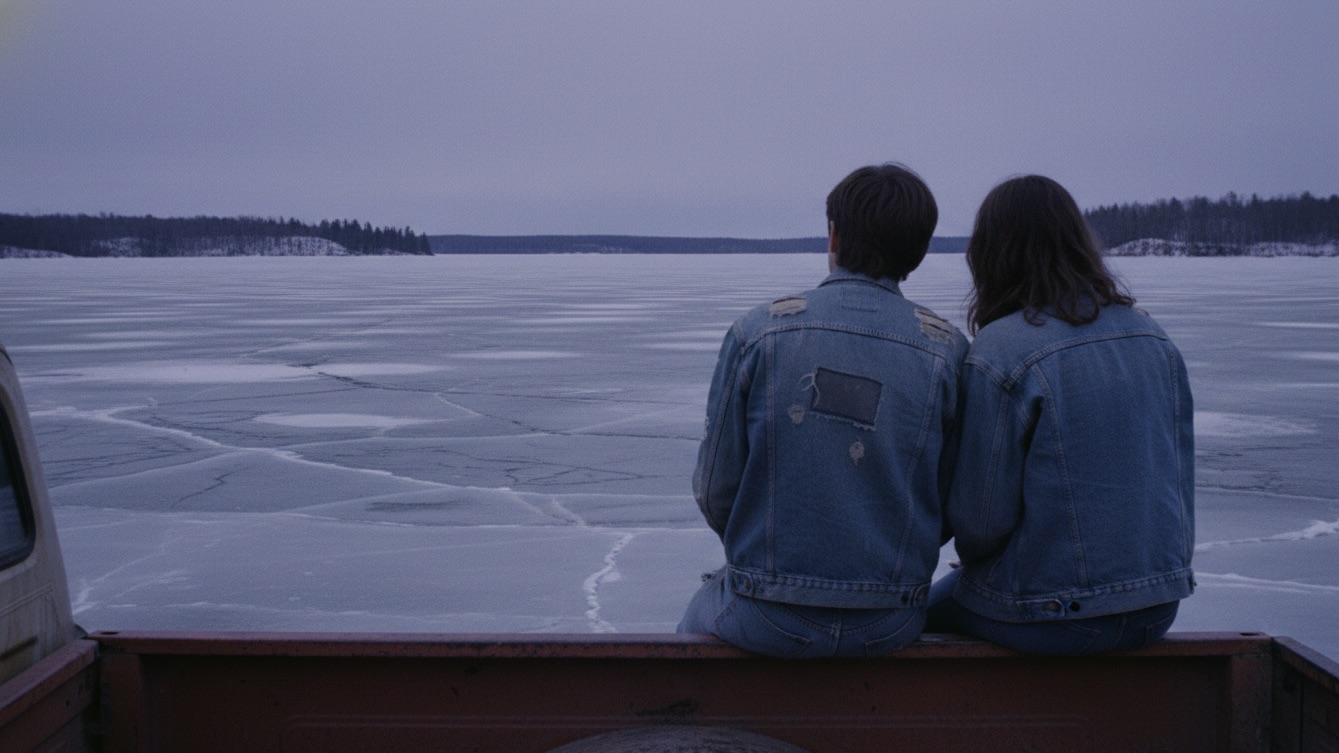
Late afternoon in early May, amidst the slush and grey ice of a Northwestern Ontario spring. Two friends sit on the back of a truck parked at a scenic lookout, debating the merits of leaving home versus the comfort of stagnation.
“You’re going to hate it. I’m telling you, Jules. You’re going to get there, and it’s going to smell like hot garbage and overpriced coffee, and you’re going to miss this.”
“Miss what, Ben? The slush? The seasonal depression? The way the wind literally hurts your face for six months of the year?”
“Yeah. Exactly. The character-building misery of it all.”
Ben took a sip from a lukewarm can of ginger ale, his breath pluming in the damp air. It wasn’t cold enough to freeze, but it was cold enough to make the dampness settle into the marrow of your bones, a heavy, wet chill that defined May in the North. They were parked at the Lookout, a gravel patch carved out of the granite hillside that offered a panoramic view of Black Sturgeon Lake. The ice was in the process of rotting—that specific, treacherous time of year when the solid white sheet turned to a bruised, translucent grey, honeycombed with weakness.
Jules kicked her heel against the rusted bumper of Ben’s Ford. The sound was a dull, metallic thud, swallowed instantly by the vast silence of the treeline. She pulled the sleeves of her oversized denim jacket down over her hands, fiddling with a loose thread on the cuff. She didn't look at him. She looked at the lake, at the way the grey sky seemed to press down on the ice, flattening the world into two dimensions.
“I can’t build any more character,” she said, her voice quiet, almost lost to the wind rattling the bare birch branches. “I’m full. I’m at capacity. If I build any more character, I’m going to collapse.”
The omniscient eye of the landscape watched them—two specks of warmth in a tableau of thawing geological violence. The Canadian Shield didn't care about their art, their anxieties, or the precarious state of the housing market in 2025. The granite had been here for billions of years, grinding down under glaciers and rising up again, indifferent to the fleeting concerns of mammals. But for Jules and Ben, twenty-two and anchored by the gravity of their hometown, this rock was the only world that existed.
Ben shifted, the suspension of the truck groaning in protest. He was a lanky guy, all elbows and knees, with hair that he cut himself in the bathroom mirror because he refused to pay twenty-five dollars for a barber. He wore a hoodie that had once been black but was now a dusty charcoal, emblazoned with the logo of a band that broke up three years ago. He worked at the tire shop in town, swapping winter treads for all-seasons, his hands permanently etched with the fine, dark lines of grease that no amount of orange pumice soap could scrub away.
“Toronto isn’t the answer, though,” Ben said, staring at the label of his soda. “It’s just... more noise. You think you’re going to go down there and suddenly the world’s going to care about your photography? It’s oversaturated, Jules. Everyone’s an artist. Everyone’s got a platform. You’re just going to be another kid with a camera and a dream, paying three grand a month for a closet.”
“Thanks. Really inspiring pep talk.”
“I’m just being real. We live in the age of the algorithm, man. You can upload your stuff from here. You don't need to be physically present to be digitally exploited.”
Jules laughed, a sharp, brittle sound. She turned to look at him finally. Her eyes were rimmed with red, not from crying, but from the lack of sleep that had plagued her since the acceptance letter arrived in her inbox three days ago. “It’s not about the algorithm, Ben. It’s about... touching things. Seeing things that aren't pine trees and rock cuts. I need to see a building taller than three stories. I need to meet someone who doesn't know who my dad is.”
She reached into her bag, a battered canvas messenger satchel, and pulled out her camera. It was an old 35mm brick of a thing, heavy and impractical, a relic she’d bought at a pawn shop in Thunder Bay. She didn't take a picture; she just held it, her fingers tracing the cold metal of the lens barrel. It was a grounding mechanism. The weight of it reminded her that she was a person who made things, not just a person who waited for things to happen.
“You know your dad’s actually really proud of you, right?” Ben asked, his voice softening. He tossed the empty soda can into the truck bed, where it clattered against a rusted toolbox.
“He thinks I’m going to art school. I haven’t told him I’m just... going. To try.”
“Semantics.”
“It’s not semantics. It’s a plan vs. a delusion.” Jules sighed, leaning back until her head hit the rear window of the cab. “God, look at that sky. It looks like a bruise.”
The sky was indeed a bruise—mottled purples and yellows fading into a sickly, overcast grey. The light was flat, devoid of shadows, illuminating the world with a clinical, unflattering clarity. It showed the trash revealing itself from the melting snow banks—tim hortons cups, plastic wrappers, crushed cigarette packs. It showed the grime on the road signs. It showed the cracks in everything.
Ben picked at a scab of rust on the tailgate. “So, you leave in... what? A month?”
“Two weeks. If I can sell the car.”
“You’re selling the Subaru?” Ben looked genuinely shocked. “Jules, that thing is your legs. You can’t survive without a car.”
“In the city, I can. Public transit. Subways.”
“Subways are for rats and people who have given up on seeing the sun,” Ben muttered. He was terrified for her. He could feel it in his stomach, a cold, hard knot that had tightened the moment she told him. It wasn't just that he would miss her—though the thought of the long, empty summer without her sitting in his passenger seat made him feel physically ill—it was that he was scared she was right. He was scared that by staying, by choosing the tire shop and the basement apartment and the safe, known radius of Black Sturgeon, he was admitting defeat. He was scared that he was rotting, just like the ice on the lake.
He watched a raven glide silently over the treeline, its black wings stark against the grey clouds. In Anishinaabe stories, the raven was a trickster, a messenger. Ben wondered what message it was carrying today. Probably something sarcastic about gas prices.
“What about your music?” Jules asked, turning the tables. She knew exactly where to press to hurt him, just like he knew where to press her.
Ben winced. “What about it?”
“You haven’t touched your guitar in weeks. I saw it in your backseat. It’s buried under laundry.”
“I’m busy. It’s busy season at the shop. Everyone wants their winters off.”
“Bullshit,” Jules said, not unkindly. “You’re hiding. You wrote that incredible set of songs in January, and then you just... stopped. Why?”
Ben looked out at the lake. The wind picked up, carrying the scent of wet asphalt and rotting vegetation—the perfume of the thaw. “Because what’s the point? I put it on Spotify, and I get, what? Twelve streams? Six of them are you, three are my cousin in Winnipeg, and the rest are bots. The world doesn't need another sad indie-folk guy with a reverb pedal. The market is saturated with feelings.”
“So you just stop feeling?”
“I stop commodifying the feeling,” Ben corrected. “I just... live. I work. I pay my rent. I hang out with you. Isn't that enough? Why does everything have to be a ‘career’? Why can't we just exist?”
“Because existing here feels like dying slowly,” Jules whispered. The confession hung in the air between them, heavy and undeniable.
The town of Black Sturgeon lay behind them, tucked into the valley. A collection of three thousand souls, a paper mill that had closed in 2018, and a tourism industry that only woke up for two months in July and August. It was a place of immense physical beauty and crushing economic stillness. For young people in 2025, it was a trap. The remote work revolution had promised them freedom—live anywhere, work anywhere!—but the reality was spotty Starlink connections and a social isolation that rotted the brain. The internet offered a window into a world where everyone else seemed to be at a gallery opening or a rooftop party, while they were here, watching the snow melt.
Jules brought the camera to her eye and focused on Ben’s profile. He didn't move. He was used to being her subject. She framed him against the jagged treeline, the hood of his sweatshirt up, his jaw set in that stubborn, defensive line she knew so well. Click. The shutter mechanism was loud, a mechanical heartbeat.
“You think I’m abandoning you,” she stated, lowering the camera.
“I think you’re escaping,” he said. “And I’m jealous. And I’m angry that I’m jealous.”
“You could come.”
Ben snorted. “With what money? And do what? Wash dishes? I have a trade here. I have... stability.”
“You have a rut.”
“A rut is just a grave with the ends kicked out.”
“That’s a quote. You didn't make that up.”
“Doesn’t make it less true.” Ben turned to her, his dark eyes intense. “Look, Jules. I get it. You have the eye. You see things differently. You need to go feed that. But don't pretend like leaving is some noble quest. It’s just... moving. You’re just changing your geography. You’re still going to be you. You’re still going to wake up at 3 AM wondering if you’re good enough. That doesn't go away just because you’re within walking distance of a Starbucks.”
Jules looked down at her boots—blundstones, scuffed and stained with road salt. She wiggled her toes, feeling the cold seep through the leather. “I know that. I’m not naive. But I need to know if the ‘me’ that exists there is different from the ‘me’ that exists here. Here, I’m just... ‘The Girl Who Takes Pictures’. I’m Mr. Henderson’s daughter. I’m Ben’s friend. I want to be... nameless. I want to be anonymous so I can figure out who I actually am.”
A truck rumbled past on the highway behind them, a massive logging rig hauling timber to the mill in Dryden. The ground shook with its passing, a low frequency vibration that rattled Jules’ teeth. They waited for the roar to fade, a comfortable silence settling back over them.
“It’s the silence I’ll miss,” Jules admitted, almost reluctantly. “Even though I hate it. In the city, it’s never quiet. Here... sometimes it’s so quiet you can hear the blood in your ears.”
“That’s high blood pressure,” Ben deadpanned.
Jules punched him in the arm, hard. “Shut up.”
“Ow. Abuse. Workplace harassment.”
They fell silent again. The sun was dipping lower, casting long, warped shadows across the ice. The temperature was dropping. Soon, the slush would re-freeze into a jagged, treacherous crust.
Ben reached into his pocket and pulled out a pack of gum. He offered a piece to Jules. It was cinnamon, spicy and artificial.
“I wrote a song about you,” he said suddenly. He didn't look at her. He looked at a specific pine tree across the gorge.
Jules froze, the wrapper half-torn in her hand. “You did?”
“Yeah. Last week. It’s... it’s not finished. But it’s about this. About the leaving.”
“Can I hear it?”
“No. It’s depressing. And the bridge chords are messy.”
“Ben.”
“It’s called ‘The Northern Vector’. Which is a stupid title, I know. But it’s about how... you know in physics class? A vector has magnitude and direction? I feel like you have both, and I just have... mass. I’m just heavy object sitting on an incline.”
Jules felt a sudden, sharp sting in her eyes. “You’re not just mass, Ben. You’re... you’re the gravity. You’re what keeps me from floating off into space and suffocating.”
“Gravity holds you down, Jules. That’s its job.”
“It also keeps you grounded.”
She shifted on the tailgate, closing the distance between them. Their shoulders touched—the friction of denim on cotton. It was a small contact, but in the vast emptiness of the landscape, it felt electric. They had hovered around this thing between them for years—a frantic, undefined intimacy that wasn't quite romance but was certainly more than friendship. It was a survival pact.
“If I go,” Jules said, her voice trembling slightly, “and I hate it... can I come back? Or will you be too ‘I told you so’ to let me hang out on your tailgate?”
Ben finally looked at her. His face was open, vulnerable in a way he rarely allowed. The sarcasm was gone, stripped away by the cold wind. “Jules. You can always come back. But I hope you don't. Because if you come back, it means this place won. And I hate it when this place wins.”
He took a breath, struggling with the words. He was a songwriter, used to hiding behind metaphors and melody, but now he had nothing but plain speech. “I need you to go and succeed. I need you to prove that escape velocity is possible. If you make it, then... then maybe I’m not just stuck. Maybe I’m just... charging. Waiting.”
“Charging,” Jules repeated, smiling faintly. “Like a battery.”
“Yeah. Like a really old, corroded battery found in a drawer.”
The wind gusted, stronger this time, biting through their layers. Jules shivered violently. The sun was gone now, dipped below the horizon, leaving behind a sky that was quickly turning from bruise-purple to the color of wet slate.
“We should go,” Ben said. “My heater takes ten minutes to actually work.”
“Wait,” Jules said. She didn't want the moment to end. Once they got in the truck, the spell would break. They would drive back to town, listen to the radio, and become people who lived in houses again. Right now, on the tailgate, they were suspended in the in-between.
“What?”
“Why did you really stop playing?” Jules asked. “Don't give me the ‘market saturation’ crap. You love it. You play when you think no one is listening. I hear you through the floorboards when I’m at your place.”
Ben looked down at his hands. He rubbed his thumb over a callus on his index finger. “Because I’m scared,” he whispered. “I’m scared that if I actually try, really try, and I fail... then I have nothing left. As long as I don't try, I can tell myself I’m a ‘hidden gem’ or ‘undiscovered’. But if I try and the world says ‘no thanks’... then I’m just a guy who changes tires.”
“You’re not just a guy who changes tires,” Jules said fiercely. She grabbed his hand, her fingers cold and strong wrapping around his. “You’re Benjamin Fisher. You write lyrics that make me feel like my chest is being ripped open. That matters. Even if only twelve people hear it. It matters to me.”
Ben squeezed her hand back. “You’re one of the twelve.”
“I’m the only one that counts,” she joked, though her heart was hammering.
They sat there for a long moment, hand in hand, watching the twilight consume the lake. The ice groaned loudly, a deep, resonant boom that echoed off the cliff walls—the sound of the lake breathing, shifting, preparing to shed its skin. It was a terrifying, beautiful sound.
“I have to tell you something,” Ben said, his voice tight. He pulled his hand away, breaking the connection. He reached into the front pocket of his hoodie and pulled out a crumpled piece of paper. It looked like it had been balled up, smoothed out, and balled up again a dozen times.
“What’s that?” Jules asked, a sudden dread pooling in her stomach.
“You know how you said I should apply to that audio engineering program in Vancouver? The one you sent me the link to in February?”
Jules nodded slowly. “Yeah. You said it was too expensive. You said you didn't have the grades.”
“I lied,” Ben said. He smoothed the paper out on his knee. In the dying light, Jules could just make out the letterhead. It was thick, official-looking paper.
“I applied,” Ben said, his voice flat. “And I got in. Full scholarship. They liked my demo tape.”
Jules gasped, a smile breaking across her face. “Ben! That’s... oh my god! That’s amazing! Why didn't you tell me? We could go together! We could—”
She stopped. She saw the look on his face. It wasn't triumph. It was resignation.
“Ben?”
“I turned it down,” he said.
The silence that followed was heavier than the granite beneath them. It was absolute. A void.
“You... what?”
“I emailed them this morning. I declined the offer.”
“Why?” Jules all but screamed, standing up on the gravel, her hands balling into fists. “Are you insane? Ben, that’s... that’s the way out! That’s the ticket! Why would you do that?”
Ben didn't stand up. He stayed sitting on the tailgate, looking small and defeated in the gathering dark. “Because of my mom, Jules.”
“Your mom is fine! She’s working at the clinic!”
“She’s not fine,” Ben said quietly. “She was diagnosed last week. Early onset. Same thing her dad had. She doesn't remember where she put her keys half the time. In a year... she might not remember me.”
Jules felt the air leave her lungs. The anger evaporated, replaced by a crushing wave of sorrow. The unfairness of it—the sheer, brutal randomness of life—hit her like a physical blow.
“I can’t leave her,” Ben said, his voice cracking. “I can’t go to Vancouver and learn how to mix snare drums while she forgets how to use the stove. I have to stay. I’m the only one she has.”
Jules stared at him, her heart breaking for the boy who had just casually sacrificed his future without asking for a medal. She realized then that his bravery wasn't the loud, artistic kind—it wasn't leaving to conquer the city. It was the quiet, agonizing bravery of staying. It was the bravery of endurance.
“Oh, Ben,” she breathed, stepping back toward him.
“So you go,” Ben said, looking up at her, his eyes shining with unshed tears. “You go and you take enough pictures for both of us. Okay? You have to go. Because if you stay... if we both stay... this place will just swallow us whole.”
Jules opened her mouth to speak, to tell him she would stay, that she would help him, but he held up a hand to stop her.
“Don't,” he warned. “Don't offer. Because I might say yes. And I need you to go.”
Suddenly, Jules’ phone buzzed in her pocket. A harsh, vibrating intrusion. She ignored it. It buzzed again. And again. A call.
She pulled it out, annoyed, wiping the screen with her thumb. It was her mother.
“I have to take this,” she whispered apologetically. “She’s been spiraling about the packing.”
Ben nodded, turning back to the lake.
Jules swiped answer. “Mom? I’m at the lookout with Ben, I’ll be home in—”
“Julianna,” her mother’s voice was sharp, breathless. Panic, raw and unfiltered, crackled through the speaker. “Where are you? Are you with Ben?”
“Yes, I just said—”
“Listen to me. Don't come home. Not yet.”
“What? Why?” Jules felt the cold creeping up her spine again, sharper this time.
“There’s... there’s a fire, Jules. It’s the garage. It’s... oh god, honey, it’s the studio. Your dad was welding and... everything is gone. The portfolio. The negatives. It’s all gone.”
“There’s... there’s a fire, Jules. It’s the garage. It’s... oh god, honey, it’s the studio. Your dad was welding and... everything is gone. The portfolio. The negatives. It’s all gone.”
Share This Story


