The Condensation on Cold Things
Snowflakes, thick as ash from a foundry, drift down between the iron-girdered towers of the city, settling on the skeletal branches of trees in a forgotten park. The air, tasting of coal smoke and ozone, carries the rhythmic clang of distant machinery and the soft, percussive hiss of pneumatic tubes running beneath the frost-hardened ground.
"Does it ever bother you?"
The voice was quiet, nearly lost beneath the sigh of a pressure release from a nearby sanitation automaton. Finnian didn't look up at first. He was watching the automaton work, its spindly brass legs picking their way across the icy flagstones with an unnerving delicacy. It swept fallen snow into neat piles with a rotary brush, its single glass optic glowing a dull, dutiful amber. It bothered him, yes. Everything bothered him.
He finally turned his head. A young woman had sat on the other end of the cast-iron bench. Not too close, but not far enough to be a complete accident. She was bundled in a heavy wool coat, the collar turned up so high it almost met the brim of her worn felt hat. A pair of silver-rimmed spectacles were perched on her nose, slightly fogged by the cold. She was watching him watch the machine.
"The noise? Or the fact it has better posture than my landlord?" Finnian asked. His own breath plumed white in the frigid air.
A small smile touched her lips, gone as quickly as it came. "The neatness of it all. The straight lines. It never misses a spot." She gestured with a gloved hand. "As if the world is just a surface to be polished."
Finnian grunted, a sound of noncommittal agreement. He’d spent ten hours today calibrating pressure gauges on a municipal boiler, his fingers numb and stained with grease. He knew all about the city’s obsession with polished surfaces and the grimy, screaming mechanics hidden just beneath.
"Someone has to sweep the snow," he said, the statement flat and final. An attempt to end the conversation.
But she didn't take the hint. She settled back, her gaze drifting upwards, past the skeletal trees, to where the sky was a bruised grey ceiling, occasionally sliced by the dark silhouette of a passing airship. The city's perpetual steam-haze smudged out the sun.
"I knew a man once," she began, her voice taking on a different timbre, softer, more distant. "He was a chronographer. Not one of the important ones who calibrate the mainsprings at the Grand Terminus, just a small-time repairman. Had a little shop near the Lower Sprawl, full of ticking things."
Finnian remained silent. He didn't want to hear a story. He wanted to sit until his joints seized from the cold and then walk back to his room and not think. But the silence stretched, and her quiet presence was insistent.
"Go on," he found himself saying, the words feeling foreign and rusty in his own mouth.
---
"His name was Gideon," Isolde said, her eyes fixed on some middle distance between the park and the sky. "He was obsessed with precision. He believed human memory was… faulty. A flaw in the design. He called it 'emotional sludge'. Said it corroded the gears of rational thought. You'd remember an argument, but your pride would change the words. You'd remember a kindness, but sentimentality would inflate its importance. It was all just noise to him."
She paused, pulling her gloves tighter. Finnian watched the way the worn leather creased over her knuckles. He could feel the cold of the iron bench seeping through his coat, a deep, invasive chill.
"So he decided to fix it. He started small. He built this little device, a kind of audio-engraver linked to a series of galvanic probes he’d press to his temples. He’d take a memory—say, the first time he successfully repaired a Babbage Engine escapement—and he'd narrate it. Every detail. The feel of the brass under his fingertips, the smell of the lubricating oil, the exact number of teeth on the third cog. He recorded it all onto a thin brass spool, no bigger than my thumb."
"And then?" Finnian asked, leaning forward slightly. The sanitation automaton had finished its section of the path and was now standing perfectly still, its amber light blinking in the gloom.
"And then he'd undergo a process. Something with electrical currents and aetheric dampeners. I don’t understand the mechanics of it. But it would… erase the original memory. Just wipe it clean. A blank space. In its place, he had the spool. The pure, factual, uncorrupted data. He kept them in a beautiful mahogany box lined with velvet. Each one had a tiny, immaculate label."
Finnian pictured it. A man sitting in a room full of clocks, willingly scouring his own mind. The thought was colder than the bench he was sitting on. "That's… unnatural."
"Is it?" Isolde turned to look at him properly for the first time. Her eyes behind the fogged lenses were a sharp, intelligent grey. "We replace our weak limbs with piston-driven prosthetics. We use optical enhancers to see farther than our eyes were designed to. We use calculation engines to solve problems our brains can't handle. Where do you draw the line? He saw a faulty component and he upgraded it."
Her logic was the city’s logic. The cold, brutal, forward-marching logic that powered the great engines and filled the sky with smoke. It was the logic he fought against in his own head every single day.
"What did he record?" Finnian asked.
"Everything," she said. "His apprenticeship. His first sale. The day he met his wife. He told me he recorded that one three times before he was satisfied he’d filtered out all the 'biological noise'—nervousness, irrational attraction, all of that. He just wanted the facts. Her name, the date, the barometric pressure, what she was wearing."
"His wife?" The word hung in the air between them, absurd.
"Oh yes. She was a lovely woman. A weaver. Her hands were always stained with dye. She tried to understand, at first. She’d watch him sit at his desk in the evenings, strapped into his machine, narrating their life into a metal cylinder. One day, she asked him to tell her about the day they met. He didn't tell her a story. He took out a spool, slotted it into a player, and a mechanical voice, his voice, recited the data points."
Isolde fell silent. A gust of wind stirred the snow on the ground, creating small, ghostly whirlwinds. Up above, the gas-lamps of a passing cargo hauler blinked rhythmically.
"She left him, of course," Isolde continued, her voice barely a murmur. "She packed a bag and she was gone. Gideon was… confused. He consulted his spools. The data indicated a high probability of a stable domestic partnership. He couldn't find an error in his calculations. So he made a new recording: 'The day my wife left.' He catalogued her exact words, the sound the door made when it closed, the sudden drop in ambient temperature in the room. He filed it away in the mahogany box. And he went back to work."
The Ticking in the Walls
Finnian thought about his own memories. The grease under his fingernails that never quite came out. The taste of stale bread and weak tea in his cramped apartment. The sound of his father's cough, a memory that was all sludge and ache, nothing precise about it at all. He wouldn’t trade it. He wouldn't trade the pain of it, the messy, imprecise reality of it.
"Where is he now?" Finnian asked.
"His shop is still there," Isolde said, tracing a pattern on the frosty bench with her fingertip. "But he's not. I went by last week. The place was… quiet. It was the first time I’d ever been in there and not heard ticking. All the clocks had stopped. The mahogany box was open on his workbench. It was empty."
"He took them?"
"I think he did one last recording. The final one. The memory of everything. Of the box, the spools, the entire project. And then I think he wiped it. He upgraded himself into a perfect blank. A man with no history, no sludge, no attachments. Just an empty vessel, perfectly precise. Perfectly clean."
She shivered, though it may not have been from the cold. "The last I heard, he took a job on one of the long-haul airships. A ballast technician. Simple, repetitive work. No decisions to make. No memories required."
The story settled around them, as heavy and as silent as the snow. Finnian looked at the automaton again. It was still standing sentinel, its single eye unblinking. It wasn't waiting for orders. It was just… off. A machine with no task. An empty vessel. He wondered if it felt the cold.
"That's a cheerful story for a winter afternoon," he said, the cynical remark a flimsy shield against the profound unease the tale had stirred in him.
"It's the only kind I have," Isolde replied, her voice soft. "The city is full of them. Stories of people who file themselves down, gear by gear, until there's nothing left but function."
They sat in silence for a long time after that. The light began to fail, the grey sky deepening to slate. One by one, the park's steam-lamps hissed to life, casting a sickly yellow glow on the snow-covered ground. The light caught the brass plating of the dormant automaton, making it gleam like a funeral monument. The rhythmic clang of the city seemed to get louder in the encroaching dark, a monstrous, metallic heartbeat. Finnian looked over at the young woman beside him, a stranger who had handed him this bleak, polished stone of a story. He didn't know her name, or where she worked, or why she had chosen this bench, this afternoon. But he understood her. In the shared chill, in the oppressive neatness of their world, he understood completely. He didn’t feel warmer. He didn’t feel hopeful. He just felt, for the first time all day, a little less singular in his own quiet despair.
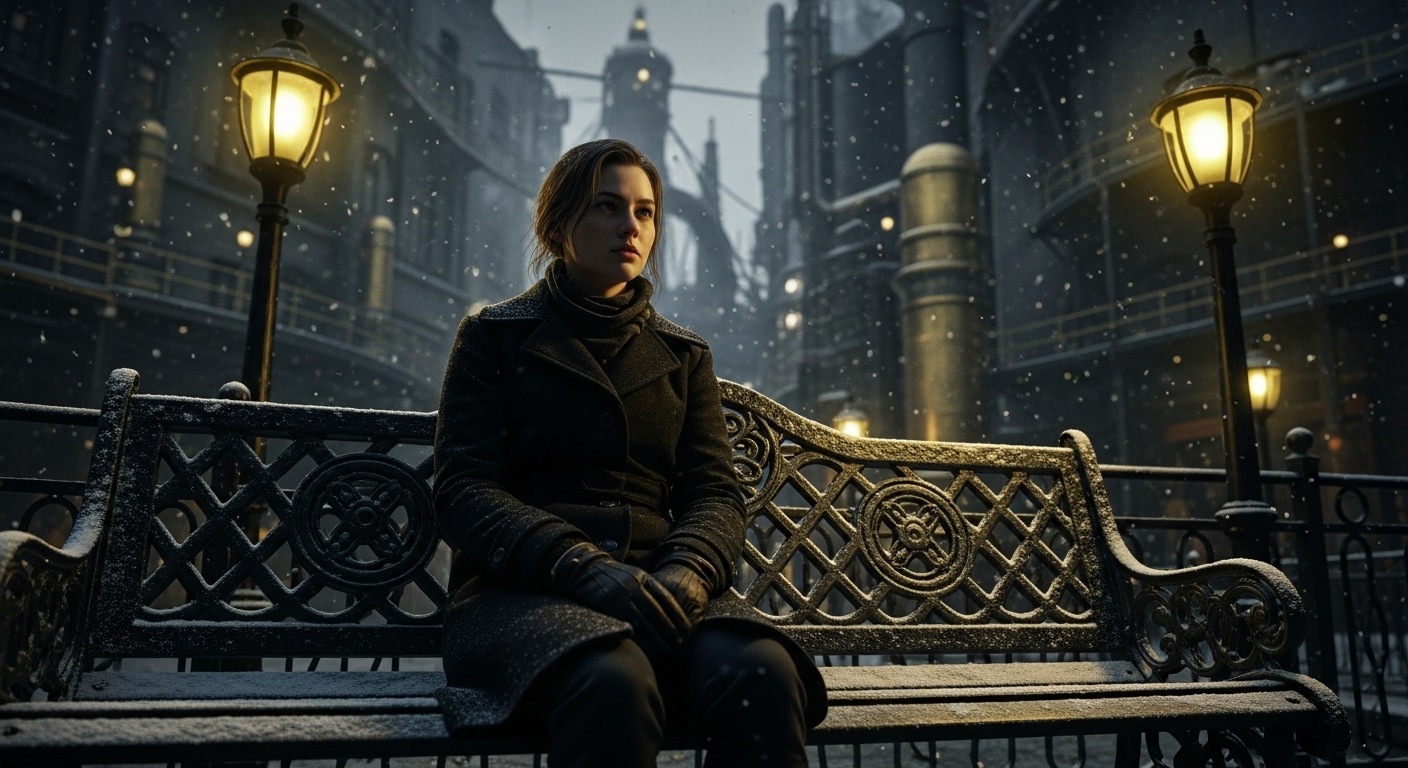
He didn’t feel warmer. He didn’t feel hopeful. He just felt, for the first time all day, a little less singular in his own quiet despair.
Share This Story


