The Wind Tunnel
James follows Simon through the frozen streets of downtown Winnipeg, battling the -40 windchill and his own bitter internal monologue.
The cold didn't just bite; it chewed. It gnawed at the exposed strip of skin between James's scarf and his toque, a dull, throbbing pressure that felt less like temperature and more like blunt force trauma. He squinted against the wind, his eyelashes heavy with ice crystals that dragged his eyelids down. Ahead, the heavy canvas coat of the man he was chasing bobbed and weaved through the grey-white blur of the street.
Simon didn't run. He stalked. He moved with that infuriating, ground-eating stride that belonged to people who worked with their hands, people who knew how to plant a boot on slick concrete and trust the friction. James, by contrast, was skittering. His dress shoes—leather soles, no grip, stupid choice—slapped against the hard-packed snow. He felt like a cartoon character spinning his wheels, burning energy just to stay upright.
He shouldn't be here. He should be in his apartment, under the weighted blanket, staring at the ceiling and ignoring the pile of unanswered emails on his laptop. He should be wallowing. That was the plan. Wallow, reheat coffee, sleep, repeat. Instead, he was out here, lungs burning with air that tasted like exhaust and metal, chasing an ex-boyfriend who had shown up at his door ten minutes ago with a crowbar and a grin.
The wind howled down Portage Avenue, funneling between the concrete towers like water through a burst pipe. It hit James in the chest, staggering him. He grabbed a lamppost to steady himself. The metal bit through his glove.
"Keep up."
Simon didn't turn around. The voice was low, carried away instantly by the gale, but James heard it. He heard the amusement in it. That gravelly baritone that used to vibrate against James's spine on Sunday mornings.
"Slippery," James gasped out. The word tore at his throat.
Simon stopped. Finally. He turned, the bulky collar of his Carhartt jacket framing a face that was red from the wind but otherwise annoyingly composed. He looked at James's feet.
"Dress shoes," Simon said. Flat. Judgmental.
"I didn't have time."
"You had three years."
James flipped him off. The gesture was clumsy in his mittens. Simon just smirked, the expression cracking the ice in his beard, and turned back to the street. He pointed a gloved finger at the sidewalk.
"Look."
James looked. At first, he saw nothing but the gritty, salt-stained snow, the kind of grey sludge that defined Winnipeg in February. But then he saw it. A smudge of blue. A few feet later, another one. They were footprints. Not real ones, but painted ones. Bright, electric azure spray paint, stenciled directly onto the ice.
"What is it?" James asked, stepping closer.
"Summer," Simon said. He started walking again, following the blue track.
"That's stupid."
"You're following."
James ground his teeth. He was. He pushed off the lamppost and skated after him. The absurdity of it clawed at him. He was twenty-eight. He was an architect—well, an unemployed one as of Tuesday. He was supposed to be serious. He wasn't supposed to be playing follow-the-leader in a blizzard because his ex claimed he knew where the heat was.
The city felt abandoned. Cars huddled in snowbanks like hibernating beasts, their windshields opaque with frost. The exhaust from the few passing buses hung in the air, thick and motionless, refusing to dissipate. It was a suspended reality. The cold paused time. It made everything brittle.
They turned a corner into the Exchange District, the wind cutting out abruptly as the brick warehouses shielded them. The silence that followed was heavy. The only sound was the crunch of salt under boots and the distant, rhythmic thumping of a pile driver somewhere construction was braving the freeze.
Simon stopped at a heavy steel door covered in stickers. He didn't open it. He just leaned against the brick, waiting.
James caught up, his breath pluming out in massive white clouds. He bent over, hands on his knees, trying to force oxygen into his tight chest.
"Why?" James wheezed.
"You looked pathetic," Simon said. Not mean. Just a fact. Like stating the tire pressure was low.
"I was fine."
"You were wearing the same sweatpants as last week. I could see you through the window."
"Creepy."
"Observant."
Simon reached out. For a second, James flinched, expecting... what? A hit? A hug? Simon just brushed snow off James's shoulder. The touch was heavy, firm. It lingered a fraction of a second too long.
"The blue prints," Simon said, nodding at the ground. "Kid down at the youth center told me about them. Said they lead to the only warm spot in the city."
"A radiator?"
"Something better. Come on."
They moved deeper into the Exchange. The buildings here were old, turn-of-the-century stone and brick, looming over the narrow alleys like canyon walls. The blue footprints wove a chaotic path. They went up stairs, across loading docks, around dumpsters. It wasn't a straight line. It was a game. Someone had played here. Someone had danced with a spray can in the middle of the night.
James found himself watching the ground, anticipating the next flash of blue. It was... distracting. The rhythmic search stopped him from thinking about the severance package email. It stopped him from replaying the meeting where they said his designs were 'too sterile.'
Here, nothing was sterile. The alley smelled of frying onions from a vent and wet cardboard. The brick was rough and pitted. The snow was a textured landscape of drift and melt.
"Watch it," Simon warned.
He grabbed James's elbow, hauling him back. A massive sheet of snow slid off the roof three stories up, crashing onto the pavement exactly where James had been about to step. The impact was a dull thud that vibrated through the soles of James's shoes.
James stared at the pile of white debris. "Okay. Thanks."
"Don't mention it."
Simon didn't let go of his elbow immediately. He held on, guiding him around the snow pile. His grip was warm through the layers of wool and down. It felt steady. James remembered that steadiness. He remembered why he ran from it. It was too much gravity. James liked to float, to keep options open. Simon was an anchor.
"You still working at the garage?" James asked, the silence becoming too loud.
"Yep. Lead mechanic now."
"Good for you."
"It is."
Conversation died. It always did with them. They communicated in friction, in sparks, not in sentences. James looked at the back of Simon's neck, the way his hairline was trimmed perfectly straight. The man was meticulous. He probably ironed his socks.
The blue footprints took a sharp left, leading toward a chain-link fence. A hole had been cut in the wire, the edges curled back like peeled metal skin.
"We're trespassing," James noted.
"Probably."
Simon ducked through the hole. He moved with a surprising grace for a big man, shifting his shoulders to clear the jagged wire without snagging his coat. He stood on the other side and waited.
James looked at the fence. He looked at his coat—Italian wool, dry clean only. He looked at Simon.
He sighed, crouched, and shimmied through. A piece of wire caught his scarf, pulling him back. He tugged, ripping a thread loose. Great. Another thing ruined.
They were in a courtyard behind an old theatre. It was a space that shouldn't exist—a pocket of air trapped between four high walls. And it was... different. The wind didn't reach down here. The air was still. And there was a smell. Not garbage, not exhaust.
Sugar. Burnt sugar and yeast.
In the center of the courtyard, sitting on a majestic throne of wooden pallets and snow, was a massive, industrial space heater. It was roaring, a jet engine of heat glowing orange behind a safety grate. And around it, sitting on mismatched lawn chairs, were three people.
A teenager in a neon ski suit. An old woman with a walker that had skis duct-taped to the legs. And a guy tuning a guitar.
"What is this?" James whispered.
"The warm spot," Simon said.
The guy with the guitar looked up. He wore a balaclava rolled up like a toque. "Entry fee is a joke or a cigarette."
Simon patted his pockets. "I quit. James?"
James blinked. "I don't smoke."
"Joke then."
James's mind went blank. He stood there, freezing despite the radiating heat from the blower, feeling like he was on stage. The old woman watched him with hawk eyes.
"What's..." James started, his voice cracking. He cleared his throat. "What is a ghost's favorite fruit?"
The teenager groaned. "Boo-berries. Everyone knows that one. Try again."
James flushed. The cold was making his brain sluggish. He looked at Simon for help. Simon just crossed his arms, leaning back, enjoying the show. Sadist.
"Okay," James said. "Why did the scarecrow win an award?"
"Because he was out standing in his field!" the old woman shouted, cackling. "That's a classic. Sit down, skinny boy. You look like you're about to snap in half."
She kicked a plastic crate toward him. James sat. He had to. His legs were shaking. He sat close to the heater, the blast of hot air hitting his face like a physical blow. It was aggressive, dry heat, but god, it felt like salvation. He could feel the blood rushing back into his nose and ears, a prickly, painful thaw.
Simon sat on a bucket next to him. He pulled a thermos from inside his jacket. He unscrewed the cup, poured a steaming dark liquid, and handed it to the old woman first. Then he poured a second cup for James.
"Whiskey?" James asked, smelling the fumes.
"Tea. With a kick."
James took a sip. It scalded his tongue, sweet and sharp with bourbon. It went down like liquid fire, settling in his stomach and radiating outward. He closed his eyes.
"Better?" Simon asked. Quietly.
"Yeah."
"You were spiraling."
"I lost my job, Simon."
He hadn't meant to say it. The words just fell out of his mouth, loosened by the heat and the whiskey. He stared into the cup, waiting for the lecture. Waiting for Simon to tell him he should have taken that project manager gig, or that he was too picky.
Simon didn't say anything. He just bumped his shoulder against James's. A solid, heavy impact. Acknowledgement.
"Their loss," Simon said eventually.
"They said I lack vision."
"Bullshit. You saw the potential in that wreck of a loft on Princess Street. You saw the potential in me."
James laughed, a short, sharp bark. "You weren't a wreck."
"I was living in a van and eating raw noodles. I was a wreck."
"You were... bohemian."
"I was homeless, Jules. You gave me keys."
The nickname hit James in the chest. Jules. Nobody else called him that. It sounded soft in the harsh industrial courtyard.
The guitar guy started playing. It wasn't a song, just chords. wandering, bluesy notes that echoed off the brick walls. The teenager was roasting a marshmallow over the heater grate on a bent coat hanger.
It was ridiculous. It was a tableau of absolute nonsense. And yet, James felt his shoulders drop three inches. The knot in his stomach, the one that had been tightening since Tuesday morning, began to unravel.
He looked at the blue footprints ending at the base of the heater. Someone had taken the time to lead people here. To this secret, absurd little pockets of warmth.
"Who does this?" James asked, gesturing at the heater.
"Does it matter?" the old woman snapped. "Eat a marshmallow."
She handed him a charred, gooey lump on a napkin. James took it. It was sticky and scorched, tasting of propane and sugar. It was the best thing he had eaten in months.
Simon was watching him. The look on his face wasn't smug anymore. It was... soft. There was a vulnerability there that James hadn't seen often. Simon, the rock, the anchor, looking at James like he was the one who might drift away.
"I missed you," Simon said. He didn't whisper it. He said it over the guitar, over the roar of the heater.
James swallowed the sticky sweetness. "I'm still a mess, Simon. I'm unemployed. I'm wearing dress shoes in a blizzard."
"I know."
"I can't offer you anything right now."
"I have a job. I have a truck. I have heat. I don't need you to offer me things. I just need you to stop running."
James looked at the fire inside the heater. He thought about his empty apartment. He thought about the cold waiting outside the courtyard walls. It was going to be a long winter. The forecast said -45 tomorrow.
But right here, his knee was pressing against Simon's knee. The contact was a grounding wire.
"Okay," James said. "I'll stop running."
Simon smiled. It wasn't a big grin. Just a slight quirk of the corner of his mouth. He reached out and took James's gloved hand, squeezing it once, hard.
"Good."
They sat there for an hour. The light above the courtyard faded from grey to a bruised purple. The guitar guy packed up. The teenager left, following the blue track back out. The old woman fell asleep in her chair.
It was peaceful. It was hopeful. It was the kind of moment you wanted to freeze in amber, to keep on a shelf for when the darkness came back.
"We should go," Simon said, checking his watch. " heater runs out of fuel soon."
"Yeah."
They stood up. James's legs were stiff, but the frantic energy was gone. He felt heavy, solid. He followed Simon back through the hole in the fence, back into the alley.
The wind was waiting for them. It hit them instantly, colder than before, stripping away the accumulated warmth of the courtyard in seconds. James shivered violently.
"Truck's parked on Albert," Simon said. "Heated seats."
"Sounds like heaven."
They walked side by side this time. Not touching, but close enough that their arms brushed with every step. The blue footprints were harder to see now in the dim light.
As they reached the street, James’s phone buzzed in his pocket. He ignored it. Then it buzzed again. And again. A sustained vibration that felt like an alarm.
He stopped, frowning. He pulled it out. The screen was bright in the gloom.
Three missed calls. All from his mother.
And a text message.
He read it. The cold that washed over him then had nothing to do with the wind. It started in his gut and froze his veins solid. The whimsical warmth of the courtyard, the taste of the marshmallow, the hope of Simon's hand—it all evaporated, sucked into the void of the glowing screen.
Simon stopped a few feet ahead. He turned back, his breath clouding. He saw James's face.
"Jules?" Simon asked. The playfulness was gone. His voice was sharp, alert.
James looked up. The streetlights flickered overhead, casting long, twitching shadows against the snow. The pile driver in the distance had stopped, leaving a silence that felt heavy, expectant. The wind died down, but the air pressure dropped, a sudden, crushing weight pressing against his eardrums.
"What is it?" Simon stepped closer, reaching out.
James couldn't speak. He just held up the phone. The screen displayed the message, stark and final against the white background.
Behind Simon, at the end of the street, a black car turned the corner. It moved slowly, crawling like a predator, its headlights cut. It wasn't a normal car. It was too long, too dark, and it was rolling straight toward them.
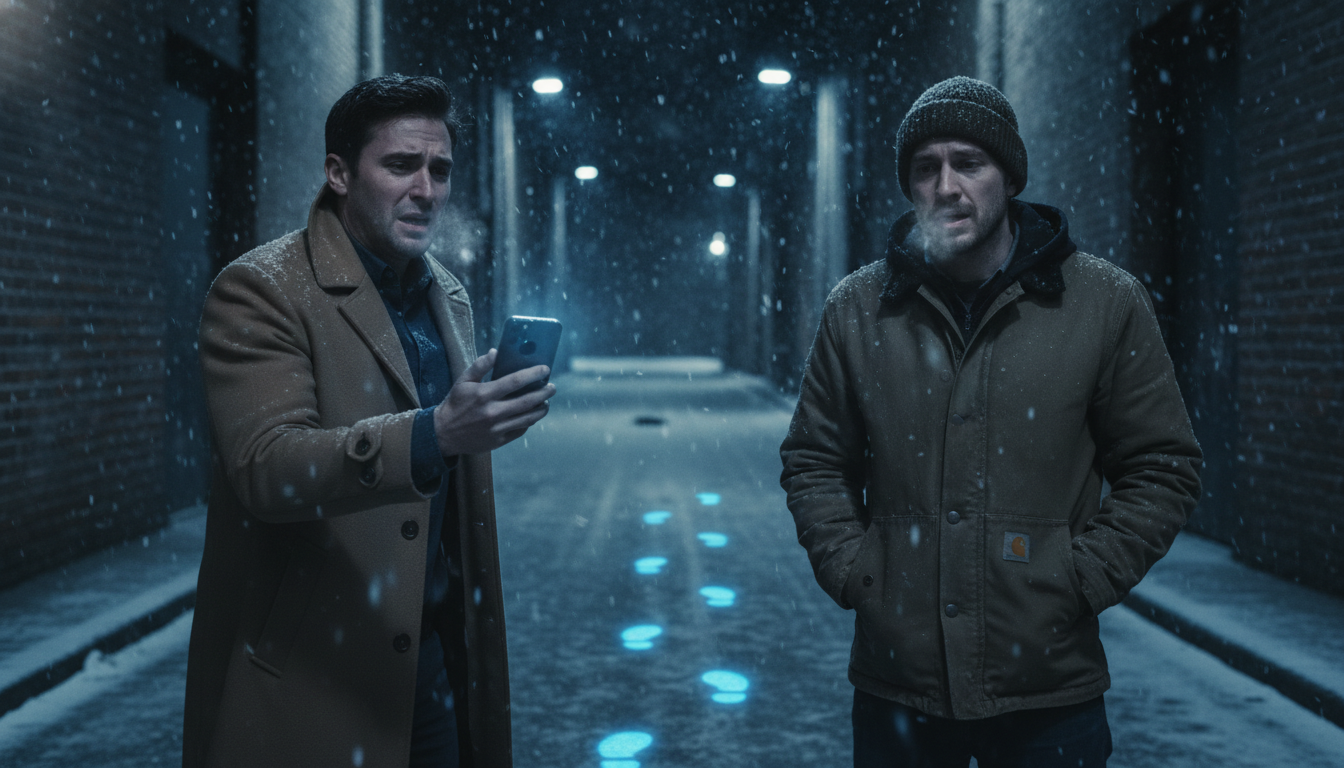
Behind Simon, at the end of the street, a black car turned the corner. It moved slowly, crawling like a predator, its headlights cut.
Share This Story


