The Windbreak
A frantic walk through downtown Winnipeg in freezing weather, moving from the streets to the skywalks and finally to a bridge.
The wind didn't just blow in Winnipeg; it hunted. It came sweeping down off the prairies, accelerated through the concrete wind tunnels of Portage and Main, and found the one spot between my scarf and my toque that I’d left exposed. It felt like a physical slap, a wet, heavy towel made of ice hitting the side of my face. My eyes watered instantly, the tears cooling before they could even roll down my cheeks.
"It is a hostile entity," Simon shouted. He was walking three paces ahead of me, his long wool coat flapping behind him like a cape. He refused to wear a proper winter parka. He said puffy coats destroyed the silhouette of human suffering. "Do you feel it, Jeff? The malice? Nature is not indifferent here. It is actively offended by our presence."
"I feel," I gasped, jogging to catch up, slipping slightly on a patch of black ice disguised as wet pavement, "that we should have waited for the bus."
"The bus is a surrender!" Simon didn't turn around. He just marched. His boots were heavy, leather combat style, clacking loudly against the frozen concrete. "To wait in that glass coffin of a shelter is to admit defeat. We move. We generate heat. We live."
"We freeze," I corrected, but the wind tore the words away. I shoved my hands deeper into my pockets. My knuckles were scraping against the lint at the bottom. I could feel the cold seeping through the denim of my jeans, that specific, numbing burn that starts at the thighs and works its way into your bones. It was November. Technically autumn. But the city didn't care about the calendar. The leaves were gone, mashed into brown pulp in the gutters, and the sky was a flat, oppressive sheet of galvanized steel.
We were moving fast. Urgent. Simon had this idea that we had to get to the Forks before the sun went down. He hadn't said why. He just showed up at my locker, eyes wide and frantic, looking like a poet who’d just seen a ghost, and said, We must depart. So I departed. Because that’s what I did. I followed Simon into the cold.
The sidewalk on Graham Avenue was crowded with people rushing, heads down, shoulders hunched up to their ears. Everyone looked like they were fleeing a crime scene. That’s the Winnipeg walk—brisk, angry, efficient. Avoid eye contact, avoid the slush puddles, get to the heated airlock of the next building.
"Pick up the pace, Jeffnard!" Simon commanded, swinging around a light pole. He looked ridiculous and magnificent. His cheeks were flushed a violent red, his dark hair whipped into a frenzy. He looked like he was on a stage, performing Hamlet to an audience of parking meters.
"My name is Jeff," I muttered, breathless. The air tasted like exhaust and dry grit. "And my legs aren't as long as yours."
"Details," he waved a gloved hand. Leather gloves. Of course. "We are racing the dying of the light. Do you see it?" He pointed up at the gap between two office towers. The sun was already dipping, a weak, bruised peach color trying to push through the grey. It was only four o'clock.
We hit a red light at the intersection. Simon vibrated with energy, bouncing on the balls of his feet. I leaned against the traffic control box, trying to catch my breath. The metal was freezing, sucking the heat right out of my shoulder through my jacket, but I was too tired to move.
"Why are we doing this?" I asked. My voice cracked. Puberty was mostly over, but the cold made my throat tight. "Seriously, Simon. It's minus twenty with the windchill. My toes are numb. Why the Forks?"
Simon turned to me. For a second, the theatrics dropped. His dark eyes locked onto mine, and there was something frantic in them. Scared, maybe? Or just hyper-awake. He stepped closer, invading my personal space, blocking the wind for a split second. I could smell him—cedar wood soap and the stale, electric smell of old wool.
"Because nothing happens in the warm, Jeff," he said, his voice dropping an octave, trying to sound profound but sounding mostly just desperate. "Comfort is the enemy of revelation. We need to see the river freeze. We need to see the moment the water gives up."
"The water doesn't give up," I said, shivering. "It just... changes state. Physics."
"Do not reduce the tragedy of the seasons to thermodynamics!" He spun around as the light changed. "Forward!"
We ran across the street, dodging a turning pickup truck that honked aggressively. The driver flipped us off. Simon bowed to him. actually bowed.
My heart was hammering against my ribs. Not just from the running. It was him. It was always him. Being around Simon was like standing next to a live wire. You knew you were going to get shocked, but the hum was addictive. I’d known him since third grade, when he wore a cape to school every day for a year. Now, in eleventh grade, the cape was gone, replaced by the coat, but the energy was the same. He was too much for this city. Too much for me. But here I was, chasing him down Main Street.
We ducked into the underground walkway system near Portage and Main to escape the worst of the gusts. The sudden silence was jarring. The air here was warm, smelling of floor wax and fast food grease. The fluorescent lights hummed a low, headache-inducing E-flat.
"Sanctuary," Simon whispered, shaking the snow off his coat. He looked at his reflection in the dark window of a closed office. He fixed his hair, aggressive swipes to tame the mess. "We made good time. But we cannot linger. The subterranean labyrinth is a trap. It makes you soft."
"It makes me warm," I argued, unzipping my jacket. The heat prickled my skin, making my face itch. "Can we just stay here? Grab a donut? The river will still be there tomorrow."
"Tomorrow it will be solid," Simon said, turning to me. He looked intense again. "I need to see the struggle. The slush. The in-between."
He started walking again, faster now, his boots squeaking on the linoleum. I trotted after him, my unzipped jacket flapping. People stared. A security guard watched us warily, hand resting near his belt. We looked like trouble. Two teenagers, flushed and frantic, storming through the tunnels.
"You're weird today," I said, coming up beside him. "Weirder than usual. Did something happen? Did your mom... ask about the play?"
Simon stiffened. I saw it in his shoulders. A microscopic flinch. "The matriarch is irrelevant to the mission. This is about existence, Jeff. Pure, unadulterated existence."
"Okay, so she did," I thought. Simon's mom didn't get him. She wanted him to play hockey. He wanted to play Richard III. It was the eternal Winnipeg conflict.
We burst out of the walkway doors near the train station, back into the biting cold. It felt worse now, after the brief respite. The sweat on my back turned instantly clammy. The sky was darker now, the bruised peach turning to a deep, angry purple.
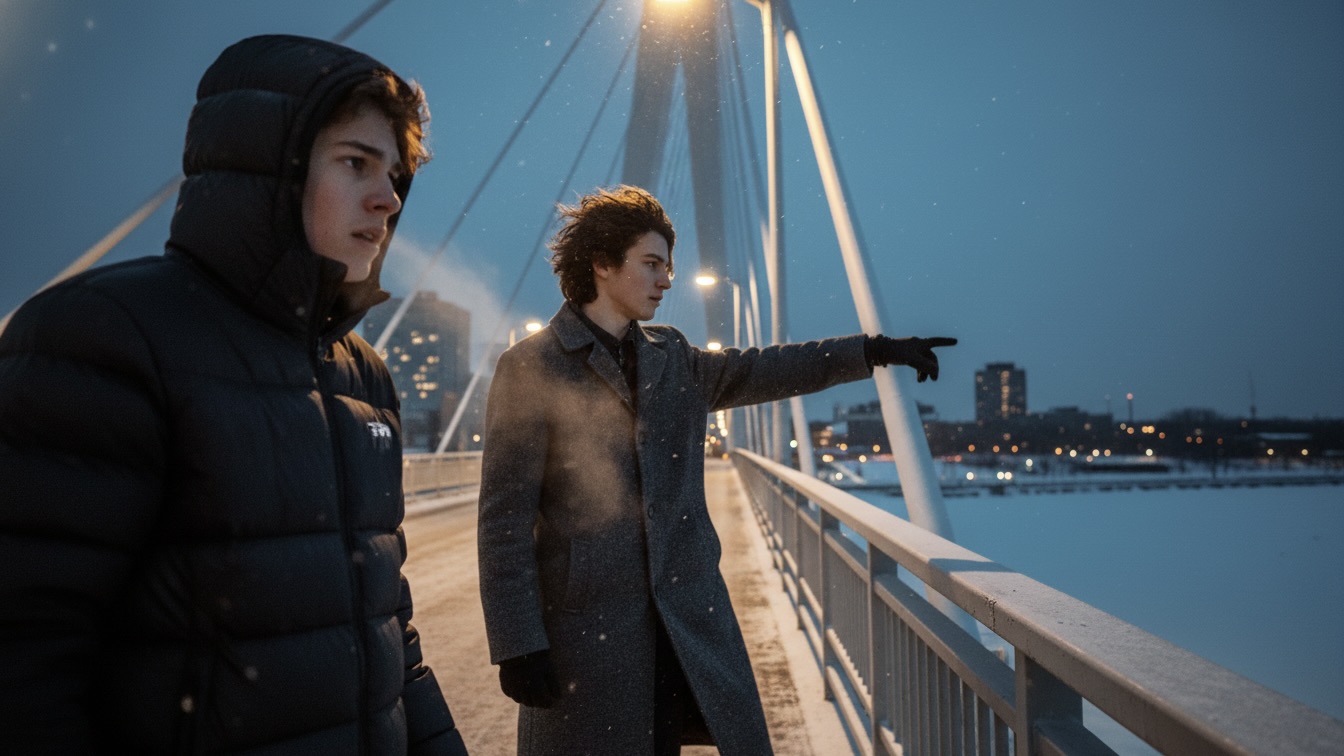
"The bridge," Simon pointed. The Esplanade Riel. The white suspension bridge that crossed to the French quarter. "We must ascend."
"It's going to be freezing up there," I complained, but I was already following him. I was always following him. It was pathetic, really. He snapped his fingers, and I came running. He decided we were pilgrims of the winter, and I put on my boots.
We ran up the ramp. The wind up here was ferocious. It screamed through the cables of the bridge, a high-pitched wail that vibrated in my teeth. Below us, the Red River was a mess of grey sludge, chunks of ice grinding against each other, moving slowly, sluggishly toward the north.
Simon stopped in the middle of the bridge. He leaned over the railing, staring down at the dark water. The wind whipped his hair across his face. He didn't brush it away.
"Look at it," he shouted over the wind. "It doesn't want to stop. It fights the ice. It churns. But the cold wins. The cold always wins."
I stood next to him, huddled in my jacket. I looked down. It just looked like dirty water to me. Cold and uninviting. But then I looked at Simon. His knuckles were white where he gripped the railing. He wasn't looking at the river anymore. He was looking at the horizon, where the city lights were starting to flicker on, amber grids against the twilight.
"It's not winning," I yelled back. "It's just resting. It melts in the spring. It comes back."
Simon turned his head slowly. He looked at me, really looked at me. His eyes were watery from the wind. "You are painfully optimistic, Jeffnard. It is a fatal flaw."
"And you're painfully dramatic," I shot back. "It's a coping mechanism."
He laughed. A short, sharp bark of a laugh that was snatched away by the gale. "Perhaps. Or perhaps I am the only one who sees the tragedy of it all."
"What tragedy?" I asked, stepping closer. The space between us was shrinking. The cold was pushing us together. "That it's cold? Everyone knows it's cold, Simon. We live in Winnipeg. It's the factory setting."
"Not the weather," he said, his voice dropping, suddenly quiet enough that I had to lean in to hear him. " The timing. The inevitable freezing of things that should be fluid."
I didn't know what he was talking about. I rarely did. But my stomach did a little flip, a nervous somersault that had nothing to do with the temperature. He was staring at my mouth. I was sure of it. Or maybe he was looking at my chapped lips. I licked them nervously, tasting salt.
"Simon," I started, not sure what I was going to say. I'm cold? I like you? You're crazy?
He let go of the railing and turned fully toward me. The theatrical mask slipped completely. He looked young. Scared. He reached out, his gloved hand hovering near my face, then awkwardy brushing a piece of hair away from my forehead. The leather was cold, but his touch was careful.
"I got into the program," he said. The words were rushed, barely audible.
I blinked. "What?"
"The theatre intensive. In Toronto. For next semester."
The wind seemed to stop. The noise of the traffic on the bridge faded into a dull buzz. Toronto. Next semester. That was... January. That was two months away.
"Oh," I said. It was a stupid sound. A small, round sound that fell out of my mouth and froze on the pavement.
"I leave in January," Simon said. He was back to his formal tone, but it sounded brittle now, like thin ice. "Hence, the urgency. I needed to see the river freeze. I needed to remind myself that things change. That they enter... stasis."
He was leaving. Simon was leaving. The color drained out of the world. The amber streetlights looked sickly. The purple sky looked like a bruise.
"That's... great," I managed. "That's what you wanted. right?"
"It is the objective," he stated. He looked away, back to the river. "It is the logical progression of my narrative."
"Screw your narrative," I said. The anger flared up, hot and sudden. "You're leaving? Just like that?"
"It is an opportunity, Jeff!" He threw his hands up. "I cannot rot here in the frost! I need... I need expansion!"
"And what about... everything else?" I asked. What about me?
He looked at me, his expression pained. "There is nothing else. There is only the work. And the winter."
He was lying. I knew he was lying. I could see the twitch in his jaw. He was terrified. He was running away, not toward something.
"You're full of it," I said, my voice shaking. "You're just scared."
"I am petrified!" he shouted, his voice cracking. "Is that what you want to hear? I am terrified of staying here and freezing into a statue of mediocrity!"
"I'm here!" I yelled back. "I'm right here! Is that mediocre?"
Simon stopped. He stared at me, his chest heaving. The wind howled around us, tearing at our clothes. We were two dark shapes on a white bridge, suspended over black water.
"No," he said softly. "You are... the anchor. And anchors drown, Jeff."
That hurt. That hurt more than the wind. I took a step back. "So that's it? You're cutting the line?"
"I am saving you," he whispered. "From the drag."
"I didn't ask to be saved," I said. I felt tears pricking my eyes again, and this time I let them freeze on my lashes. "I just wanted to walk with you."
Simon looked torn. He took a step toward me, his hand reaching out again. He looked like he was going to grab me, shake me, maybe hug me. The moment stretched, tense and vibrating. The air between us was charged, heavier than the storm.
"Jeff," he started, his voice rough. "I..."
A sudden, blinding light washed over us. A siren chirped—short, loud, aggressive.
We both jumped, shielding our eyes. A police cruiser had rolled up silently onto the pedestrian path behind us, its lights flashing blue and red against the snow.
"Hey!" a voice boomed from the loudspeaker, distorted and metallic. "You two! Off the railing! Now!"
The moment shattered. The tension broke, replaced by a sudden, jarring spike of adrenaline. Simon looked at the cop car, then back at me. The vulnerability vanished, instantly replaced by the mask. He straightened his coat, lifted his chin, and adopted a pose of regal annoyance.
"The authorities," Simon declared, though his voice shook slightly. "They always arrive at the climax."
"Let's just go," I muttered, grabbing his sleeve. I wanted to get away. I wanted to hide.
"Run?" Simon looked at me, a wild grin splitting his face. It was manic, fake, but brilliant. " fleeing into the night? A classic motif."
"No, just... walk away," I hissed.
But the cop was opening the door. "I said get off the railing, kids! What are you doing up here?"
Simon turned to the officer. "Observing the entropy of the universe, constable!" he shouted.
"Shut up, Simon," I whispered, dragging him by the arm. "We're leaving! Sorry! We're leaving!"
We hurried down the other side of the ramp, slipping on the snow, half-running, half-falling. We didn't stop until we hit the gravel path of the Forks, hidden by the trees. My lungs were burning. My legs felt like jelly.
We leaned against a rough bark of an oak tree, gasping for air. The police lights were spinning above us on the bridge, casting frantic shadows through the branches.
"That..." Simon wheezed, "was... exhilarating."
"You're an idiot," I said, leaning my head back against the tree. "You're a total idiot."
He looked at me. The wildness was fading, replaced by that sadness again. The Toronto sadness. "I know," he said. "Jeff?"
"Yeah?"
He didn't say anything for a long time. He just watched the steam of our breath mix in the air between us. "About what I said. About the anchor."
"Don't," I said. "Just don't."
He nodded. He reached into his deep coat pocket and pulled out something. It was a small, crumpled paper bag. Grease stains on the bottom.
"I acquired this," he said, handing it to me. "Before I met you. For the journey."
I opened it. A cinnamon bun. Cold, squished, rock hard.
"Thanks," I said. I broke off a piece. It tasted like sugar and old cardboard. It was the best thing I'd ever eaten.
"We have to go back," I said after a minute. "My mom will kill me if I'm late for dinner. And you... you have packing to do, I guess."
"Packing is a state of mind," he deflected. But he pushed off the tree. "Come. The 11 bus awaits. We shall submit to the glass coffin."
We walked back toward Main Street. The wind was at our backs now, pushing us forward. It was easier, but it felt colder. Simon walked close to me. His shoulder brushed mine every few steps. Friction. Heat.
We got to the bus stop just as the 11 came roaring around the corner, its destination sign lit up in warm amber. We piled on, scanning for seats. The bus was packed. Steam rose from wet coats; the floor was a soup of grey slush.
We found standing room near the back. I grabbed the overhead strap. Simon stood next to me, swaying with the lurch of the bus. He looked tired. The performance was exhausting him.
The bus turned onto Portage. I watched the city scroll by—pawn shops, empty storefronts, the bright lights of the Life Building. It was ugly and beautiful and freezing.
Simon leaned in close. The bus rattled over a pothole, knocking his hip into mine. He didn't pull away.
"I'm not leaving until January," he murmured. It was barely a whisper. No theatrics. No projection. Just a fact.
"I know," I said, staring at the back of a stranger's parka.
"That is... sixty-one days," he said. "A significant duration. Much can occur in sixty-one days. Empires rise and fall. Rivers freeze."
I looked up at him. He was looking at me with that same intensity as on the bridge, but softer now. The bus lights flickered overhead.
"Yeah," I said, my heart starting that stupid hammering again. "They do."
"I do not wish to be a statue," he said. "But I do not wish to be alone on the ice, either."
He moved his hand. Slowly. Deliberately. He covered my hand on the metal pole. His leather glove over my bare knuckles. It was shocking. Public. Undeniable.
"Simon," I breathed.
"Hush," he said, staring straight ahead, his jaw tight. "I am attempting a plot twist."
I stood there, feeling the warmth of his hand seep through the leather. The bus groaned and hissed, carrying us deeper into the frozen night. I didn't care about Toronto. I didn't care about the wind. I just held on.
But then the bus screeched to a halt. The doors hissed open.
"Main and Mountain!" the driver yelled.
Simon flinched. He pulled his hand away as if burned. He looked at the open door, then at me. Panic flared in his eyes again. Real panic.
"This is my stop," he said, his voice strangled.
"What? No, you live in Wolseley. That's miles away."
"I have... an errant to run," he stammered. He was already backing away, pushing through the crowd. "I must... I must go."
"Simon!" I called out, but he was already shoving past a woman with a stroller.
He jumped off the bus into the snow. The doors started to close. I scrambled to the window, wiping away the condensation with my sleeve. I saw him standing on the corner, his coat billowing, looking lost. And then I saw who was waiting for him.
Standing under the streetlamp, arms crossed, looking furious, was his father. The one who hadn't spoken to him in two years. Simon shrank. He actually shrank. The great performer, the master of the winter, looked like a terrified little kid.
His father grabbed his arm. Rough. Simon stumbled.
The bus engine roared, and we pulled away, leaving them behind in the dark.
The bus engine roared, and we pulled away, leaving them behind in the dark.
Share This Story


