The Blue Flicker of Dawn
The Winnipeg summer dawn bled a pale, insipid blue through the gap in the curtains, a colour Fred despised. It was the precise shade of disappointment, a thin, weak wash over the lingering vibrancy of the night just vanished. His bed sheets, damp with sweat from the oppressive heat, felt like a shroud, clinging to him, anchoring him to a world he desperately wished to escape, a world that offered none of the profound, gentle solace of his dream.
The air in Fred’s room hung thick and heavy, tasting of stale sleep and the faint, sweet decay of humid summer. He blinked, the sharp edges of his bedroom – the peeling paint on the window frame, the stack of unread textbooks, the charger cable snaking across the floor – assaulting his senses with their unforgiving solidity. In the dream, the light had been soft, diffused through cathedral glass, casting long, dancing shadows on the worn flagstones of the market square. And there, amongst the bustle of laughing, ordinary faces, his grandmother had been, her smile not a memory, but a presence, a warmth that still hummed in his chest, a phantom echo of a hug.
He pushed himself upright, the cheap mattress springs groaning under his weight, a sound too loud, too grating. The digital clock on his bedside table glowed 5:07 AM, an indictment. Too early to be awake, too late to slip back into the silken threads of that other place. A dull ache throbbed behind his eyes, a familiar souvenir of the journey between states. He dragged a hand through his perpetually messy auburn hair, the strands gritty with sweat. His skin felt too tight, a flimsy covering over a soul that felt stretched and raw.
He stumbled out of bed, his bare feet meeting the cool, dusty floorboards. Each step was a tiny betrayal, taking him further from the vivid realism of the dream. In the dream, he’d been laughing, a genuine, unburdened sound that felt alien to his waking throat. His grandmother had been telling him about a new recipe for bannock, her voice reedy but strong, her hands kneading invisible dough. It was all so mundane, so utterly normal, and that’s what made it exquisitely, excruciatingly real. The mundane details were the sharpest hooks.
The Unspoken Language of Longing
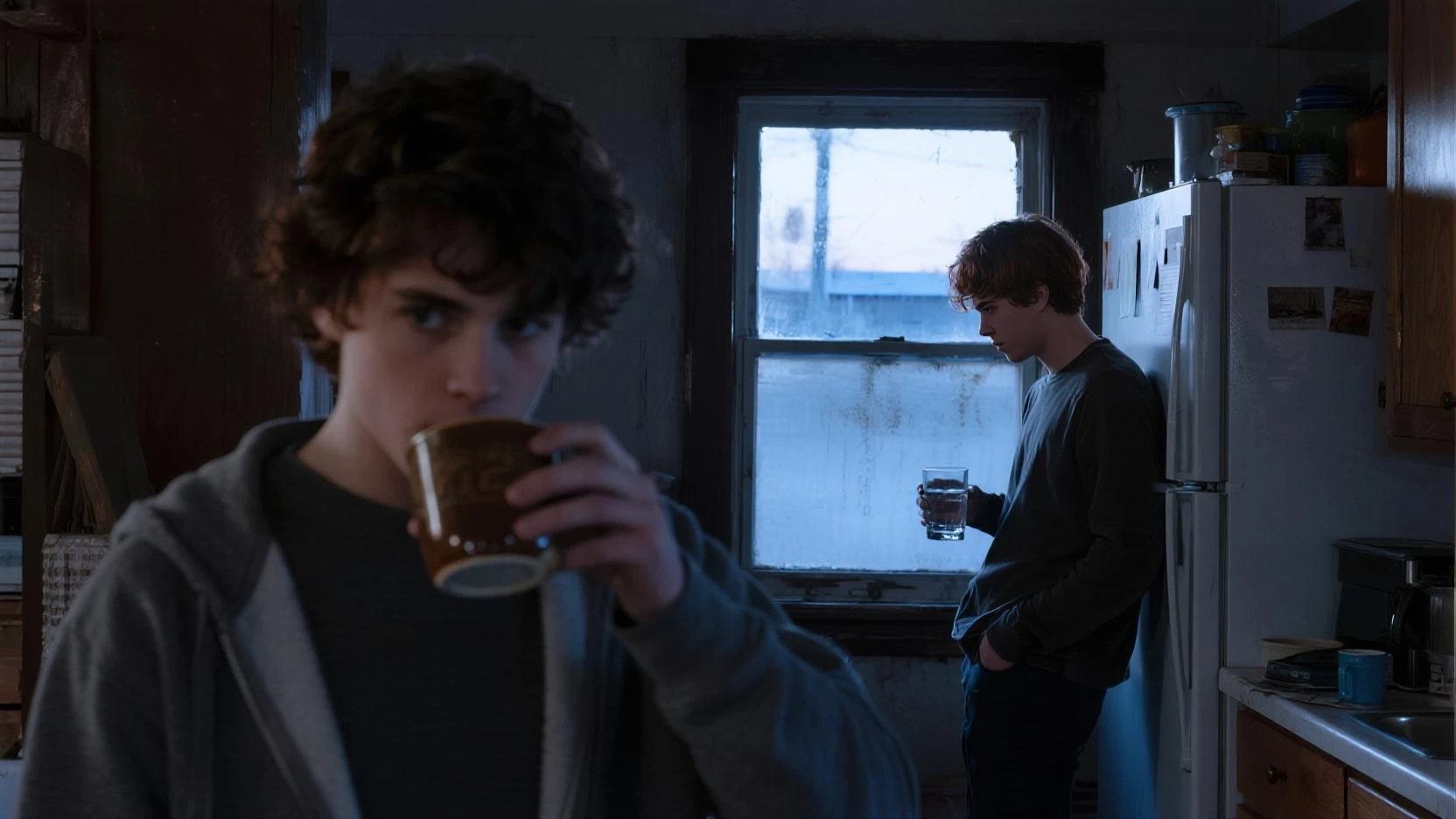
The kitchen was still and cool, the only sound the low hum of the old refrigerator. He poured himself a glass of water, the ice cubes clinking like tiny, fragile bells. His reflection in the dark glass of the window showed a hollow-eyed stranger, a stark contrast to the lively, hopeful version of himself that had existed just moments before. He saw the faint purple smudges beneath his eyes, the slight tremble in his hand as he brought the glass to his lips. He was twenty-one, but felt a thousand years old, burdened by a grief that only intensified with each dawn.
A soft knock, tentative, then more insistent, rattled the back door. Fred flinched, nearly dropping the glass. Only one person ever used the back door at this hour. He knew it was Thom before he even saw the outline through the frosted pane.
He pulled the door open, the humid summer air instantly pressing into the kitchen, carrying the scent of cut grass and distant exhaust fumes. Thom stood on the porch, a grey hoodie pulled up over his dark curls, his shoulders hunched. He looked tired, too, a mirror image of Fred's own disquiet. His blue eyes, usually so sharp, held a familiar, distant glaze. Thom was a couple of years older, broader in the shoulder, but there was a fragility about him sometimes, especially in these early hours.
"Rough night?" Thom asked, his voice low, almost a whisper, as if afraid to break something delicate. He didn't wait for an answer, just stepped inside, letting the door click shut behind him. He walked straight to the coffee pot, pouring himself a mug without asking, a ritual ingrained over years.
Fred just grunted, leaning against the counter, still holding his half-empty water glass. The mundane actions, Thom’s familiar presence, usually comforting, today felt like an intrusion. "She was… there," Fred said, the words a raw confession. "At the Forks. We were talking about, I don't know, the Red River. About how it always flows north." He trailed off, the details fading even as he spoke them, like sand through his fingers.
Thom stirred his coffee, not looking at him. "Mine was… my dad. Fixing his old truck. Just like he used to." His voice was tight, strained. Thom's father had died five years ago, a sudden heart attack that had left a hole in Thom that Fred sometimes felt he could almost fall into. The silence stretched between them, thick with understanding, with unspoken longing. It wasn't pity Thom offered, but shared ground.
"It’s getting harder," Fred admitted, finally meeting Thom’s gaze. "Harder to… come back. The real stuff just feels so… thin, compared to it. Like a photocopy of a photocopy." He gestured vaguely at the kitchen, at the morning light that felt so inadequate.
Thom nodded slowly, his eyes still distant. "I know. Every time, I try to hold on. Just a little longer. It's like… you can taste it, almost. The way things used to be." He took a slow sip of coffee, his knuckles white around the mug. "But you can't, Fred. You know you can't. It's not real."
"But it feels real," Fred argued, a sudden heat rising in his chest. "More real than this. Her hand on my arm. The way she smelled, like lavender and old paper. The way she wrinkled her nose when she laughed. You can't tell me that's not real, Thom."
The Current Beneath the Skin
Thom finally turned, his gaze sharper now, locking onto Fred's. "It's a memory, Fred. A damn good one, a vivid one. But it's not her. She's gone. And if you keep chasing it, you're going to get lost. You're going to lose yourself here."
The words stung, but Fred knew there was truth in them. He hated it. He hated the way Thom's concern was a tether, pulling him back when all he wanted was to drift. "And what if I don't want to be found here?" he shot back, his voice rising, betraying the raw desperation bubbling within him. "What if 'here' isn't enough?"
Thom pushed off the counter, stepping closer, until they were almost toe-to-toe in the small kitchen. The air between them crackled, thick with unspoken tensions, shared sorrow, and something else, something warm and complicated that always seemed to linger when they were like this. Fred could smell Thom’s faint sleep-scent, the clean laundry detergent on his hoodie, the bitter coffee. It was grounding, too real.
"It has to be enough," Thom said, his voice softer now, almost pleading. His hand hovered, almost reaching for Fred’s arm, then dropped. "It has to be. We have… this. We have each other. Isn't that… something?"
Fred looked at Thom’s earnest face, the slight flush on his cheeks, the way his dark hair fell across his brow. He saw the concern, yes, but also a flicker of something deeper, something vulnerable that mirrored his own unarticulated feelings. In the dream, he could be whoever he wanted, free of the messy anxieties of the waking world. Free of the confusing, aching pull he felt towards Thom, a pull he hadn't fully acknowledged, even to himself. But in the dream, Thom wasn’t there, not really. Only the ghosts of what had been.
"What is 'this', Thom?" Fred asked, his voice barely a whisper, the question loaded with far more than just the topic of dreams. He was asking about their friendship, their unspoken bond, the way their lives had woven together since childhood, the way Thom was always there.
Thom’s jaw tightened. He looked away, his gaze falling to the worn linoleum on the floor. "It's… real. It's now. That's what it is." He cleared his throat, the sound rough. "You've got that history paper due this week. And the summer job at the library starts Monday. You can't just… float away, Fred. Not permanently."
---
The Weight of Waking
Fred knew Thom was right, on a purely logical level. He knew the responsibilities, the need to function. But the logic felt like a dull, flat note against the rich, orchestral swell of his dreams. The library job felt like another cage, another anchor. He wanted the lightness, the freedom of a world where his grandmother was alive, where loss was a concept, not a crushing weight in his chest. He wanted the effortless conversations, the quiet comfort of a life undisturbed by the sharp edges of grief.
He walked past Thom, heading to the sink, rinsing his glass with unnecessary vigour. The running water was loud, a deliberate barrier. "I'm not floating away," he lied, the words tasting like ash. "I just… need to understand it better. Control it."
Thom scoffed, a short, sharp sound. "'Control it'? You're talking about lucid dreaming, Fred. It's a skill. Most people barely manage to remember what they had for breakfast, let alone pilot their own subconscious. You're just lucky. It's a gift, sure, but you're treating it like an escape hatch. And escape hatches get locked from the outside."
"What if I don't want to wake up?" Fred turned back, his gaze pleading. "What if I find a way to stay? Just for a little while longer? What would be so wrong with that?"
Thom stared at him, his expression a complex mix of frustration, fear, and something Fred couldn't quite decipher. It was a look that seemed to hold a world of unspoken worry, a deep, protective instinct. For a moment, the air thickened with possibility, with a question Fred dared not ask, a confession he dared not make. He wondered if Thom felt the pull too, not just to his own lost father, but to Fred himself, in some unfathomable way. The possibility hung, shimmering, just out of reach.
"Everything," Thom said, his voice barely audible, the single word heavy with implication. He shook his head, a decisive, almost violent motion. "Everything would be wrong with that."
Then, as quickly as the intensity had flared, it vanished. Thom turned, moving to the back door. "Look, I've got to hit the gym. Early shift today." He pulled the hoodie tighter around him. "Just… think about it, okay? About what you're doing. And what you're leaving behind."
The door closed with a soft click, leaving Fred alone in the too-bright kitchen. The silence returned, heavier now, punctuated only by the refrigerator's hum. He looked down at his hands, calloused from years of sketching and working odd summer jobs. Real hands. Hands that could grasp, could feel, could create. Hands that ached for a warmth that was only truly present in the fluid, impossible architecture of his dreams.
He closed his eyes, inhaling slowly, deeply, trying to conjure the scent of lavender and old paper. He needed to go back. Not just for his grandmother, but for himself. To find a way to bend the rules, to push the boundaries, to simply stay. The sun was now a brazen yellow, glaring through the window, but Fred felt only the deep, undeniable pull of the blue flicker, the promise of another night, another chance to reclaim what reality had stolen.
He opened his eyes, a decision hardening in them. The world of waking, for all its grit and sharp edges, was simply a bridge. And he intended to cross it, again and again, until he could find a way to remain on the other side, even if it meant risking everything he had here. The thought of Thom’s face, etched with worry and something unreadable, flashed through his mind, a fleeting pang. But it was quickly overshadowed by the profound, irresistible lure of the dream. He would sleep. He would find a way back.
He would sleep. He would find a way back, determined to reclaim what reality had stolen, even if it meant risking everything he had, including the unspoken connection with Thom, for the boundless solace of his dreams.
Share This Story


