A Scorpion in the Boot
The prairie shimmered under a brutal, indifferent sun, the kind of summer heat that warped distant horizons and pressed down on your skull like a lead plate. Dust devils danced on the horizon, ghosts of old misfortunes, as Flynn's beat-up pickup groaned its final metres into the sleepy, wilting town. Everything looked older, rustier, and inexplicably smaller than the last time he’d seen it.
He watched the gravel spit from under his truck’s tyres, a small, satisfying rebellion against the inertia that had clung to him for three years. Three years. Three years since he’d traded these endless, bleached fields for concrete and the fleeting anonymity of bigger cities. Now, the prairie stretched out again, flat and unforgiving, smelling of dry grass and something faintly metallic he couldn’t place. His stomach churned with a familiar, unwelcome tension. He shouldn’t have come back. Not really.
David would be here. David, who wrote letters that were more like cryptic dispatches, filled with observations about the local coyote population or the strange weather patterns, never quite touching on the things Flynn actually needed to know. Never asking about the things Flynn didn’t want to say. The sun, a brutal orange bruise in the west, began its slow descent, painting the rusted skeletal remains of an old windmill in absurdly beautiful hues. It was a joke, really. Everything here was a joke, a dark, dusty punchline.
He pulled the old pickup to a stuttering halt beside David’s truck, a newer, shinier model that looked far too competent for this sad little ranch. The engine died with a sigh, leaving behind only the tick-tick-tick of cooling metal and the insistent buzz of flies. He grabbed his duffel, the canvas stiff with travel grime, and pushed open the door. The heat hit him like a physical blow, thick and humid, smelling of manure and something faintly sweet, like dying flowers. His jeans stuck to his thighs instantly. Excellent. What a homecoming.
David was nowhere in sight. Just the vast, silent acreage, the porch swing creaking a lonely rhythm in the faint breeze, and a lone, very dead badger lying belly-up near the front steps, its fur matted and dark with what Flynn hoped was just mud. Its teeth were bared in a surprisingly aggressive rigor mortis grin. A little welcoming committee, then.
“Welcome back, you arse,” a voice drawled from the side of the house. David. He rounded the corner, wiping grease from his hands with a ragged shop towel, a smudge like a tribal mark across his cheekbone. He hadn’t really changed. Taller, maybe, and his shoulders were broader, but the same coiled energy hummed beneath his skin, the same unsettling stillness in his gaze. He still wore those ridiculously worn-out denim work shirts, sleeves rolled up to reveal tanned, muscled forearms.
Flynn managed a weak smile. “You know, I was wondering if that was for me. The badger.” He gestured with his chin. “A little aggressive, don’t you think? Bit on the nose.”
David’s mouth quirked, a ghost of the old, easy grin. “He was already there. Said he was waiting for you.” He flicked the towel at the badger. “Tried to convince him to move. Unresponsive.”
“Right.” Flynn shoved his hands into his pockets. “So. Things are… good, then?” The question hung in the thick air, heavy and loaded. It wasn't about the ranch, or the badger. It was about everything. About them.
David walked past him, a movement so fluid it felt like he hadn’t touched the ground, and disappeared onto the porch. Flynn followed, feeling clunky and out of place. He watched David kick at the badger with the toe of his boot. It didn’t budge. “Depends on your definition of good, doesn’t it? The fence line’s holding, the cows haven’t stampeded off to Saskatchewan, and the well hasn’t run dry yet.” He looked up, his eyes meeting Flynn’s, a spark of something unreadable there. “You, though. You look like you’ve been wrestling a particularly stubborn ghost.”
Flynn shrugged, his backpack strap digging into his shoulder. “Just the usual kind. The ones that ride shotgun on long drives.” He dropped the duffel beside the door, the thud echoing in the stillness. “Figured you could use another pair of hands. Or at least, another body to complain about the heat with.”
David finally dragged the badger a few feet away with his boot, a small puff of dust rising. “Hands are always good. Bodies… we’ll see if you remember which end of a wrench goes where.” The words were light, almost playful, but the undercurrent of something sharper, a challenge, was undeniable. Flynn felt a flicker of annoyance, quickly smothered. Old habits died hard, apparently, on both sides.
---
The Unsprung Coil
The next morning was no cooler, merely brighter. Flynn found David already hunched over the guts of an ancient tractor, its paint peeled and faded like sunburnt skin. A collection of greasy tools lay scattered on a tarp, catching the morning light in dull glints. The air tasted of oil and hot metal, a strangely comforting scent. At least here, the problems were tangible.
“She’s seized up,” David said, not looking up as Flynn approached. His voice was rougher in the morning, like gravel. “Blew a piston last week. Been trying to get it apart, but it’s fighting me.”
Flynn knelt beside him, picking up a heavy spanner. The metal was warm. “Fighting you, or are you just out of practice on anything that isn’t a brand-new engine?” He twisted his lips into a mock-smirk, hoping it came off as genuine. It felt foreign.
David grunted, a short, dismissive sound. “Always the comedian, aren’t you? Still got that quick mouth on you, even if everything else looks a little… softer.” He didn’t elaborate, just kept wrenching at a rusted bolt with surprising strength. The subtext hung like exhaust fumes: You left. You got soft. I stayed, I got stronger.
Flynn’s jaw tightened. “And you’ve got… more rust. Must be all this fresh air.” He pushed a smaller wrench into David’s hand without looking. Their fingers brushed. A jolt, quick and unexpected, ran up Flynn’s arm. David didn’t react, or at least, didn’t show it. Good. He hated that feeling, that old current that still arced between them, even after everything.
They worked in a strained silence, the only sounds the metallic clangs of tools, the occasional frustrated sigh from David, and the insistent chirping of cicadas. Flynn felt clumsy, his movements hesitant compared to David’s practiced efficiency. He kept glancing at David’s profile, at the stubborn set of his jaw, the way a bead of sweat tracked a path through the grease on his temple. The years had etched something new there, a hardness around his eyes that hadn’t been present in the boy who’d once laughed at Flynn’s terrible jokes until his stomach hurt.
“Remember that time,” Flynn started, then hesitated. “With the ’98 Ford? You tried to change the oil and put it in the brake fluid reservoir?” He risked a quick look. David’s mouth was a grim line.
“And you laughed so hard you fell off the creeper and broke your nose. Yeah, I remember.” David didn’t laugh. His gaze was fixed on the engine, but his eyes were distant. “Good times.” The sarcasm was thick enough to cut with a knife. Flynn flinched internally. That memory was tainted now, by other, darker ones that lingered, unsaid, between them.
Flynn sighed, running a hand through his hair, leaving a greasy streak. “Look, I… I know things are different. I know I left.”
“You did,” David agreed, still not looking at him. His voice was flat, devoid of emotion, which was far worse than anger. “People do. It happens.”
“And I know it was… rough. After.” Flynn pushed. He had to. This silent avoidance was worse than any fight. “Everything. The whole… mess.” He let the word hang, a poisoned arrow aimed at their shared past. The accident. The fire. The reason Flynn had bolted and David had stayed, rooted to this land like an old oak.
David finally looked at him, his gaze sharp and cold. “The mess? That’s what you call it? A mess?” He let out a short, humourless laugh, a dry, rattling sound like stones in a tin can. “You always did have a way with words, Flynn. Never quite grasping the magnitude of things, though.” He turned back to the tractor, leaving Flynn to stew in the silence, the implied accusation a physical weight in his chest.
Flynn picked at a loose thread on his jeans, feeling his face flush with a mix of shame and irritation. He wanted to retort, to defend himself, but the words felt hollow. David was right. He had run. And David had stayed, picking up the pieces, living in the debris of their shared catastrophe. The thought was like a small, dull knife twisting in his gut. A part of him wanted to grab David, shake him, demand they just talk about it, really talk. But another part, the larger, more cowardly part, knew it was better to keep things buried under layers of grease and strained pleasantries.
Hours later, sweat-soaked and caked in grime, they had the piston out, lying on the tarp like a broken trophy. David wiped his brow with the back of his hand, leaving a black smear. “Need to order parts. Be a couple of days.” He stretched, his back cracking, and Flynn found his eyes lingering a moment too long on the taut curve of David’s spine beneath the thin fabric of his shirt.
David turned, catching Flynn’s gaze. A flicker of something, quick as a hummingbird’s wing, passed between them. It wasn't hostile. Not quite. More like a question. A memory. A ghost of a possibility that had once been so bright, so simple, before everything went sideways.
“Right,” Flynn mumbled, looking away, suddenly fascinated by a chip in the tractor’s faded green paint. “Couple of days. Great.”
David walked over to the old water pump, its handle grimy and well-worn. He worked it, and a gush of cold, clear water burst from the spout. He plunged his head under it, scrubbing at the grease, the water sluicing down his neck and shoulders, plastering his hair to his scalp. Flynn watched him, a strange, dizzying mix of familiarity and longing and fear churning in his stomach. David was still David, but the edges were sharper, the shadows deeper. He was a man now, carved by the kind of grief and responsibility Flynn had fled.
When David straightened, shaking water from his hair like a wet dog, his eyes met Flynn’s again. This time, there was a knowing in them, a quiet challenge. “You still haven’t told me why you really came back, Flynn. Not just for a couple of days. You don’t do short visits.” He walked closer, his voice dropping, intimate and low, cutting through the vastness of the prairie. “Something’s different. Something happened. You look like you’ve been running from a fresh disaster.”
Flynn looked at the distant line of dusty hills, the way the setting sun was turning them into blood orange silhouettes. The air still hummed with cicadas, a sound that suddenly felt less like summer and more like a warning. He hadn’t been running from a fresh disaster. Not exactly. He’d been running from the memory of an old one, a memory that, much like the relentless summer heat, seemed to have followed him all the way back here, refusing to be outrun.
And now, seeing David again, with that new hardness around his eyes and that unnerving stillness, Flynn realised something even worse. He wasn't just running from a memory. He was running from the knowledge that the disaster, whatever it had truly been, was still here. It was in the land, in the silent gaps between their words, and perhaps, most terrifyingly of all, it was still very much alive inside both of them, just waiting for the right moment to surface and claim its final due. He felt a cold dread creep through his sun-baked skin. What if he hadn’t just returned to the scene of the crime, but had, in fact, walked right back into the trap?
He watched as David took a long, slow drink from the pump, the water running down his chin, glistening in the last rays of light. The silhouette of the old windmill, still rusty, still broken, seemed to loom larger against the darkening sky, a sentry to all the things that wouldn't ever truly heal here, not even under the bright, forgiving mask of summer.
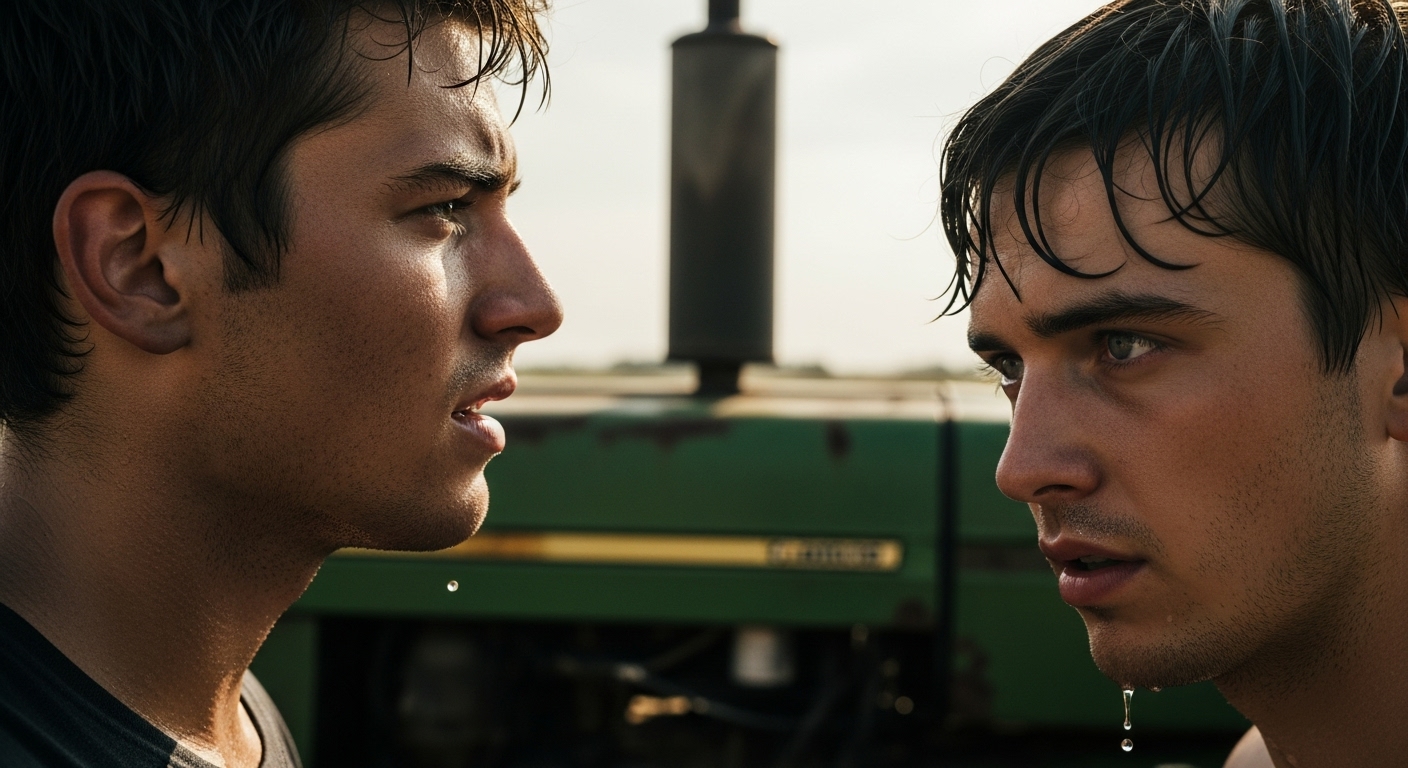
Flynn looked at David, really looked, and knew with a chilling certainty that the reason he had left was not a secret kept from the town, but a debt waiting to be collected, and David, with his quiet strength and wounded eyes, was the ledger.
Share This Story


