Blueprints and Bad Blood
The community centre's workshop smelled of sawdust, old paint, and the faint, lingering odour of decades of bingo nights. It was a cavern of organized chaos, filled with half-finished projects for the upcoming BayFest. In the centre of it all, looking like a skeletal whale beached on a sea of drop cloths, was the frame of the Historical Society's float.
Dima stared at the float's wooden frame with deep-seated resentment. His father had volunteered him. 'It will be good for you,' he'd said in Russian, 'to do something for the community. To show respect.' What Dima heard was: 'You will waste your last few weeks of summer gluing crepe paper to plywood instead of earning money on the boat.'
His resentment deepened when Sergei walked in. Sergei, whose father was a well-known cardiologist, whose family lived in a detached house in Manhattan Beach, and who always wore clothes that looked like they'd never been near a fishing net. Sergei was carrying a large portfolio case and a tube of drafting paper, looking less like he was here to build a float and more like he was about to present an architectural redesign of the entire building.
"You must be Dima," Sergei said, his English precise, lacking the rougher edges of Dima's own. He didn't offer to shake hands, just set his things down on a clean workbench.
"Yeah," Dima grunted, wiping his hands on his already grease-stained jeans. "You're Sergei."
It wasn't a question. Everyone knew who Sergei was. He was the golden boy, the one who won art prizes, the one whose parents boasted about his early acceptance to a prestigious design school. Dima, by contrast, was known for being able to fillet a flounder in under thirty seconds. Their worlds were not meant to overlap.
Mrs. Petrova, the head of the Historical Society, bustled over, clapping her hands together. "Wonderful! You are both here! Our theme is 'The Spirit of the Bay.' I leave it to you, our creative young minds, to bring it to life!" She beamed at them and then bustled away, leaving a void of awkward silence.
"So," Sergei said, unrolling a large, detailed blueprint across the workbench. It was a complex, swirling design of waves and abstract shapes, rendered in beautiful coloured pencil. "I was thinking of a dynamic, sculptural representation of the ocean's power, a metaphor for the immigrant spirit..."
Dima stared at the drawing. "It's a bunch of squiggles," he said flatly. "How are we supposed to build that out of chicken wire and two-by-fours?"
Sergei's face tightened. "It's a conceptual design. We can use steam-bent wood for the main forms and stretched fabric for the surfaces to create a translucent effect."
Dima scoffed. "Steam-bent wood? Do I look like a shipwright from the 18th century? We have a week and a budget of two hundred dollars. I was thinking we build a big fishing boat, stick a mermaid on the front. Simple. People get it."
"A mermaid?" Sergei said, his voice dripping with disdain. "How utterly pedestrian. This is an opportunity to create art, not a kitschy lawn ornament."
"This is a float for a neighbourhood parade, not an installation at the Met," Dima shot back. "It needs to survive being pulled by a pickup truck down Emmons Avenue, not be 'analysed' by art critics."
They were at an impasse, two opposing forces of pragmatism and ambition. Dima saw wood and nails; Sergei saw form and metaphor. The skeletal whale between them seemed to mock their inability to agree on what kind of skin to give it.
The Grain of the Wood
They worked for hours in simmering silence, accomplishing nothing. Dima measured and sawed boards for a basic rectangular frame, ignoring Sergei's pleas for more 'organic curvature'. Sergei sat at his workbench, sketching moodily in a leather-bound book, pointedly ignoring Dima's 'brute-force carpentry'.
As dusk fell, the community centre emptied out, until it was just the two of them under the fluorescent hum of the workshop lights. The silence became less angry and more... empty.
Dima's stomach growled, a loud, vulgar sound in the quiet. Sergei looked up from his sketchbook, a flicker of something unreadable in his eyes.
"My mother packed me some food," Sergei said quietly, gesturing to a tote bag. "There's more than enough."
Dima was too hungry to let pride get in the way. He nodded, and they sat on opposite ends of a workbench, eating warm blini and cheese from a plastic container. It was surprisingly good.
"Your mom's a good cook," Dima admitted.
"She worries," Sergei said. "She thinks I'll waste away if left to my own devices." He picked at a blin. "She doesn't really understand the art school thing. My dad doesn't either. They think it's a phase. They want me to be a doctor, like him."
It was the first real thing Sergei had said all day. Dima looked at the other boy, at his expensive clothes and his fancy drawings, and saw, for the first time, a crack in the perfect facade.
"My dad wants me to take over the boat," Dima said. "He's been on the water his whole life. His father too. It's all he knows." Dima shrugged. "It's a hard life. I don't know if I want it."
The shared confession changed the air in the room. They weren't just the fisherman's son and the doctor's son anymore. They were just two boys, trapped by the expectations of their fathers.
Sergei closed the food container and pushed his sketchbook across the bench towards Dima. "You can look, if you want."
Hesitantly, Dima opened it. He had expected more abstract squiggles, but the book was filled with stunningly realistic charcoal portraits. The faces of the old men who played chess on the boardwalk, the woman who sold newspapers by the train station, the tired, lined face of a fisherman who looked startlingly like Dima's own father. Sergei hadn't just seen these people; he had studied them, understood them. His art wasn't lofty and disconnected. It was grounded in the very neighbourhood Dima had accused him of not understanding.
"These are... incredible," Dima breathed, turning a page. He stopped at a drawing of a hand, calloused and strong, mending a fishing net. "How did you...?"
"I watch," Sergei said. "I see things." He reached across the table, his finger tracing the lines of the drawing. "Like the way a fisherman's hands are never really clean, there's always grime in the creases. Or the way the light hits the water just before a storm."
As Sergei leaned in, his arm brushed against Dima's. It was a simple, accidental touch, but a jolt, sharp and electric, shot up Dima's arm. He pulled back as if burned. Sergei froze, his eyes wide, looking at Dima with a new, dawning awareness. The hum of the fluorescent lights seemed to swell, filling the sudden, breathless silence in the room.
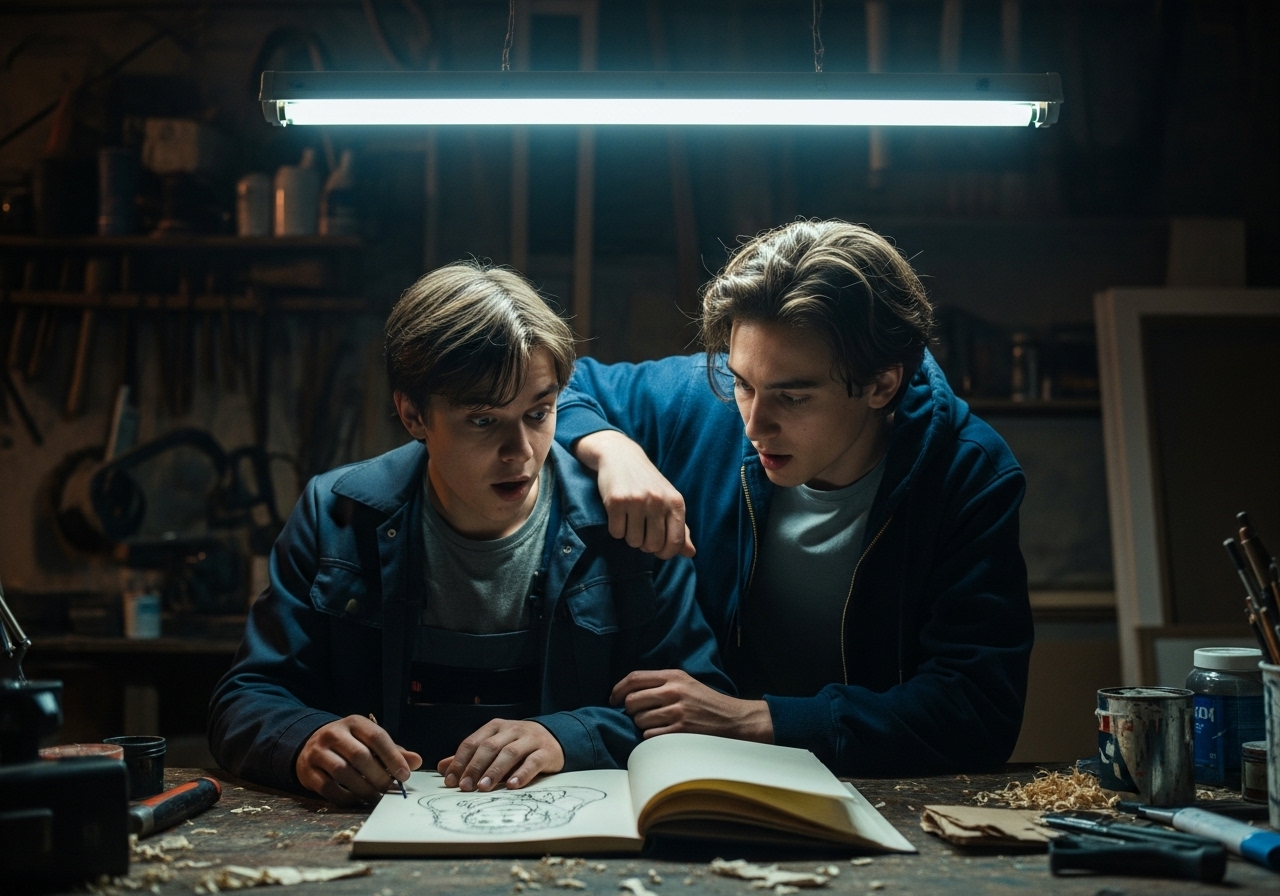
The air crackled with unspoken tension. They stared at each other across the workbench, the sketchbook lying open between them like a shared secret, both of them suddenly seeing the other not as a rival, but as something else entirely.
Share This Story


