The Sun's Tyranny
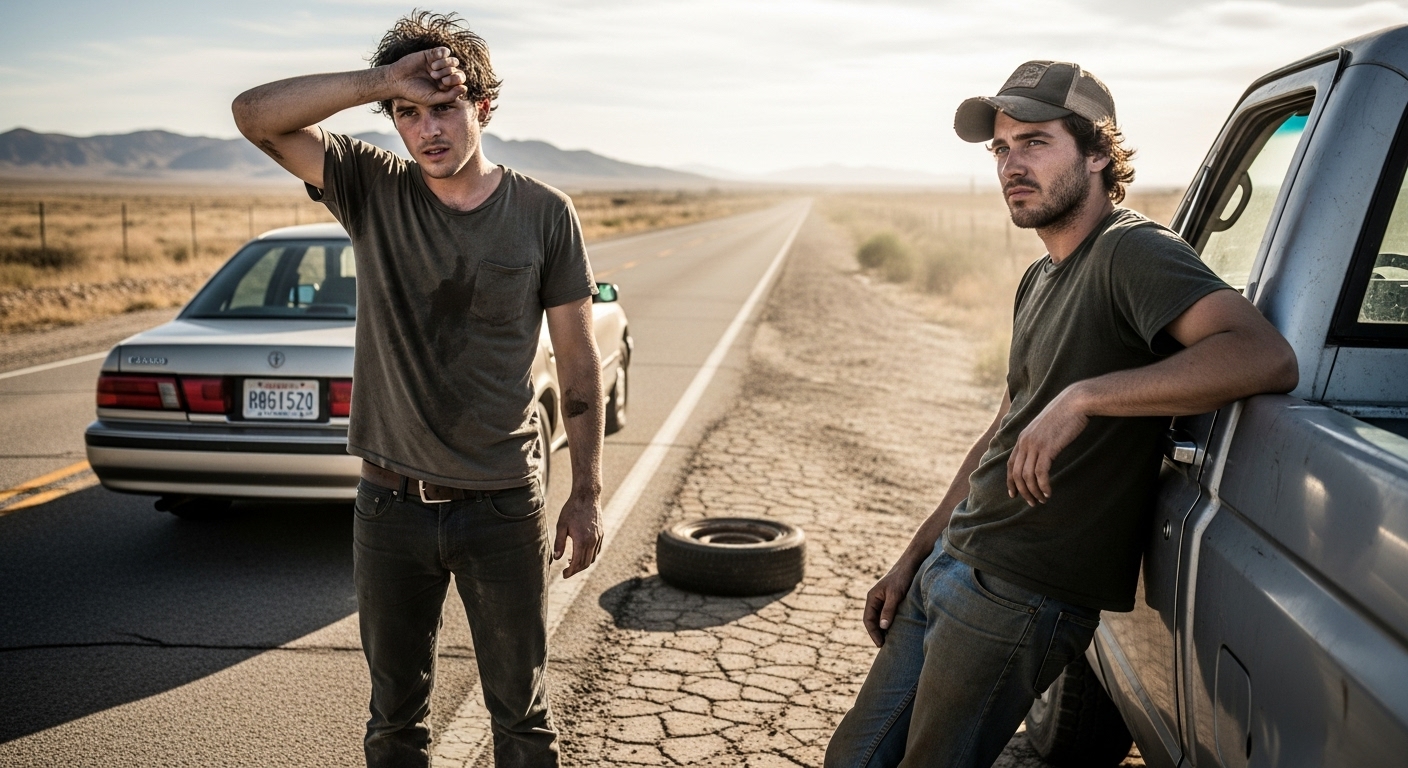
The asphalt, a dark, bruised ribbon, buckled under the relentless summer sun. Heat waves danced above its surface, distorting the already distant horizon into a liquid smear of ochre and dull green. A lone, aging sedan sat on the shoulder, its front driver-side wheel a deflated mockery of mobility, a flat, sad grin against the backdrop of a vast, indifferent sky. The air, thick with the scent of baked earth and exhaust residue, seemed to press down, stifling any impulse for swift action.
This was, Elias mused, precisely the sort of calamity one cultivated through an ill-advised mixture of apathy and misplaced optimism. The ‘scenic route,’ his father had called it, with that paternal glint in his eye that always presaged something tiresome. Elias had simply shrugged, loaded the duffel, and pointed the old sedan west. Now, the west was a baking, empty expanse, and the sedan, a monument to poor maintenance. He leaned against the searing metal of the car, the denim of his jeans already damp against his skin, a grim testament to the season’s indifference. His throat felt like sandpaper, and the water bottle, once a promise of relief, was now just a warm, mocking half-litre of tepid regret. What was the point? Of anything. Of this trip. Of trying to fix this particular, inevitable failure. The sky, a vast, bleached canvas, offered no answers, only more heat, a palpable, buzzing weight that seemed to press directly upon his skull. A bead of sweat, thick and slow, traced a path from his temple, tickled past his ear, and disappeared into the collar of his faded t-shirt. He didn’t bother to wipe it.
His gaze drifted along the road, a perfectly straight line that seemed to extend to the very curvature of the earth. Nothing. No shimmering mirage of a distant vehicle, no wisp of dust promising arrival. Just the oppressive hum of cicadas, a sound like friction and heat personified, and the occasional, unsettling rustle in the dry scrub along the roadside. A coyote, perhaps. Or merely the wind playing its dry, skeletal tune through the desiccated weeds. The sheer, inescapable breadth of it all—the empty land, the empty sky, the empty road—was almost soothing in its finality. There was no escaping this. No quick fix. Only the slow, tedious process of waiting, or the equally tedious process of attempting a repair in this oppressive oven. He chose neither for a long, quiet moment, preferring the inertia, the cynical acceptance of the predicament.
A Torque of Unwillingness
It was a distant disturbance first, a faint, growing rumble that Elias almost dismissed as an auditory hallucination induced by the sun. But the sound solidified, grew into a distinct engine thrum, and a cloud of ruddy dust began to materialise on the horizon, swelling with each passing second. He straightened, a jolt of something akin to reluctant hope, though he suspected it was merely the biological imperative to survive overcoming his preferred state of resigned ennui. The vehicle resolved itself: a battered, mud-splattered pickup truck, its paint faded to a dull, indeterminate blue, chrome grilles rusting like old teeth. It approached with a deliberate, unhurried pace, as if its driver considered urgency a weakness. The truck slowed, then pulled over a good ten metres ahead of Elias’s sedan, kicking up a final, lingering puff of dust.
The driver’s side door creaked open, and a figure unfolded from within. Tall, slender, with sun-bleached hair that escaped an old baseball cap, he moved with a languid grace that belied the ruggedness of his vehicle. He was younger than Elias had expected, perhaps a year or two his senior, judging by the set of his jaw and the cynical tilt to his mouth. The stranger pushed the cap further onto his head, then began to saunter back towards Elias, his hands tucked into the pockets of equally faded jeans. His eyes, when they met Elias’s, were a startling, intense blue, assessing and entirely devoid of warmth.
“A rather unfortunate turn of events,” the stranger remarked, his voice a low, gravelly baritone that seemed to vibrate with a perpetual undercurrent of amusement at the world’s expense. He paused a few feet away, surveying the flat tyre with an air of clinical disinterest, as if observing a particularly vexing specimen. “One observes the universe’s particular brand of humour has elected to visit upon you this afternoon.”
Elias felt a prickle of irritation. “Indeed,” he responded, striving for a similar level of detached observation. “The universe, it seems, possesses an uncommonly keen eye for inconvenient timings. And a penchant for puncturing the mundane.” He shifted his weight, the soles of his shoes hot through the rubber, trying to project an air of nonchalance he did not feel.
Orion, for that was the name he offered without further elaboration, merely dipped his head. “The mundane often proves most susceptible to such punctures. Do you possess a spare, or is this particular tragedy to be a more prolonged affair?” His gaze, sharp and analytical, flickered between Elias and the tyre, then to the unblemished, empty passenger seat of Elias’s vehicle.
“A spare is present,” Elias confirmed, gesturing vaguely towards the boot. “As is the requisite apparatus. Regrettably, the heat conspires against a solo endeavour of such strenuousness.” He watched Orion, waiting for the inevitable shrug and departure, for the reaffirmation of his isolation. But Orion surprised him. A faint, almost imperceptible smirk touched the corner of the stranger’s mouth.
“One surmises as much,” Orion said. He pushed off the ground and moved towards the back of Elias’s car. “Though fortitude, even in the face of meteorological adversity, is generally considered a virtue. Nevertheless, I am not entirely without pity, particularly for those who demonstrate a modicum of self-awareness regarding their limitations.” He pulled off his cap, revealing slightly longer, sun-streaked hair, and then leaned down, squinting at the boot latch. “You will, of course, be expected to assist. My charitable impulses are not, I assure you, boundless.”
---
The process was, as Elias had anticipated, arduous. The jack, stiff with disuse, grated against the chassis. The lug nuts, fused by years of neglect and road grit, resisted with a stubbornness that felt personal. Orion worked with an economy of motion, his movements precise and strong, yet his every action seemed to communicate a palpable disdain for the entire undertaking. He grunted once, a low, guttural sound, as a wrench slipped, scraping against the rusted metal. Elias flinched, not from the sound, but the sheer force of the other man’s suppressed frustration.
“This particular specimen of automotive engineering,” Orion commented, his voice devoid of any genuine curiosity, “appears to have suffered a rather comprehensive neglect. A veritable monument to postponed maintenance.” He wiped a smear of grease from his forearm with the cuff of his t-shirt, leaving a darker smudge.
Elias, wrestling with a particularly recalcitrant nut, managed a tight, humourless smile. “My father’s. His philosophy, I believe, hinges on the notion that entropy will eventually claim all things, regardless of intervention. Why hasten the inevitable?”
Orion paused, holding the heavy wrench, his head tilted slightly as he considered Elias’s words. “A remarkably… fatalistic perspective. And one that, in this instance, has deposited you quite literally in the path of my own, rather more pragmatic, philosophy. Which dictates that one should at least attempt to delay the inevitable for as long as is feasible, if only to spite the universe’s assumptions.” He returned to the task, his movements still precise, but a subtle tension had eased from his shoulders. A thread of shared, bitter humour had formed, tenuous but present.
The spare tyre, dusty and equally neglected, was finally bolted into place. Both young men stood back, wiping sweat from their brows, their shirts clinging uncomfortably. The air shimmered around them, the heat radiating off the asphalt in visible waves. Elias felt a dull ache in his lower back, a phantom pain from bending and straining in the unyielding sun. Orion stretched, his back popping audibly, then reached into the cab of his truck, returning with two bottles of water, condensation dripping onto his calloused fingers.
He offered one to Elias, not with generosity, but with the air of one fulfilling an unwritten obligation. “A small remuneration for your… presence,” he stated, his eyes scanning the horizon, perhaps searching for further cosmic injustices. “And for refraining from rendering the endeavour more arduous than strictly necessary.”
Elias accepted the bottle, the cool plastic a shock against his hand, and twisted the cap with a quiet hiss. He took a long, deep draught, feeling the water, cool and clean, sluice down his parched throat. “My gratitude,” he managed, the words still slightly sticky with dryness. “Though I confess to contributing little more than moral support and the occasional, ill-timed groan.”
Orion snorted, a surprisingly human sound. “The groans were, in their own way, quite… informative. A rather excellent barometer of the futility we faced.” He finished his water, tossing the empty bottle into the back of his truck with practiced ease. “You are a considerable distance from anywhere that might be termed a ‘convenience.’ And that spare… it appears to be a fair-weather friend at best. Its structural integrity seems rather compromised.”
Elias looked at the patched-up, slightly lopsided spare. Orion was right. It wouldn’t last. “I had rather surmised as much,” he conceded, the earlier irritation returning. “The intention was merely to reach the next habitation capable of providing a more permanent solution.”
“Indeed.” Orion’s gaze swept over the sedan, then back to Elias. “The nearest such habitation, if one can dignify it with such a term, is some sixty kilometres hence. A small settlement known as Blackwood. My present trajectory, fortuitously, takes me directly through its uninspiring environs. One could… provide conveyance, if such an arrangement were deemed acceptable.” He offered it with the same clipped, formal tone, making it sound less like a favour and more like a logical, if tedious, proposition.
Elias hesitated. The thought of another hour, perhaps two, in this heat, slowly limping along on a dubious spare, was deeply unappealing. And yet, the idea of being beholden to this cynical stranger, whose every utterance seemed to carry a thinly veiled critique, was almost equally so. But necessity, as his father often quoted, was a stern mistress.
“That would be… exceptionally convenient,” Elias finally said, choosing his words with care. “My appreciation would be considerable.”
Orion nodded, a single, decisive movement. “Then it is settled. Though I must warn you, my conversational offerings are generally limited to observations on the lamentable state of humanity and the inherent flaws in all mechanical contrivances. One should not expect effusive pleasantries.” He turned and strode back to his truck, leaving Elias to retrieve his duffel bag and lock the derelict sedan.
---
The interior of Orion’s truck was a testament to utilitarianism and a profound disregard for aesthetic appeal. The dashboard was cracked, the passenger seat cushion sagged, and the air conditioner, if it had ever existed, was certainly not operational. The air, despite the open windows, was still hot, but at least it moved, carrying with it the scent of dust, diesel, and something indefinably metallic. Orion engaged the clutch with a practiced jolt, and the truck rumbled back onto the highway, accelerating with a surprisingly robust growl.
They drove in silence for a time, the vast, sun-scorched landscape unfolding around them. Elias watched the scenery pass—scrub brush, a few gnarled mesquite trees, the occasional, forlorn fence post leaning against the relentless wind. He found himself studying Orion from the corner of his eye. The other man held the steering wheel with a relaxed grip, his gaze fixed on the endless road, an inscrutable expression on his face. He chewed on the inside of his cheek, a small, unconscious gesture that betrayed a deeper thought process beneath the cynical exterior.
“This landscape,” Elias began, choosing his words deliberately, “it possesses a certain… austere charm. Or perhaps, merely an oppressive emptiness. One struggles to differentiate.”
Orion’s eyes remained on the road. “Charm is subjective. Emptiness, however, is an empirical observation. This land, it cares not for the ephemeral travails of its inhabitants. It simply endures. And, by extension, ensures that those who choose to reside within its embrace must also endure.” He spoke as if delivering a lecture, his voice steady, his focus unwavering. “A rather fundamental lesson, one would contend. Taught with unwavering consistency.”
“And a rather brutal curriculum, at that,” Elias murmured, looking out at a field of dried, brittle stalks, the ghosts of some forgotten crop. The sun cast long, hard shadows now, beginning its slow, inevitable descent towards the western edge of the world. He felt a strange sort of kinship with Orion in that moment, a shared understanding of a particular, bleak truth. This place, this life, offered no easy comforts, no gentle paths. Only endurance, and perhaps, the faint, bitter satisfaction of still standing.
“Indeed,” Orion responded, a hint of something unreadable in his tone. He glanced at Elias, a fleeting, almost shy look that vanished before Elias could truly grasp it. “A brutality, however, that clarifies the mind. Strips away the superfluous. One learns quickly what truly constitutes a necessity. And what does not.” He slowed the truck slightly, gesturing with a tilt of his head towards a barely visible turn-off in the distance. “Blackwood approaches. And with it, the potential for further, equally exasperating, complications.”
The sun, now a bleeding orange disc on the horizon, painted the desolate landscape in shades of fire and long, purple shadows. A solitary hawk circled high above, a patient, predatory silhouette against the darkening sky. Elias felt a chill, despite the lingering heat, a sense of something profound and unsettling settling over him. He knew, with a certainty that unnerved him, that this chance encounter, this accidental alliance under the harsh summer sky, was far from concluded. The road, after all, always demanded a toll, and sometimes, that toll was exacted in ways one could never quite foresee, twisting paths that seemed to lead somewhere far more tangled than a mere roadside repair.
The road, after all, always demanded a toll, and sometimes, that toll was exacted in ways one could never quite foresee, twisting paths that seemed to lead somewhere far more tangled than a mere roadside repair.
Share This Story


